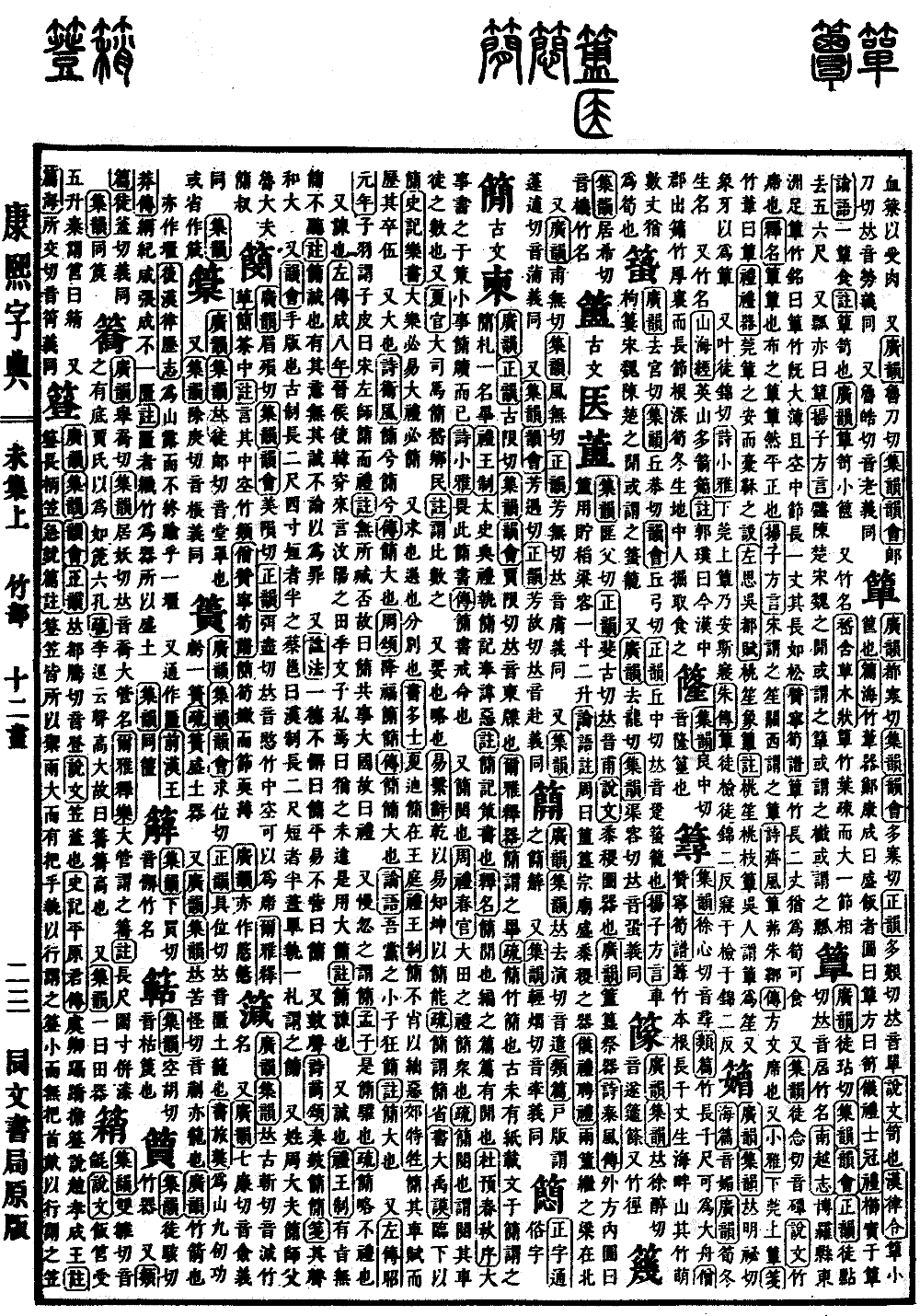
Wei Collection, Upper Volume
Radical: Bamboo (zhú)
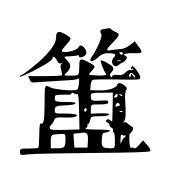
Fu
Kangxi stroke count: 18
Page 899, Entry 09
Ancient form. According to the Collection of Rhymes (Jiyun), pronounced fu; according to the Corrected Rhymes (Zhengyun), pronounced fu.
According to the Explaining Graphs and Analyzing Characters (Shuowen), a vessel for millet and grain that is round on the inside.
According to the Broad Rhymes (Guangyun), the fu and the gui are sacrificial vessels.
In the Book of Odes (Shijing), Qin section: The Explanatory Text (Shiwen) states that a vessel square on the outside and round on the inside is called a fu, used for storing rice and grain, with a capacity of one dou and two sheng.
In the Commentary on the Analects (Lunyu zhu): The Zhou dynasty referred to these as fu and gui, which are vessels used in ancestral temples to hold millet and grain.
In the Ceremonial Rites (Yili), Guest Rituals: Two fu follow, with the millet placed to the north.
Also, according to the Broad Rhymes (Guangyun), pronounced fu. According to the Collection of Rhymes (Jiyun), pronounced fu. According to the Corrected Rhymes (Zhengyun), pronounced fu. The meaning is the same.
Also, according to the Collection of Rhymes (Jiyun), pronounced pu. The meaning is the same.
Also, according to the Collection of Rhymes (Jiyun) and the Compendium of Rhymes (Yunhui), pronounced fu; according to the Corrected Rhymes (Zhengyun), pronounced fu. The meaning is the same.
Textual verification: In the Commentary on the Book of Odes (Shijing), Qin section, it is stated that a vessel square on the outside and round on the inside is called a fu. Note: The citation provided refers to the Explanatory Text (Shiwen), and therefore the reference to the commentary has been corrected to the Explanatory Text.