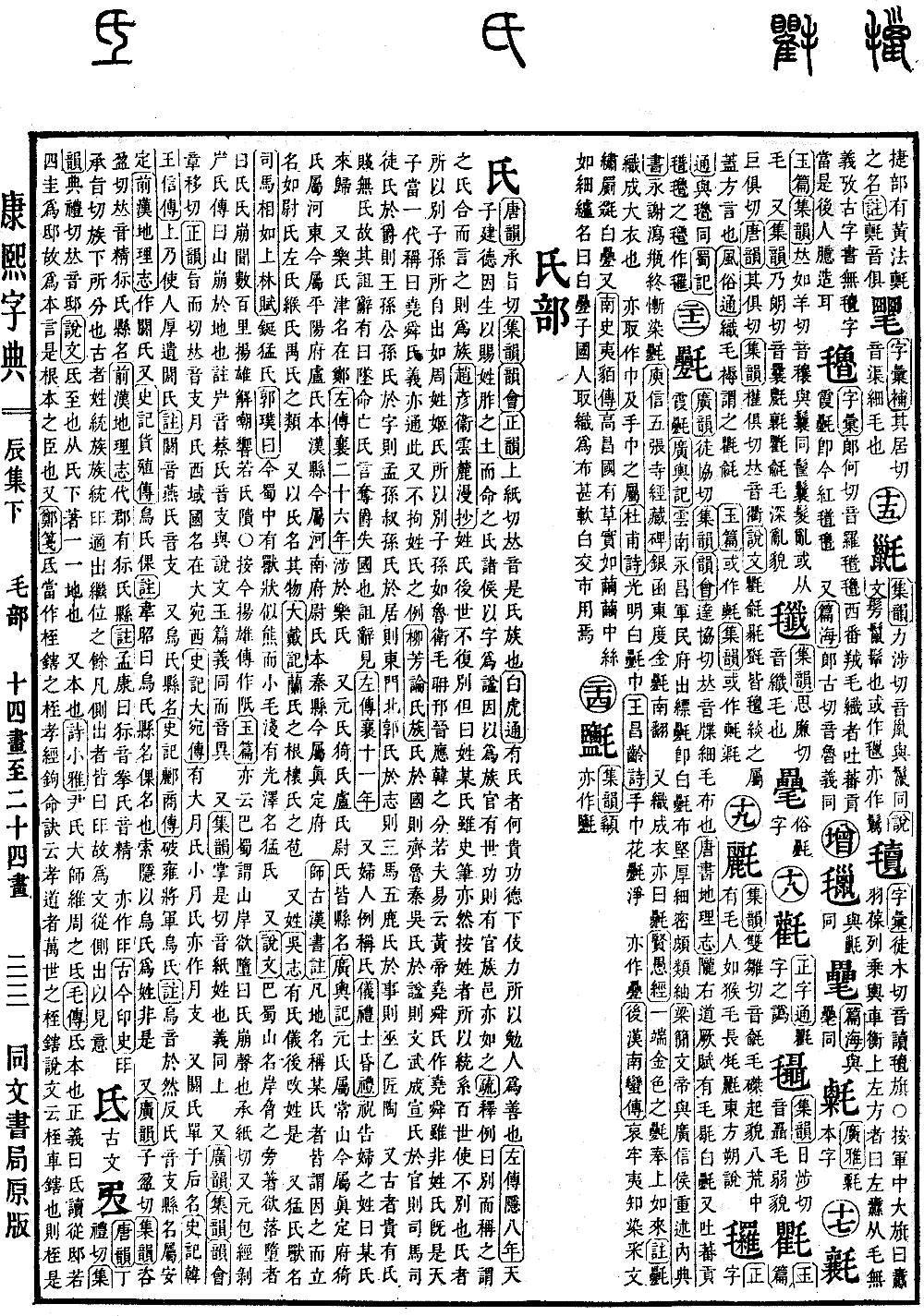
Chen Collection, Lower Volume, Radical: Clan (shì); Kangxi Strokes: 5; Page 597, Entry 19
Ancient literature records: Pronounced di. According to the Tang Rhyme (Tangyun) and the Collection of Rhymes (Jiyun), the pronunciation is the same as the character di (residence/mansion).
The Shuowen Jiezi (Explaining Graphs and Analyzing Characters) explains: Di means to reach. The character structure is composed of the clan component with a horizontal line added below, where the line represents the earth. It also carries the meaning of root or foundation.
Book of Odes (Shijing), Minor Odes: "Master Yin, you are the foundation of Zhou." The Mao Commentary explains: Di means foundation. The Correct Meaning (Zhengyi) states: Di is pronounced the same as di (residence/mansion). Just as four-kuei (ancient vessels) are called a mansion, so it carries the meaning of foundation, referring to the ministers who serve as the foundation of the state.
Zheng Xuan's annotations suggest: The di here should be written as the zhi (shackles) of shackles-and-fetters or the xia (linchpin) of a vehicle's linchpin. The Xiaojing Gouming Jue (Apocryphal Treatise on the Classic of Filial Piety) states: Filial piety is the shackles for all generations. The Shuowen Jiezi says that zhi is a vehicle's linchpin. If zhi is an alternative name for xia, then using xia to control a vehicle serves as a metaphor for ministers managing a state. Zhi is pronounced either zhi or di. Xia is also written as xia and is pronounced hu. Note: Modern editions of the Book of Odes follow the Mao Commentary, pronouncing it as di.
Also equivalent to di (to press/resist). It carries the meaning of to return.
Book of Han (Hanshu), Treatise on Food and Money: "Throughout the world, generally, they were all casting gold coins." Also recorded: "Generally, they all encountered announcements." Yan Shigu's commentary states: Di is pronounced di and means to return. "Generally" is equivalent to saying "in most cases" or "approximately."
Zuo Si's Rhapsody on the Three Capitals (Sandu Fu): "The authors generally established them as constitutional standards." Note: Di is pronounced zhi. The meaning is the same. Modern common script writes it as di.
Also refers to the Di people, a foreign state name located west of the Jianmu tree; they have human faces and fish bodies, with no feet. Seen in the Classic of Mountains and Seas (Shanhaijing). The pronunciation is the same as the di in the word for resistance (dichu). Old commentaries incorrectly categorized this under the pronunciation du-xi, which is now corrected.
Also refers to the root of a tree. Also written as di. Detailed meanings are found in the Tree Radical.
Also refers to a place where one resides or stays. Used interchangeably with di (residence).
According to the Collection of Rhymes (Jiyun), it is pronounced zhi. Di Dao is a place name in Guanghan.
According to the Guangyun, it is pronounced zhi; according to the Collection of Rhymes (Jiyun), it is pronounced zhi. Di-chi is a county name. Some mistakenly attribute it to the pronunciation zhi, which is incorrect.
According to the Guangyun, it is pronounced di; according to the Collection of Rhymes (Jiyun), the Rhyme Assembly (Yunhui), and the Correct Rhymes (Zhengyun), it is pronounced di. It refers to the Di-Qiang people.
Book of Odes (Shijing), Eulogies of Shang: "From those Di and Qiang tribes, none dared not come to pay homage, none dared not come to offer tribute." The Correct Meaning (Zhengyun) states: The Di-Qiang tribe still existed during the Han Dynasty. They lived west of Qin and Long.
The Lush (Lushi) records: There are dozens of types of Di-Qiang, with the White Horse Di being the largest.
Book of Han (Hanshu), Treatise on Geography: Records that the Longxi Commandery established the two counties of Di Dao and Qiang Dao.
Yu Huan's Records of Wei (Weilue) states: The Han Dynasty established the Wudu Commandery, displacing the Di people there and causing them to scatter into the valleys; some were called the Green Di, others the White Di.
Also a name for a lunar mansion. The Erya (Approaching Elegance), Interpretation of Heaven: The Heavenly Root is the Di mansion. Sun Yan explains: The Horn mansion and the Neck mansion are connected below to the Di mansion, like a tree having roots.
Records of the Grand Historian (Shiji), Treatise on Celestial Offices: The Di mansion consists of four stars and is an eastern mansion. Di means that all things have reached their root/foundation.
The Gan Clan Star Classic (Gan Shi Xingjing) says: The four stars of the Di mansion are the celestial palace, with the first name being Heavenly Root and the second Heavenly Talisman.
Book of Rites (Liji), Monthly Ordinances: In the early winter month (twelfth month), at dawn, the Di mansion reaches the center of the sky.
Book of Han (Hanshu), Treatise on Geography: Records that the region of Korea corresponds to the field of the Horn, Neck, and Di mansions.
Also equivalent to di (low). Means to bow or lower one's head. Book of Han (Hanshu), Treatise on Food and Money: "The titled lords all bowed their heads and looked up for supplies." Yan Shigu's commentary: Bowing the head means to look down. It also carries the meaning of low or base. Book of Han (Hanshu), Treatise on Food and Money: "The price was low and reduced from the standard."
Also the name of a god of ink called Hui-di. Seen in the Zhixu Ge Zazu (Miscellaneous Notes from the Hall of Reaching Emptiness).
According to the Collection of Rhymes (Jiyun), the Rhyme Assembly (Yunhui), and the Correct Rhymes (Zhengyun), it is pronounced di. It refers to the eastern star mansion. The meaning is the same as above.
Textual research: The Xiaojing Gouming Jue (Apocryphal Treatise on the Classic of Filial Piety). I have corrected the character jue in accordance with the original text.