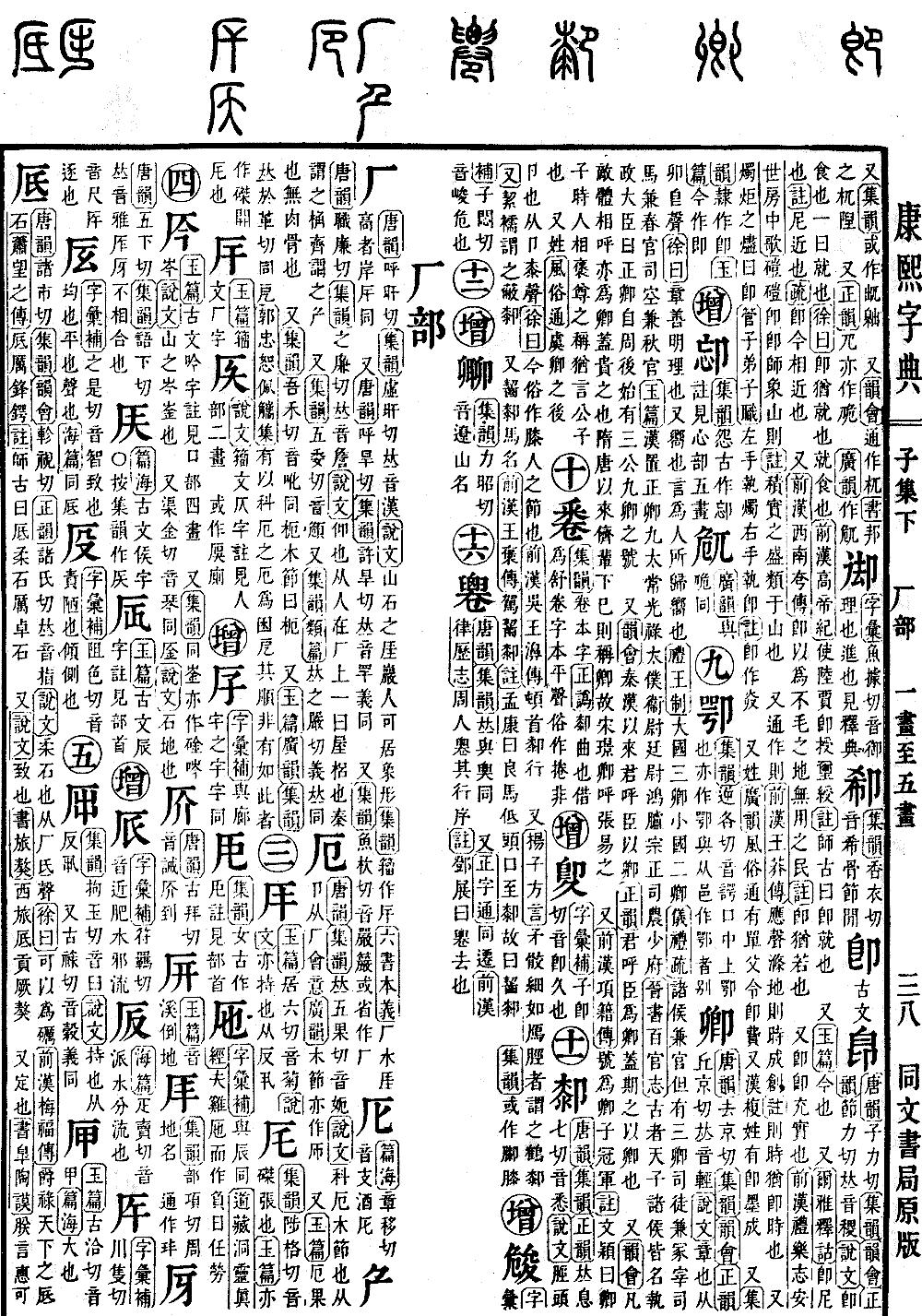
Zi Collection, Page Position: Lower. Radical: Cliff (hàn). Strokes: 7. Page: Page 160, Entry 40.
According to the Tang Dynasty Rhymes (Tangyun), the pronunciation follows the fǎnqiè system of zhū and shì. According to the Collected Rhymes (Jiyun) and the Rhyme Assembly (Yunhui), it follows zhěn and shì. According to the Correct Rhymes (Zhengyun), it follows zhū and shì. It is pronounced the same as zhǐ.
Explaining Graphs and Analyzing Characters (Shuowen Jiezi) defines this as a soft stone. The character structure uses the Cliff (hàn) radical as the semantic component and dǐ as the phonetic component.
Xu Xuan states that it can be used as a whetstone.
The Book of Han (Hanshu), Biography of Mei Fu, states that titles of nobility and official salaries are the whetstones used by the people of the world to refine themselves.
The Book of Han, Biography of Xiao Wangzhi, mentions using a whetstone to sharpen the blades of swords.
A commentary by Yan Shigu states: dǐ refers to a soft-textured whetstone, while lì refers to a coarse-textured whetstone.
Also, Shuowen Jiezi defines it as to achieve or to reach.
The Book of Documents (Shangshu), The Hounds of Lü, records that the Lü state of the Western Rong tribes reached the court to present their hounds as tribute.
It is also defined as to settle or to stabilize.
The Book of Documents, The Counsels of Gao Yao, states that my words are compliant and can be effectively implemented.
Also in Shuowen Jiezi, some versions use the Stone (shí) radical and write it as dǐ.
The Book of Odes (Shijing), Minor Odes of the Kingdom, describes a great road being as level as a whetstone.
According to the Yunhui, it is used interchangeably with the character for base, pronounced dǐ. Mencius (Mengzi) quotes the Book of Odes writing it with this character for base.
Some versions also write it as the character pronounced qí.
The Book of Odes, Sacrificial Odes of Zhou, mentions enabling your achievements to be fulfilled. A note explains that fulfilled means reached. The pronunciation is zhǐ, the same as dǐ.
According to the Jiyun, it is also pronounced with the fǎnqiè of dū and lí, sounding like dī, meaning to arrive or to reach.
It is also pronounced with the fǎnqiè of zhì and lì, sounding like zhì, meaning to cause to reach or to bring to.
The Book of Documents, Tributes of Yu, mentions that the Zhenze Lake was successfully stabilized.
It is also pronounced with the fǎnqiè of dīng and jì, sounding like dì, with the same meaning.
According to the Zhengyun, it is pronounced with the fǎnqiè of zhǐ and ér, sounding like zhī.
In the Book of Han, Biography of Mei Fu, the commentary by Yan Shigu states that dǐ is a fine whetstone, with the fǎnqiè pronunciation of zhī and lǚ, and also pronounced as zhī.
Textual Research: Regarding the entry in the Book of Han, Biography of Mei Fu, stating that nobility and salaries are the whetstones of the world. The note says Yan Shigu mentions both level and departing tones. Upon careful examination, the cited content repeats what was stated above, and Yan Shigu’s original note does not actually mention level and departing tones. Following the original text, it is now corrected to: Book of Han, Biography of Mei Fu, commentary: Yan Shigu states that dǐ is a fine whetstone, with the fǎnqiè pronunciation of zhī and lǚ, and also pronounced as zhī.