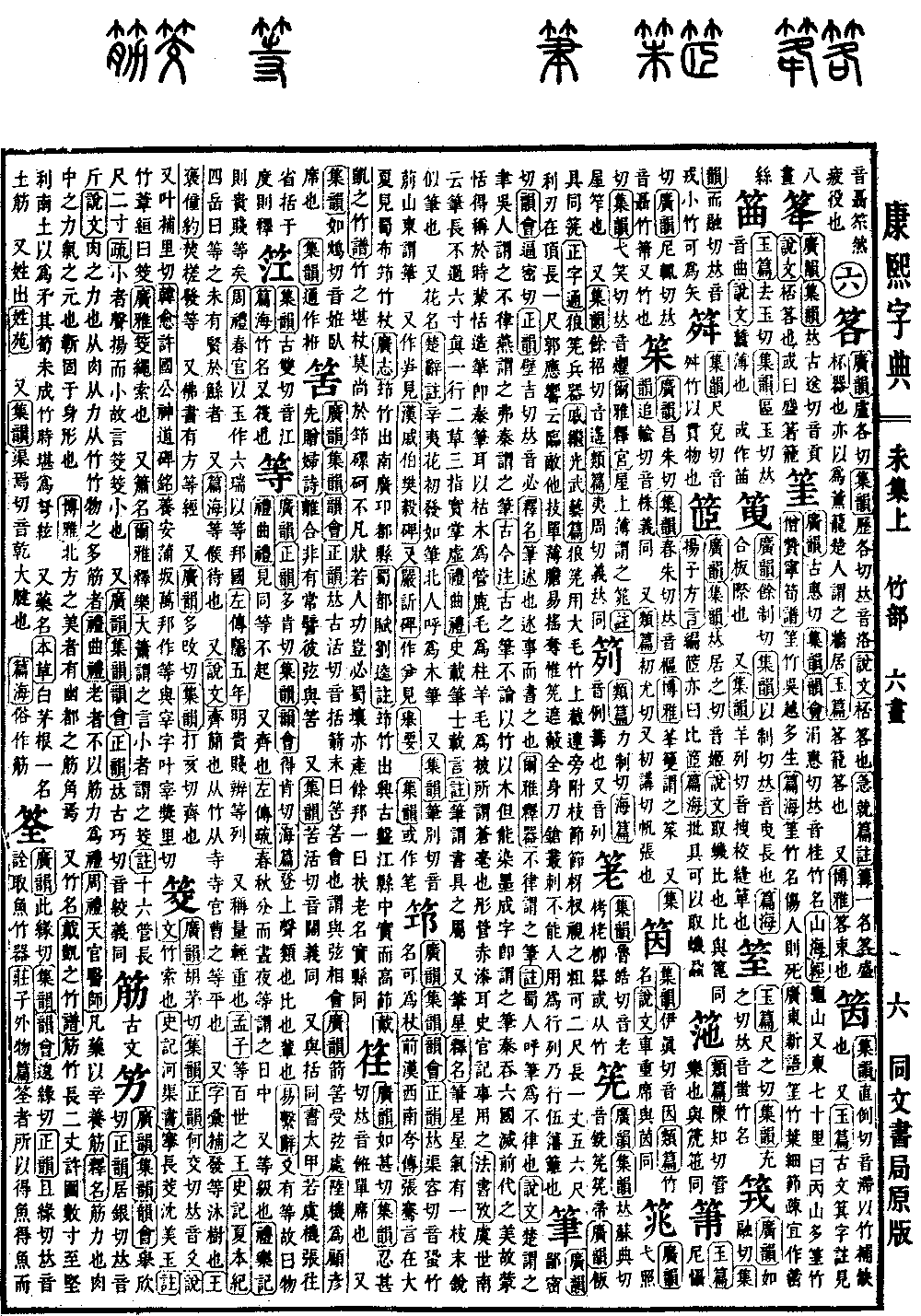
Wei Collection, Upper Volume
Radical: Bamboo (zhú)
Kangxi Strokes: 12
Page 882, Entry 24
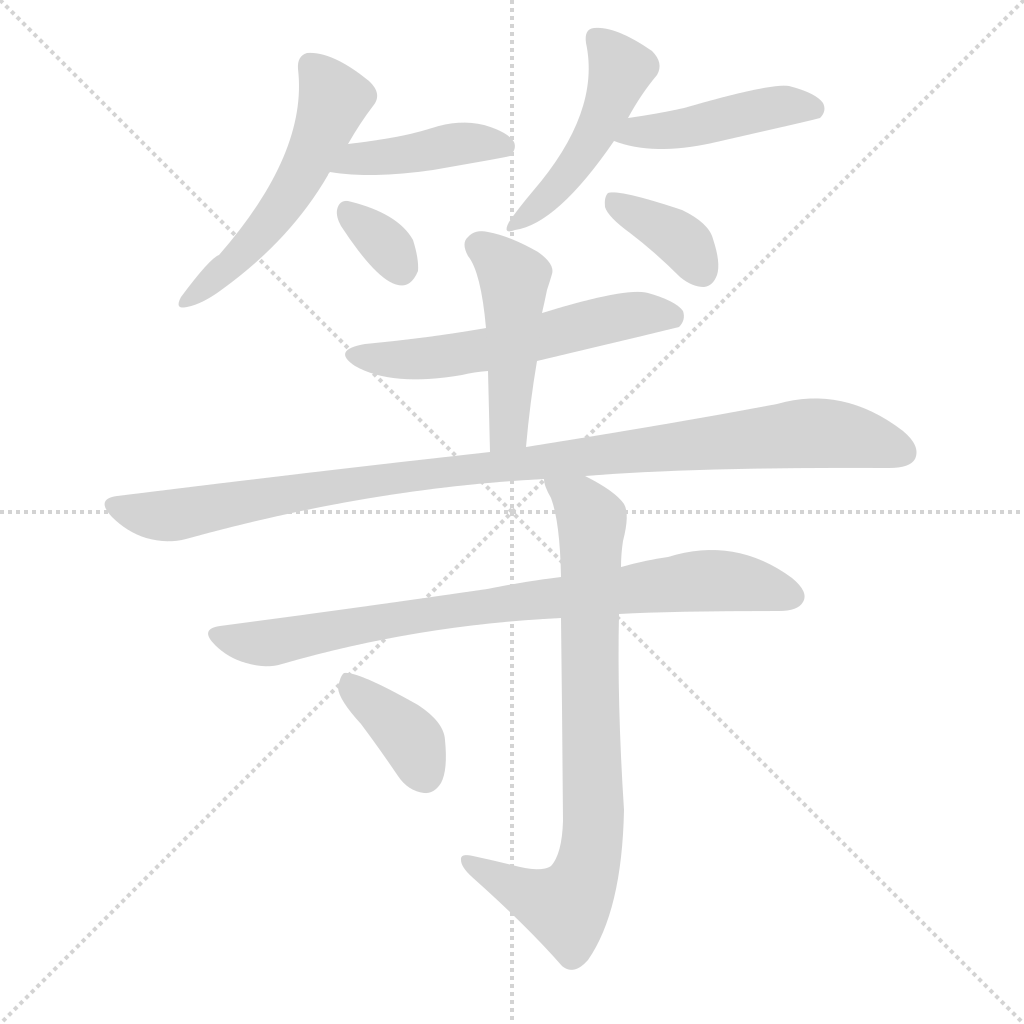
Pronounced deng. Categories, comparison, peers.
Book of Changes (Yijing): Lines have ranks, thus we speak of things.
Book of Rites (Liji): When seeing someone of equal status, one does not need to rise.
Also refers to being level or even.
Commentary on the Zuo Tradition (Zuozhuan Shu): During the spring and autumn equinoxes, day and night are equal in length, which is called the middle of the day.
Also refers to grades or ranks.
Book of Rites (Liji): Thus, there are grades between the noble and the humble.
Rites of Zhou (Zhouli): Use jade to create six types of auspicious objects to distinguish the ranks of states.
Zuo Tradition (Zuozhuan): Clarify the noble and humble, and distinguish the order of ranks.
Also means to weigh or measure.
Mencius (Mengzi): Measuring the kings of a hundred generations.
Records of the Grand Historian (Shiji): The Four Mountains said: When measuring, there is no one more virtuous than Gun.
Also, according to the Collection of Characters (Pianhai), it means to wait.
Also, according to the Explaining Graphs and Analyzing Characters (Shuowen), it means to level or make even. The character is composed of bamboo and official office. The office is where the government administration ensures fairness.
Also, according to the Supplement to the Collection of Characters (Zihui Bu), it refers to shaving off tree bark to cause a tree to wither.
Wang Bao, Contract for a Servant (Tongyue): Burn branches and strip bark.
Also, in Buddhist texts, there is the Vaipulya Sutra (Fangdeng jing).
Pronounced dai. Level or even.
Also rhymes with bu li.
Han Yu, Epitaph for the Duke of Xu (Xu Guogong Shendao Ming): Maintaining peace in Pu Ban, ten thousand states are made equal. It rhymes with the character zai. Zai is pronounced jiang li.