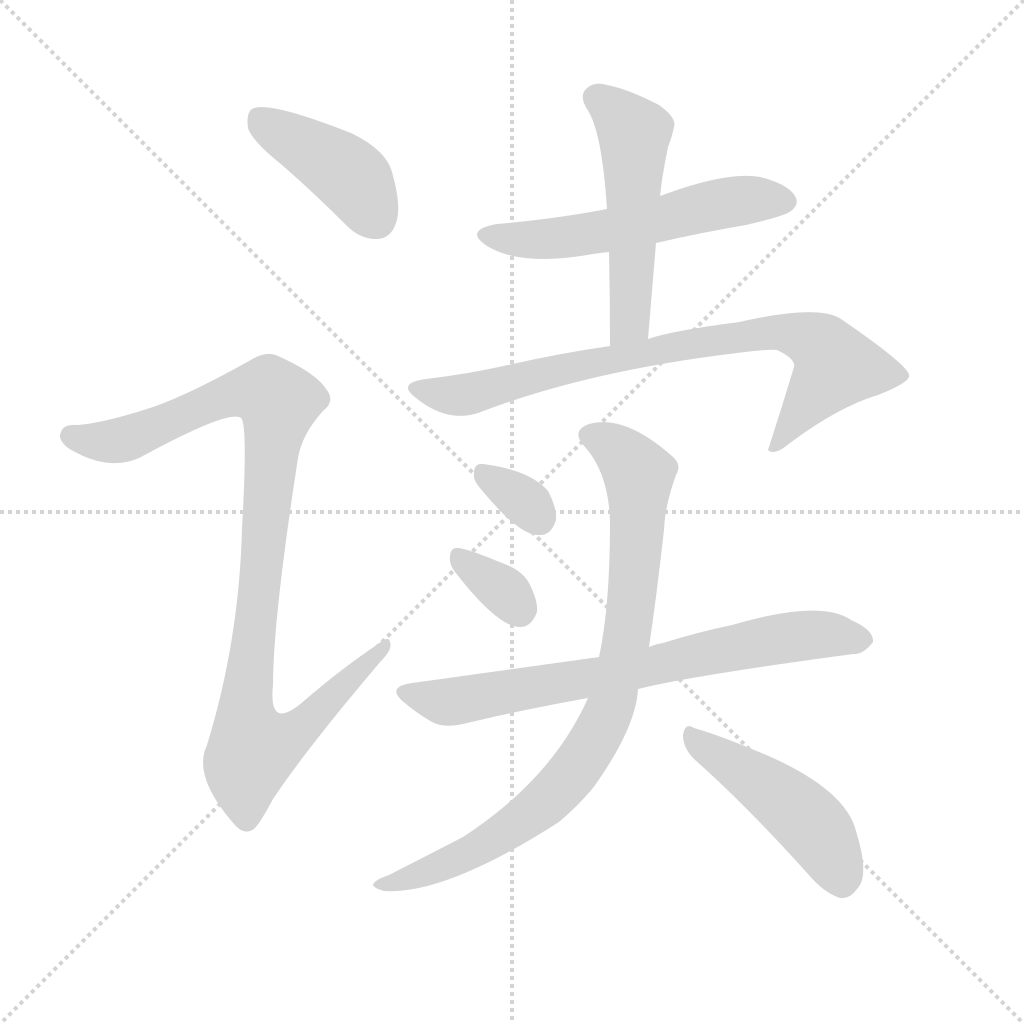
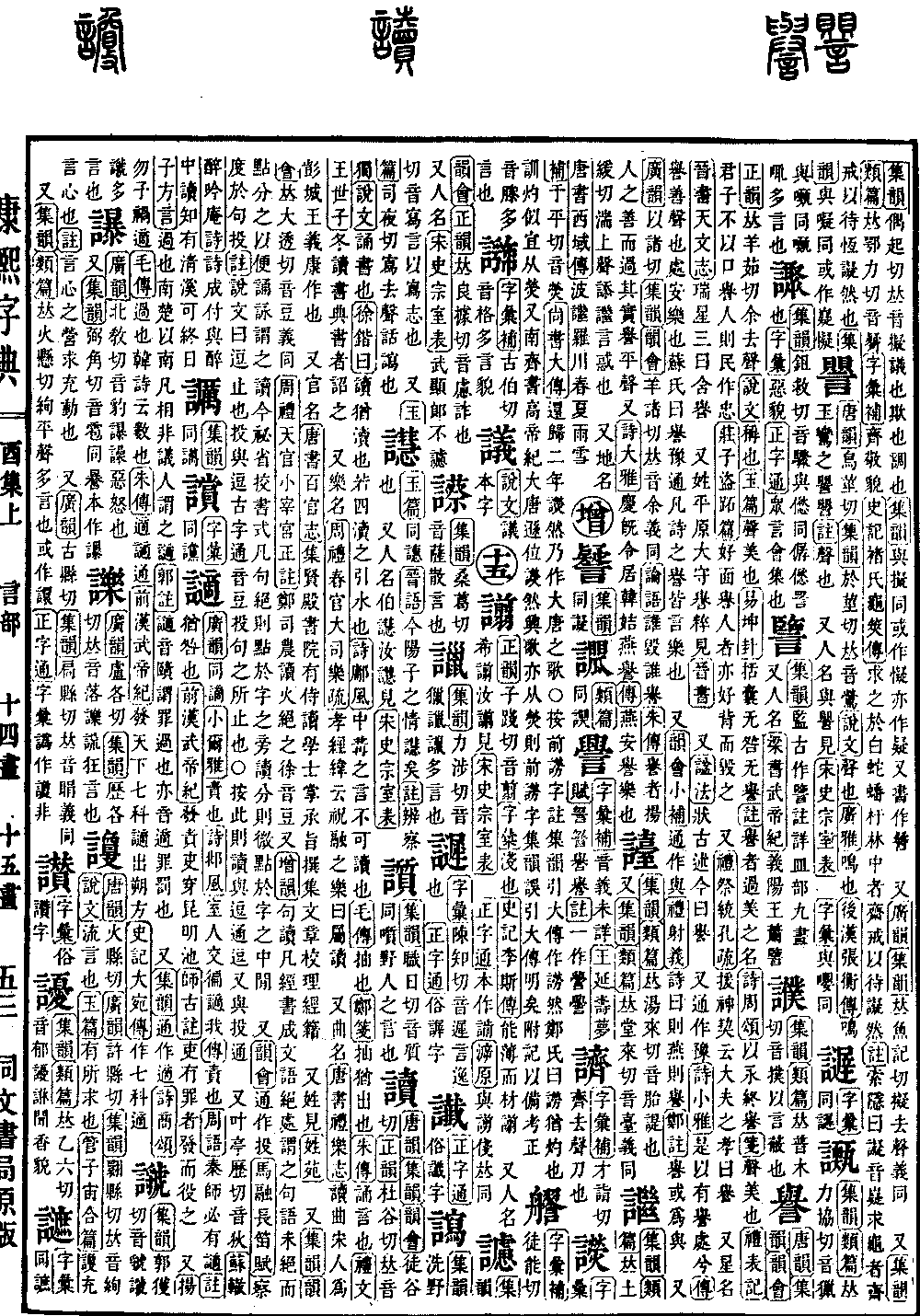
You Collection, Upper Volume
Radical: Speech (yán)
Kangxi Strokes: 22
Page 1185, Entry 01
Pronounced dú.
According to the Explaining Graphs and Analyzing Characters (Shuowen Jiezi), it means to recite books.
Xu Kai says: To read is like to flow. It is like the four major rivers channeling water.
Book of Odes (Shijing), Odes of Yong: The words of the inner court must not be read.
Mao Commentary: To draw out.
Zheng Commentary: To draw out means to bring forth.
Zhu Commentary: To recite words.
Book of Rites (Liji), Hereditary Succession of King Wen: In winter, they read books; those in charge of the books oversee them.
Also the name of a music piece.
Rites of Zhou (Zhouli), Commentary on the Great Musician: The Xiaojing Wei (Apocryphal Treatise on the Classic of Filial Piety) says: The music of Zhu Rong is called Shudu.
Also the name of a musical composition.
Book of Tang (Tangshu), Treatise on Rites and Music: Duqu was composed by a person of the Song dynasty for Prince Yikang of Pengcheng.
Also an official title.
Book of Tang (Tangshu), Treatise on Official Posts: In the Jixian Academy, there are Assistant Readers and Scholars who manage the reception of imperial decrees, the compilation of essays, and the collation of classical texts.
Also a surname; see Surname Garden (Xingyuan).
Also pronounced dòu. The meaning is the same.
Rites of Zhou (Zhouli), Commentary on the Palace Master: Zheng Sinong reads huǒ jué zhī. The Explanation of Sounds (Shiwen) notes: Xu pronounces it dòu.
Also, regarding sentence structure and pauses. In classical texts, places where the speech ends are called jù. Places where the speech is not yet finished but are punctuated for the convenience of chanting and recitation are called dú. According to the current regulations of the Imperial Library for collating books: where a sentence ends, place a mark beside the character; where a pause occurs, place a small mark in the center of the character.
Also, commonly written as tóu.
Ma Rong, Rhapsody on the Long Flute: Examining the measurements of the sentence pauses (tóu).
Commentary: The Explaining Graphs and Analyzing Characters (Shuowen Jiezi) says: Dòu means to stop. Tóu and dòu are interchangeable in ancient times, with the sound dòu. Tóu refers to where a sentence pauses. Therefore, dú is interchangeable with dòu. Dòu is also interchangeable with tóu.
Also, with the rhyming pronunciation dí.
Su Zhe, Poem of the Drunken Hermitage: When the poem is finished, I give it to be read while drunk, knowing there is a clear stream where I can spend the day.
Textual Research:
In the Rites of Zhou (Zhouli), Commentary on the Palace Master, the original text mentions the Lesser Minister, which is incorrect; it should refer to the Palace Master. The words Lesser Minister have been removed according to the original text. The two characters Explanation of Sounds (Shiwen) have been added after the sound dòu.