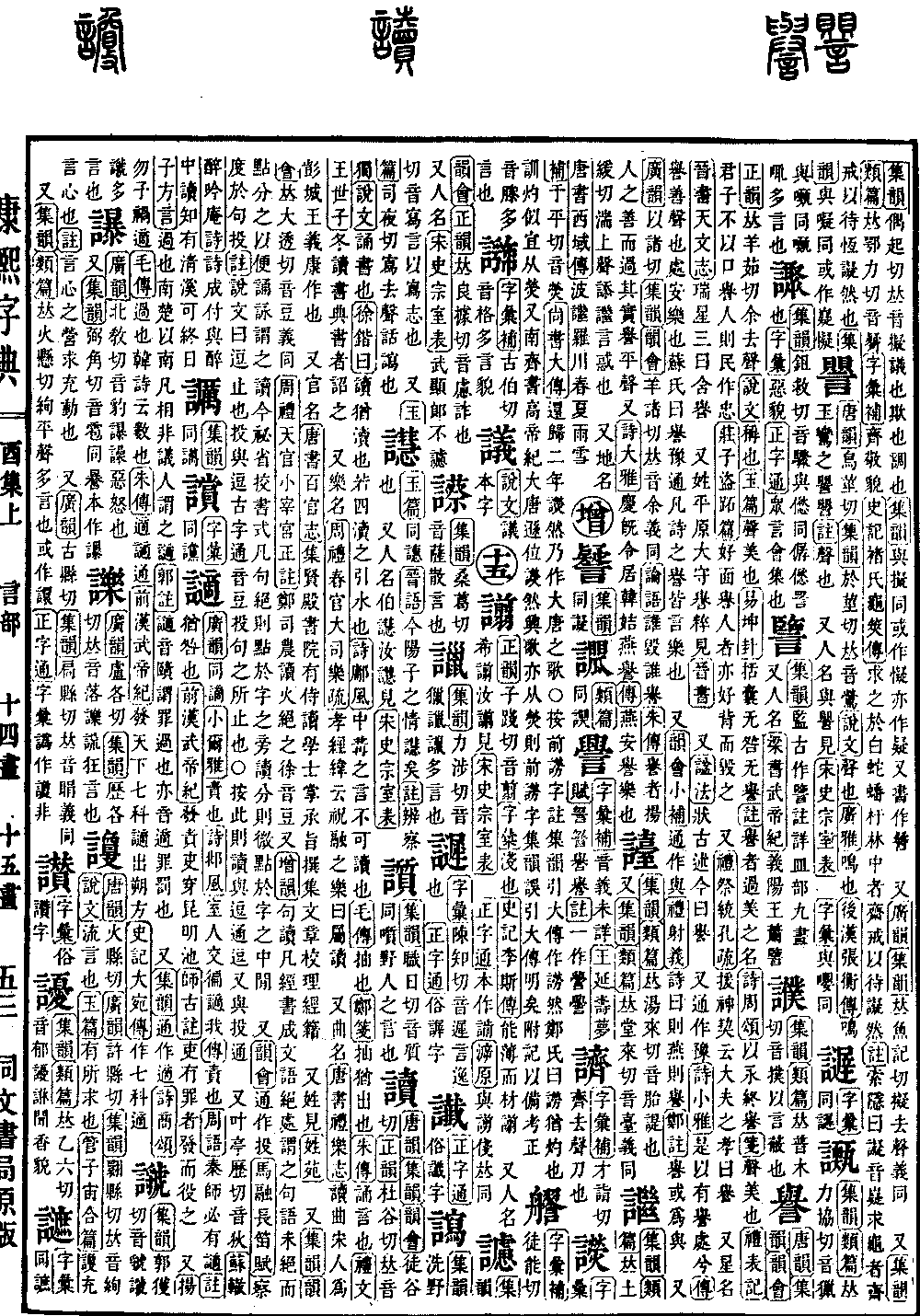
You Collection, Upper Volume
Radical: Speech (yán)
Kangxi Strokes: 22
Page 1185, Entry 27
Pronounced du (rising tone).
Shuowen Jiezi (Explaining Graphs and Analyzing Characters): To recite a book.
Xu Kai stated: To read (du) is like to flow (du). It is like the four great rivers (si du) channeling water.
Book of Odes (Shijing), Odes of Yong: Words spoken in the middle of the night, cannot be read (du).
Mao Commentary: To draw out.
Zheng Commentary: To draw out means to extract.
Zhu Commentary: To recite aloud.
Book of Rites (Liji), Hereditary Successor of King Wen: In winter they study books, and the keeper of the books instructs them.
Also the name of a music piece.
Rites of Zhou (Zhouli), Spring Offices, Grand Master of Music Commentary: The Xiaojing Wei (Apocryphal Texts of the Classic of Filial Piety) says: The music of Zhu Rong is called Shudu.
Also the name of a melody.
Old Book of Tang (Tangshu), Treatise on Ritual and Music: Duqu (Reading Melody) was composed by a person of the Song dynasty for Prince Yikang of Pengcheng.
Also the name of a government office.
Old Book of Tang (Tangshu), Treatise on Officialdom: The Jixian Academy had scholars in attendance to read (shidushi), who were in charge of drafting documents and collating classics.
Also a surname, found in the Xingyuan (Garden of Surnames).
Pronounced dou (falling tone). Same meaning.
Rites of Zhou (Zhouli), Heaven Office, Palace Director Commentary: Zheng Sinong read it as huojue (fire break). The Shixiewen (Explication of Texts) says: Xu pronounced it dou.
Zengyun (Additional Rhymes): Sentences and pauses (judou). In classic texts, where the meaning is complete and the sentence ends, it is called a sentence (ju). Where the meaning is not yet complete but one marks a pause for the convenience of chanting, it is called a read (du). The current imperial library editing code states: Whenever a sentence ends, place a dot beside the character; for a pause, place a light dot in the middle of the character.
Also used interchangeably with tou.
Ma Rong, Ode to the Long Flute: Examining the pauses in the sentences (juntou).
Commentary: Shuowen says: Dou means to stop. Tou and dou were used interchangeably in ancient times, pronounced dou. Tou refers to where a sentence stops. According to this, du is interchangeable with dou, and dou is interchangeable with tou.
Also rhymed as di (checked tone).
Su Zhe, Poem of the Drunken Hermitage: With the poem finished, I entrust it to be read (du) while drunk, knowing there is a clear stream to spend the day by.
Textual research: In the Rites of Zhou (Zhouli), Heaven Office, Palace Director Commentary, Zheng Sinong read it as huojue. Xu pronounced it dou. I note that this is the commentary of the Palace Director, not the Small Official. I have revised the text to omit the two characters for Small Official. I have added the words Shixiewen before Xu pronounced it dou.