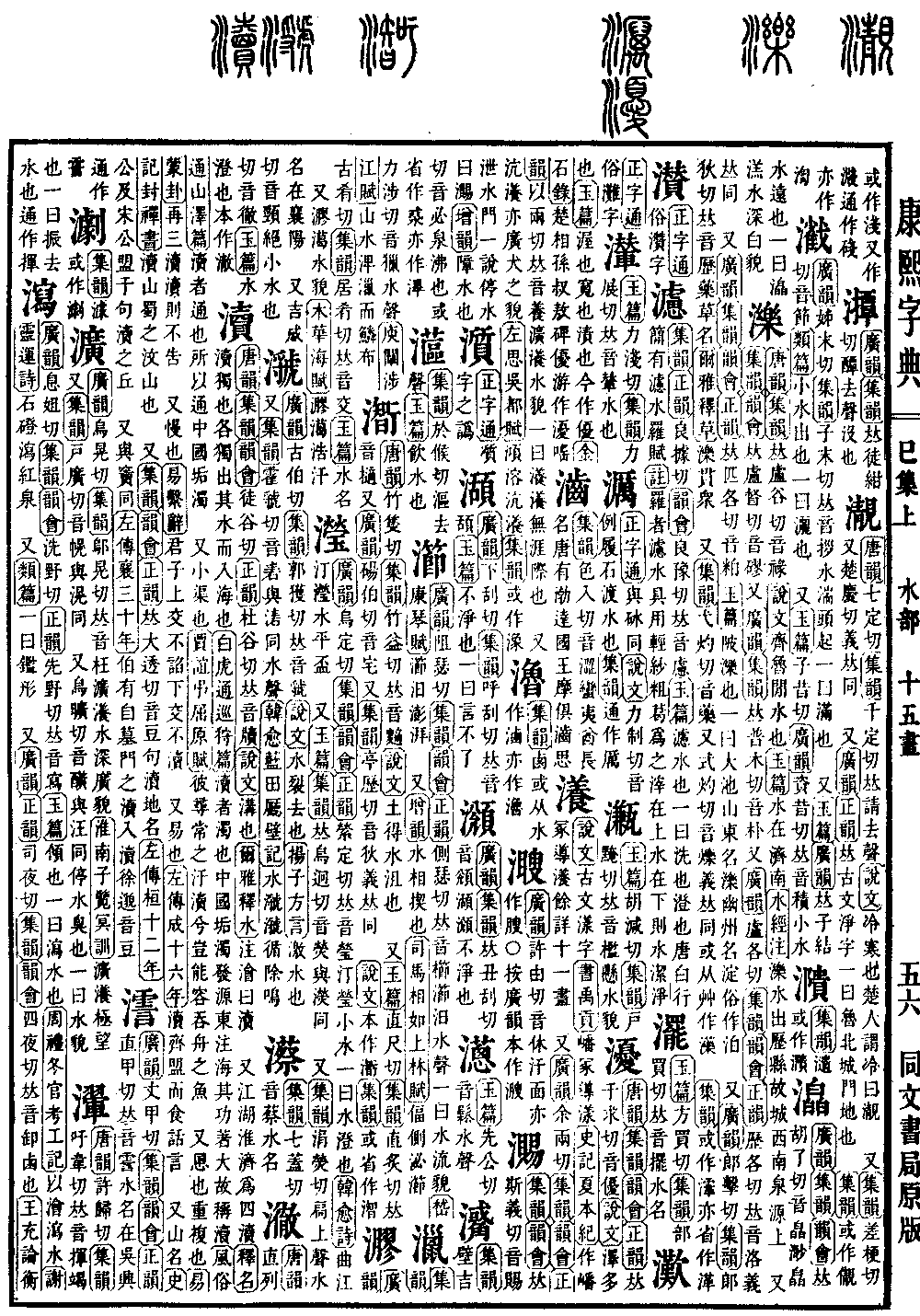
Si Collection, Upper Volume
Radical: Water (shuǐ)
Stroke count: 19
Page 658, Entry 01
Pronounced dú.
According to the Explaining Graphs and Analyzing Characters (Shuowen Jiezi), it refers to a trench or canal.
According to the Er Ya (Erya), a waterway flowing into fields is called a du.
The Yangtze, Yellow, Huai, and Ji rivers are collectively known as the Four Du.
According to the Explanation of Names (Shiming), du carries the meaning of individual; these rivers each flow independently until they converge into the sea.
According to the Comprehensive Discussions in the White Tiger Hall (Baihu Tong), in the chapter on imperial tours, du implies turbidity. The Central Plains region contains much silt and turbidity; these rivers originate in the east and flow into the sea, and because their contributions are vast and significant, they are called du.
According to the Comprehensive Customs (Fengsu Tong), in the chapter on mountains and marshes, du carries the meaning of to clear; these rivers serve to clear away the turbidity of the Central Plains.
It also refers to a small drainage ditch.
In the Lament for Qu Yuan (Diao Quyuan Fu) by Jia Yi: How can a common, petty drainage ditch contain a fish large enough to swallow a boat?
It also refers to being intrusive or repetitive.
In the Book of Changes (Yijing), regarding the Meng hexagram: Repeated intrusion will not be answered.
It also refers to being disrespectful or disdainful.
In the Book of Changes (Yijing), regarding the Appended Remarks: A superior person does not flatter those in high positions, nor is he disdainful toward those in low positions.
It also refers to changing or violating.
In the Zuo Tradition (Zuo Zhuan), in the sixteenth year of Duke Cheng: To alter the terms of an alliance is to violate one's promise.
It also refers to a mountain name.
In the Records of the Grand Historian (Shiji), regarding the Treatise on the Feng and Shan Sacrifices: Du Mountain is the same as Wen Mountain in the Shu region.
Pronounced dòu.
Goudu is a place name.
In the Zuo Tradition (Zuo Zhuan), in the twelfth year of Duke Huan: The Duke and the Duke of Song formed an alliance at the hill of Goudu.
It is also synonymous with the term for a drain or hole (dou).
In the Zuo Tradition (Zuo Zhuan), in the thirtieth year of Duke Xiang: Boyou entered through the drainage hole of the tomb gate. Regarding this instance of du, Xu Miao provides the pronunciation as dou.
Textual verification: In the Er Ya (Erya), regarding the explanation of waters, it is stated that the Yangtze, Yellow, Huai, and Ji rivers are the Four Du. In accordance with the original text, the term for the Yangtze and Huai rivers has been corrected to the Yangtze and Yellow rivers.