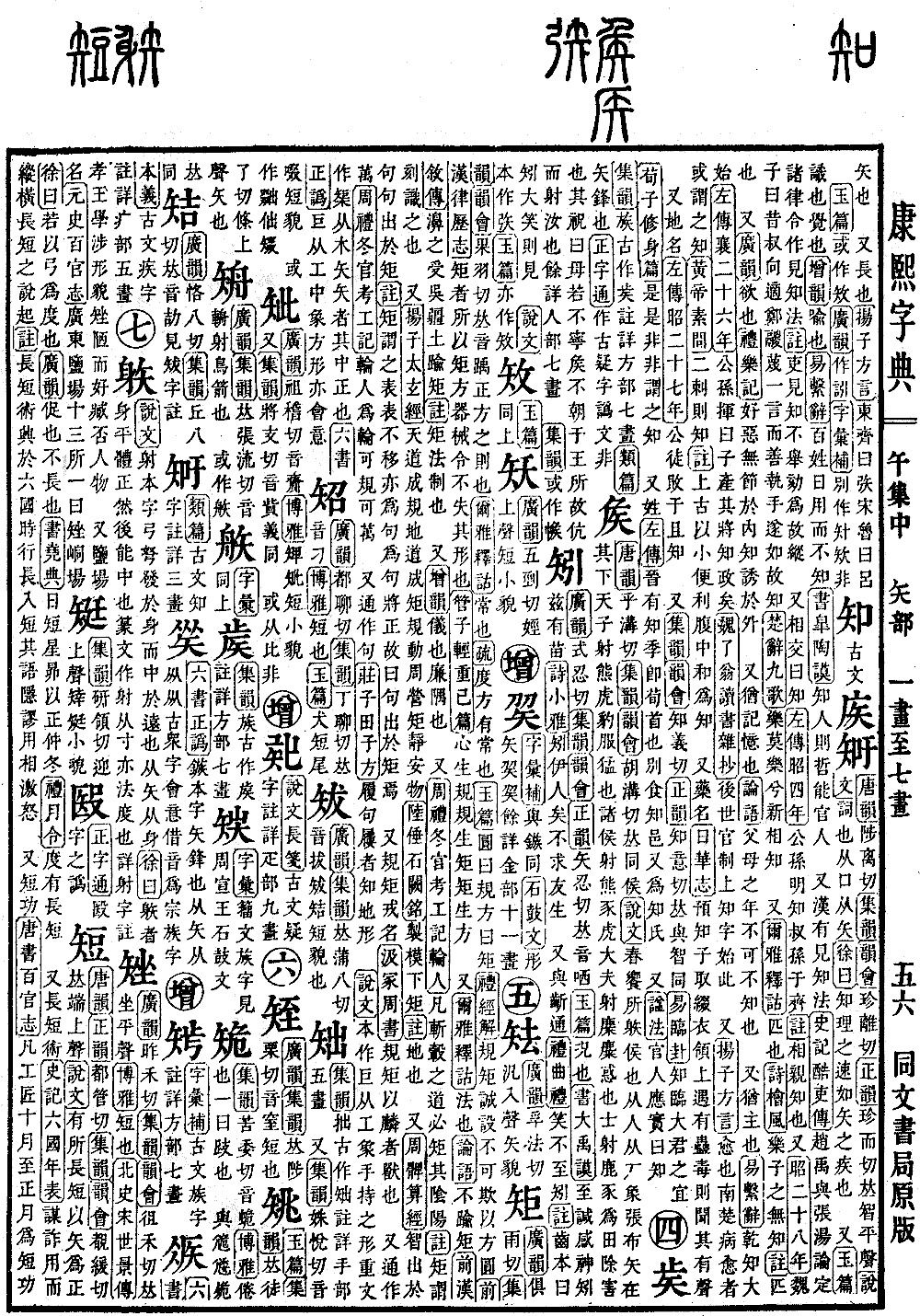
Wu Collection, Middle Volume
Radical: Arrow (shǐ)
Kangxi Strokes: 12
Page 824, Entry 33
Pronounced duan (rising tone).
Explaining in the Explaining Graphs and Analyzing Characters (Shuowen Jiezi): To measure the length of things, use an arrow as the standard.
Xu Kai adds: It is like using a bow as a standard of measurement.
The Broad Rhymes (Guangyun) explains: Short means pressing or not long.
The Book of Documents (Shangshu), Canon of Yao (Yaodian) records: When the daylight is shortest and the star Mao appears in the south, this determines the arrival of mid-winter.
The Book of Rites (Liji), Monthly Ordinances (Yueling) records: Measurements have long and short.
There is also the term long and short tactics (strategies of the School of Diplomacy).
The Records of the Grand Historian (Shiji), Chronological Table of the Six States records: Strategies and deceptions flourished, and thus the theories of the School of Diplomacy regarding advantages and disadvantages arose.
The commentary says: The long and short tactics arose during the period of the Six States, using exaggerated or subtle speech, with language that was obscure and deceitful, used to provoke one another.
There is also the term short labor (referring to a shorter period of work or corvee service).
The Book of Tang (Tangshu), Treatise on Officials records: For all craftsmen, they serve shorter labor from the tenth month to the first month.
There is also the term short person (a person of small stature).
The Records of the Grand Historian (Shiji), Hereditary House of Confucius records: The people of the Jiaoyao state are only three feet tall, which is the extreme of shortness.
The Xunzi, On Physiognomy (Feixiang) records: Emperor Yao was tall and Emperor Shun was short. King Wen of Zhou was tall and the Duke of Zhou was short. Confucius was tall and Zigong was short.
Zhang Hua in the Record of Miscellaneous Matters (Bowuzhi) records: Yi Yin had dark skin and was short in stature.
Furthermore, any criticism of another person's faults is called short.
The Records of the Grand Historian (Shiji), Biography of Qu Yuan records: The Grand Physician Shangguan slandered Qu Yuan before King Qingxiang.
The History of the Former Han (Qianhanshu), Biography of Xiao Wangzhi records: Zheng Peng repeatedly praised Xiao Wangzhi while slandering the General of Chariots and Cavalry.
Yan Shigu comments: Short means to expose the shortcomings and evil deeds of others.
Additionally, in rhyming verse, it is pronounced duan (falling tone).
Lu Ji in the Rhapsody on Thinking of My Parents (Siqin Fu) writes: The way of heaven is long and distant, the path of human life is brief. Different journeys return to the same end, with no concern for early or late.
Additionally, in rhyming verse, it is pronounced juan (falling tone).
Su Zhe in the Poem from Yi Province (Yizhong Shi) writes: The river flows and becomes deeper and wider, while the local dialect gradually changes. The peaks are the cliffs of ancient times, and the branches of the grass and trees appear short.
The Collected Rhymes (Jiyun) records: Sometimes written as a variant form.