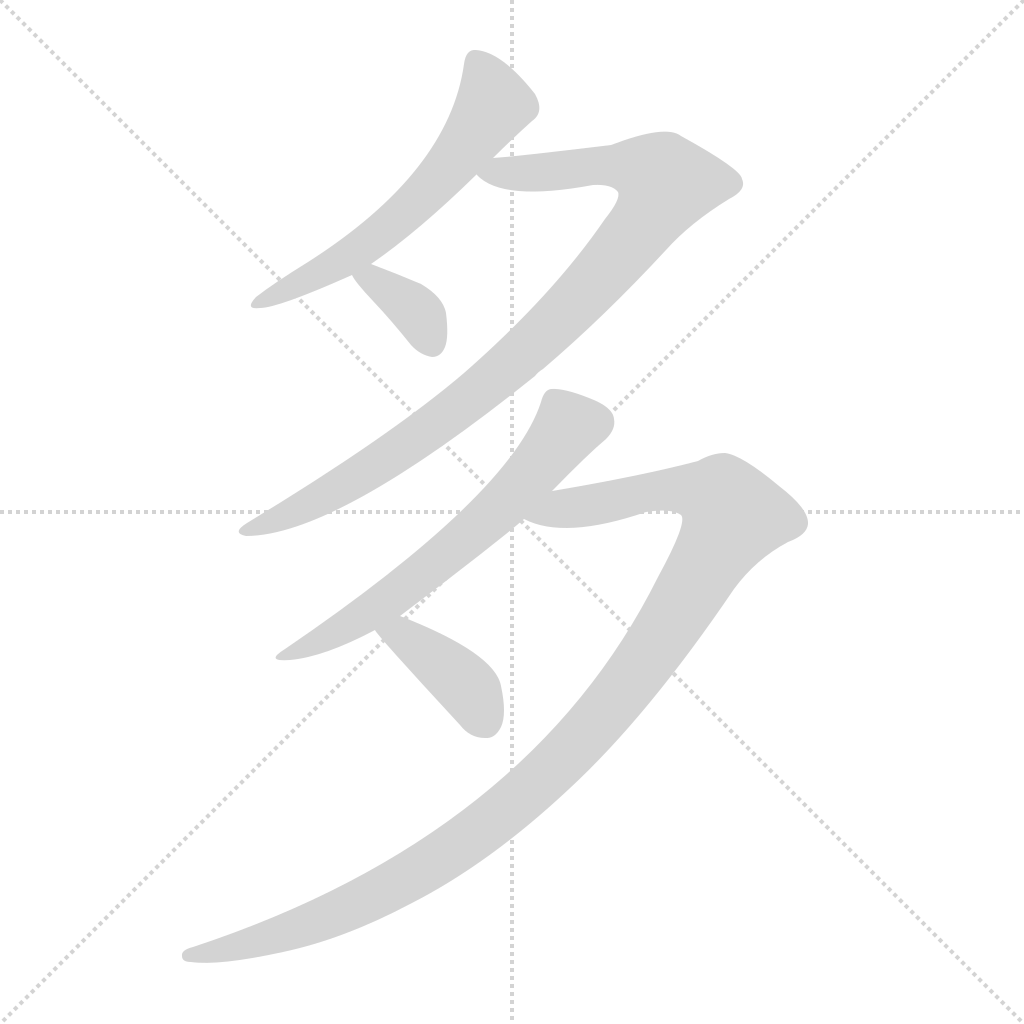
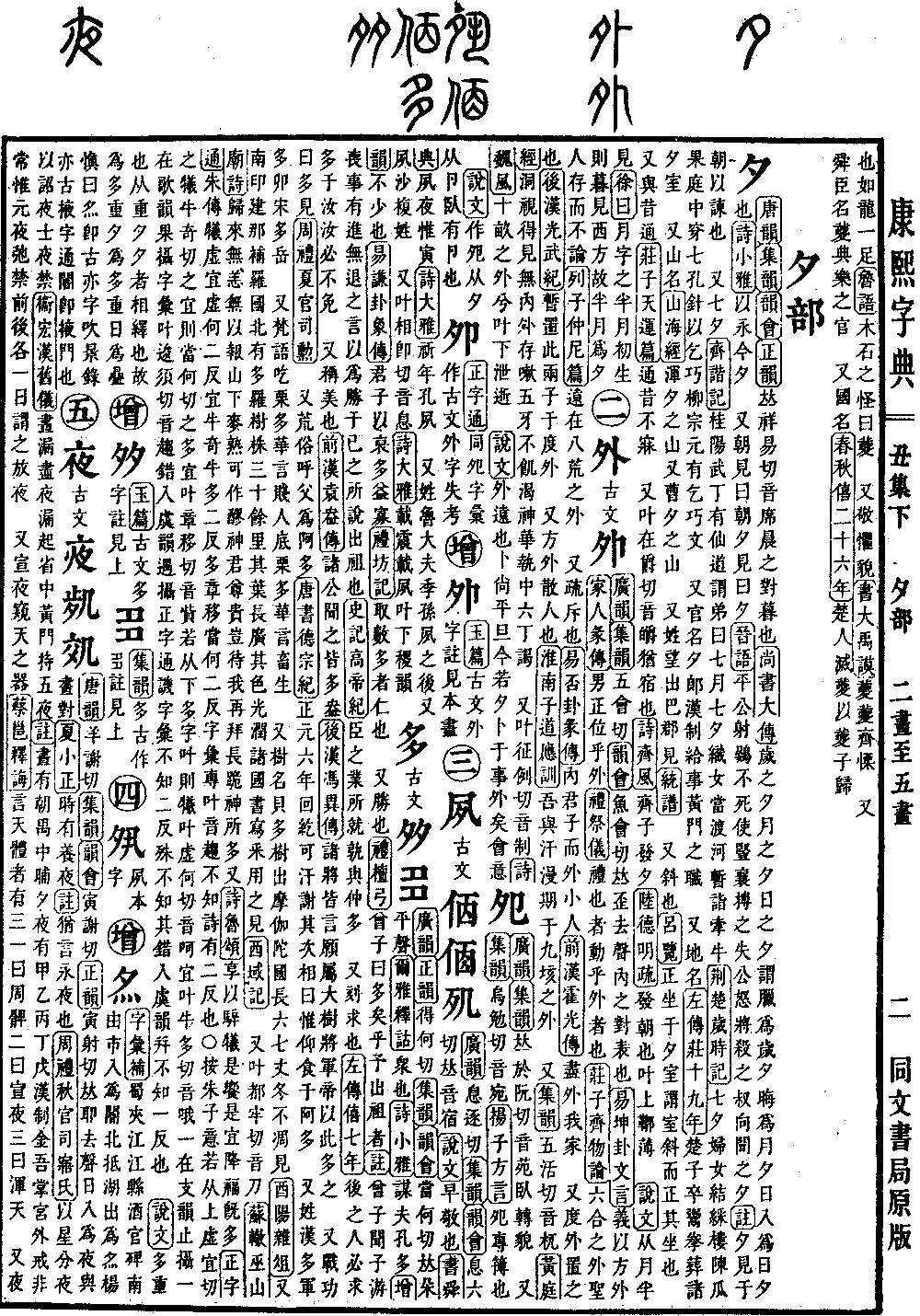
Chou Collection, Lower Volume; Radical: Evening (xī); Kangxi strokes: 6; Page 246, Entry 11
Ancient form. Pronounced he (level tone) according to Broad Rhymes (Guangyun) and Correct Rhymes (Zhengyun). Pronounced he (level tone) according to Collected Rhymes (Jiyun) and Rhyme Anthology (Yunhui); it rhymes with duo (level tone).
Erya, Explanation of Ancient Terms (Erya Shigu): Many.
Book of Odes (Shijing), Lesser Odes of the Kingdom (Xiaoya): The planners are very numerous.
Expanded Rhymes (Zengyun): Not few.
Book of Changes (Yijing), Image Commentary on the Qian Hexagram: The superior man takes from the many to increase the few.
Book of Rites (Liji), Record of Expressions (Biaoji): To take the greater number is benevolence.
Also means to excel.
Book of Rites (Liji), Tan Gong: Master Zeng said, "They are numerous, those who have gone out to perform the ancestral sacrifice."
Commentary: Master Zeng heard the words of Ziyou regarding funeral matters about advancing without retreating, and considered this to excel over what he himself had said about performing the ancestral sacrifice.
Records of the Grand Historian (Shiji), Annals of Emperor Gao: My accomplishments, how do they compare with those of Zhong?
Also means to demand excessively.
Zuo Tradition (Zuo Zhuan), Seventh Year of Duke Xi: Those who come after will demand much from you, and you will certainly not escape.
Also means to praise or admire.
History of the Former Han (Qianhan), Biography of Yuan Ang: The various lords heard of this and all praised Ang.
History of the Later Han (Houhan), Biography of Feng Yi: The generals all said they wished to belong to General Big Tree, and the Emperor praised him for this.
Military achievements are called duo; see Zhou Rites (Zhouli), Summer Offices, Minister of Merits (Sixun).
Also, barbarian custom calls a father a-duo.
Book of Tang (Tangshu), Annals of Dezong: Sixth year of Zhengyuan, the Uyghur Khagan thanked his vice-minister saying, "I only rely on a-duo for food."
Also a surname. Han dynasty had Duo Jun and Duo Mao; Song dynasty had Duo Yue.
Also, Sanskrit "chiliduo" means base person in Chinese. "Diliduo" means beast in Chinese.
Also a tree name. Beiduo tree, from the Magadha Kingdom, grows sixty to seventy feet tall, does not wither in winter; see Miscellaneous Morsels from Youyang (Youyang Zazu).
Also, north of the Jiannapulu Kingdom in Southern India there is a Duoluo tree, with trunks over thirty li in circumference; its leaves are long and wide, and their color is shiny and smooth; various countries use them for writing; see Records of the Western Regions (Xiyuji).
Also pronounced dao.
Su Zhe, Poem on the Wushan Temple: Returning safe and sound, having nothing to repay, the wheat under the mountain is ripe and can make ale. The divine lord is noble, how could he wait for me? I bow down on my knees, which the deity praises.
Also, Book of Odes (Shijing), Eulogies of Lu (Lusong): Offerings of red sacrificial animals, these are offered, these are appropriate, the blessings bestowed are many.
Correct Rhymes Dictionary (Zhengzitong): In Zhu Xi's commentary, the sacrificial animal rhymes with the reading of xu and yi; appropriate rhymes with the reading of niu and qi or niu and duo; many rhymes with the reading of zhang and yi, pronounced zi. If one follows the rhyming of the lower character, then the sacrificial animal rhymes with xu and he, pronounced e, and appropriate rhymes with niu and duo, pronounced e. One is in the level tone category, and one is in the open syllable category. The Dictionary of Characters (Zihui) incorrectly claims a reading of qu and xu, erroneously placing it in the yu rhyme group; the Correct Rhymes Dictionary criticizes the Dictionary of Characters for not knowing the two rhyming readings, while itself failing to realize it was placed in the wrong group and not knowing even one reading.
Explanation of Writing (Shuowen): Duo means heavy, derived from overlapping evening characters. Evening means to continue in succession, hence it means many. Two evening characters make many; two sun characters make a stack.
Textual research: In Book of Rites (Liji), Record of Manners (Fangji), "To take the greater number is benevolence." I have corrected "Record of Manners" to "Record of Expressions" according to the original text. In Zuo Tradition (Zuo Zhuan), Seventh Year of Duke Xi, "Those who come after will surely demand much from you." I have corrected "will surely demand" to "will demand" according to the original text.