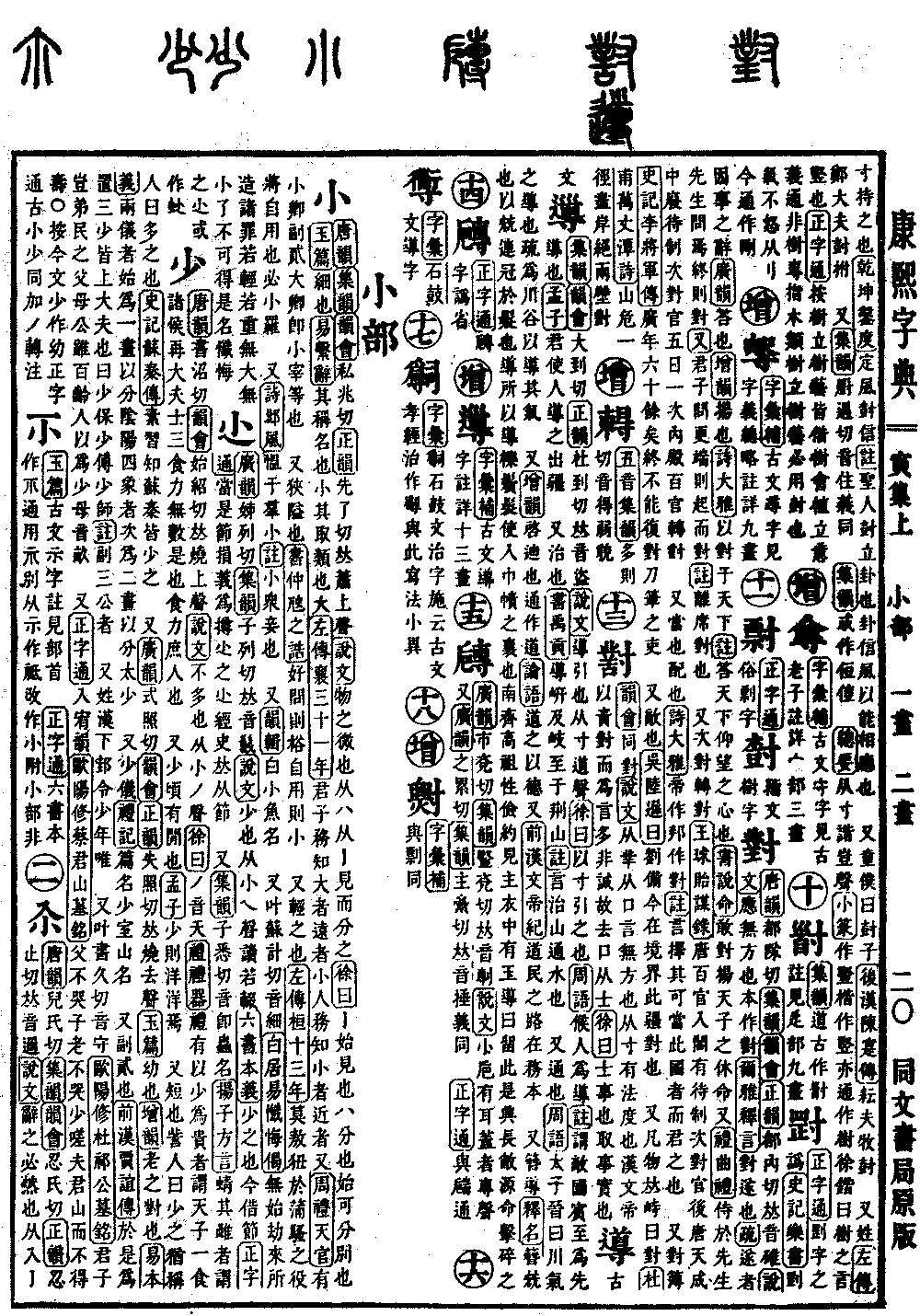
Yin Collection, Upper Volume
Radical: Inch (cùn)
Page 296, Entry 14
Pronounced duì
Shuowen Jiezi (Explaining Simple and Analyzing Compound Characters): To respond without a specific method. Originally written as a different character.
Erya (Approaching Elegance): To respond is to follow.
Commentary: To follow is an expression indicating an action taken due to a circumstance.
Guangyun (Broad Rhymes): To answer.
Zengyun (Augmented Rhymes): To manifest.
Book of Odes (Shijing): To respond to the world under heaven.
Note: To answer the heart of the world as it gazes upward in expectation.
Book of Documents (Shangshu): Dare to respond to and manifest the glorious decree of the Son of Heaven.
Also, Book of Rites (Liji): When sitting in attendance with a teacher, if the teacher asks a question, one waits until the end before responding.
Also: If a gentleman changes the subject of his inquiry, one must stand to respond.
Note: To leave one’s mat to respond.
Also: Successive responses, rotating responses.
Wangqiu Yimou Lu (Records of Inherited Strategies by Wang Qiu): During the Tang Dynasty, when officials entered the court, there were officials designated to wait and respond in turn. During the Tiancheng era of the Later Tang, these positions were abolished; officials would then rotate to respond at the inner palace once every five days.
Also: To correspond to, to match.
Book of Odes (Shijing): The Lord established the state and established a match.
Note: This means choosing someone capable of corresponding to the state to serve as its ruler.
Also: To face the records.
Records of the Grand Historian (Shiji): Guang was over sixty years old and ultimately could not bear to face the clerks with knife and brush again.
Also: To be an opponent.
Lu Xun of Wu said: Liu Bei is currently at our borders; he is a formidable opponent.
Also: Whenever things stand opposite each other, it is called a pair.
Du Fu’s poem on Wanzhang Pool: The mountains are steep, the path comes to an end, the banks are precipitous, the two cliffs stand opposite.
Textual Research:
In the Book of Rites (Liji), the phrase regarding sitting with a teacher has been amended to include the character for sit, in accordance with the original text.