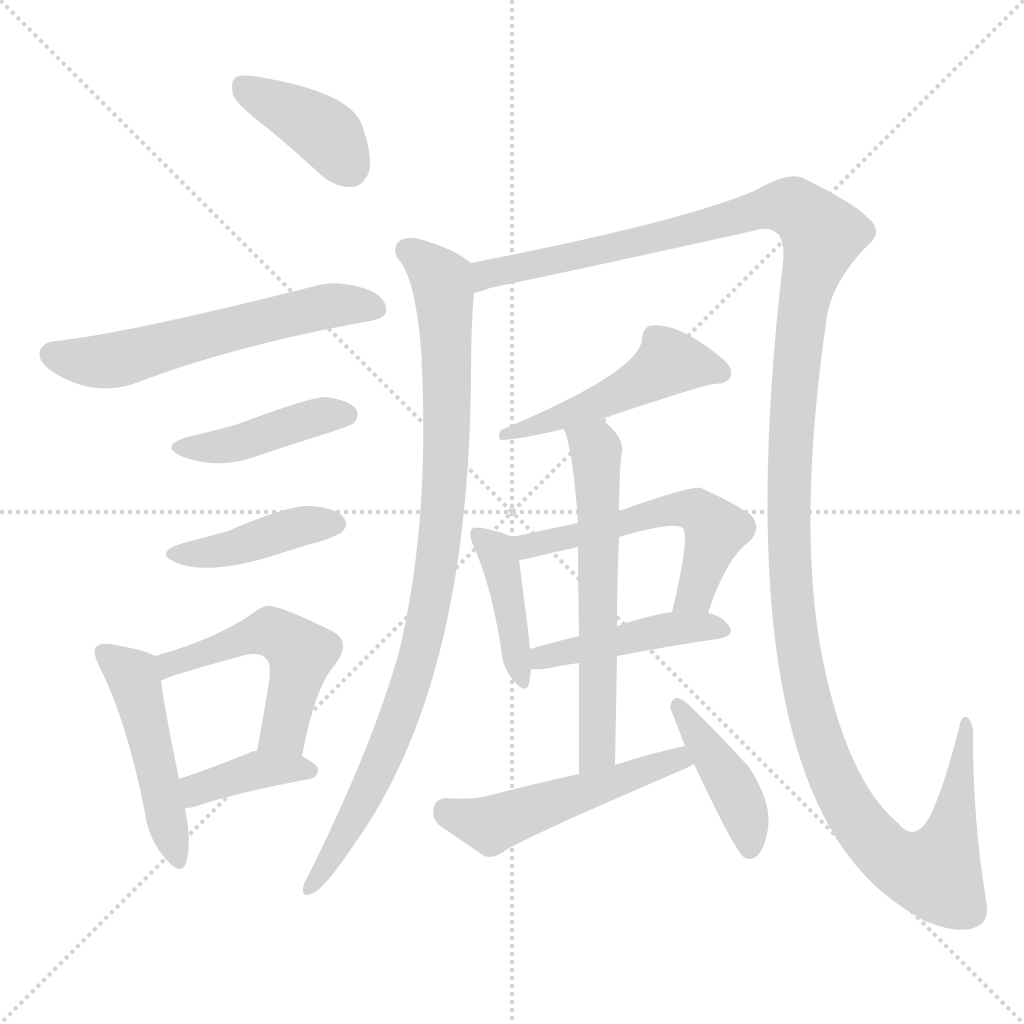
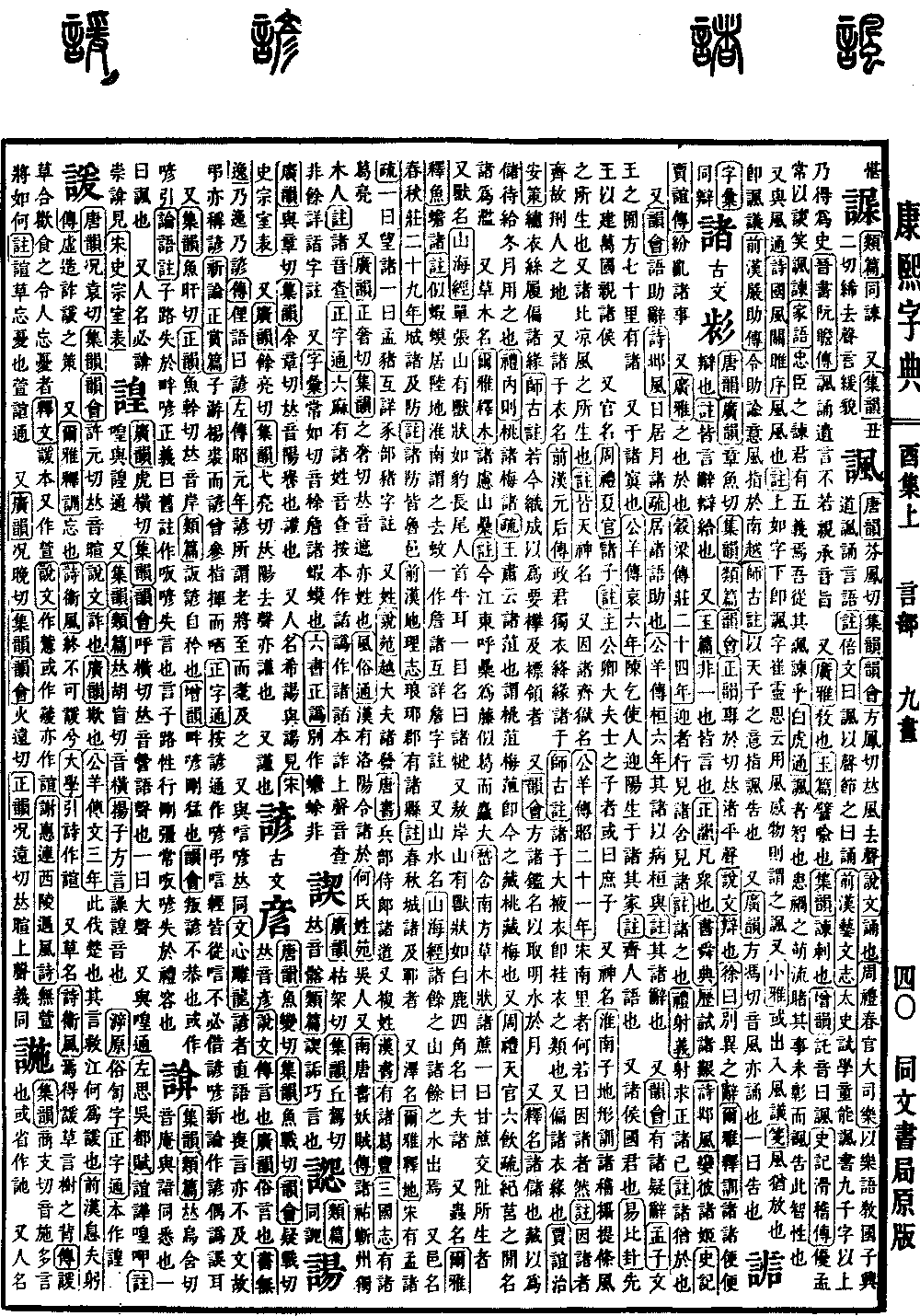
You Collection, Upper Volume
Radical: Speech (yán)
Kangxi Strokes: 16
Page 1172, Entry 02
Pronounced feng (falling tone).
Shuowen (Shuowen Jiezi): Defined as reciting or reading aloud.
Book of Rites (Zhouli), Spring Officials, Grand Director of Music: Use musical language to instruct the children of dukes, ministers, and grand masters, which includes Xing, Dao, Feng, Song, Yan, and Yu. Annotation: Reciting texts from memory is called feng, while chanting with rhythmic modulation is called song.
History of the Former Han (Qian Hanshu), Treatise on Literature and Arts: The Grand Historian conducts examinations; only students capable of reciting and writing more than nine thousand characters are eligible to serve as historians.
Book of Jin (Jinshu), Biography of Ruan Zhan: Reciting the words left behind by predecessors is not as good as personally listening to their teachings.
Also defined by Guangya as to instruct.
Yupian: Defined as an analogy or metaphor.
Jiyun: Defined as remonstrance or satire.
Zengyun: Defined as using melody or language to convey a hidden meaning.
Records of the Grand Historian (Shiji), Biographies of Jesters: You Meng frequently used humor to offer satirical remonstrance.
Family Sayings (Jiayu): There are five ways for a loyal official to remonstrate with a ruler; I advocate for the method of satirical remonstrance.
Comprehensive Discussions in the White Tiger Hall (Baihu Tong): Feng represents wisdom. When the sprouts of calamity appear, one observes the signs before they are fully manifest and offers warnings through allegory; this is the nature of wisdom.
Also interchangeable with the character for wind (feng).
Book of Odes (Shijing), Odes of the States, Preface to Guanju: Wind (feng) is equivalent to satire (feng). Annotation: The first wind is pronounced in its standard tone, the second wind is the character for satire (feng). Cui Lingen says: To influence things through wind is called satire (feng).
Also in the Lesser Odes (Xiaoya): Sometimes coming and going, speaking freely and debating. Annotation: Wind is similar in meaning to release. This refers to satirical discourse.
History of the Former Han (Qian Hanshu), Biography of Yan Zhu: Ordered Yan Zhu to convey the imperial will, using allegory to inform the ruler of Nanyue. Commentary by Shigu: Using the emperor's intent to inform through allegory.
Pronounced feng (level tone). Also carries the meaning of reciting. Another interpretation is to inform.