Zi Collection, Page Position: Lower
Radical: Private (sī)
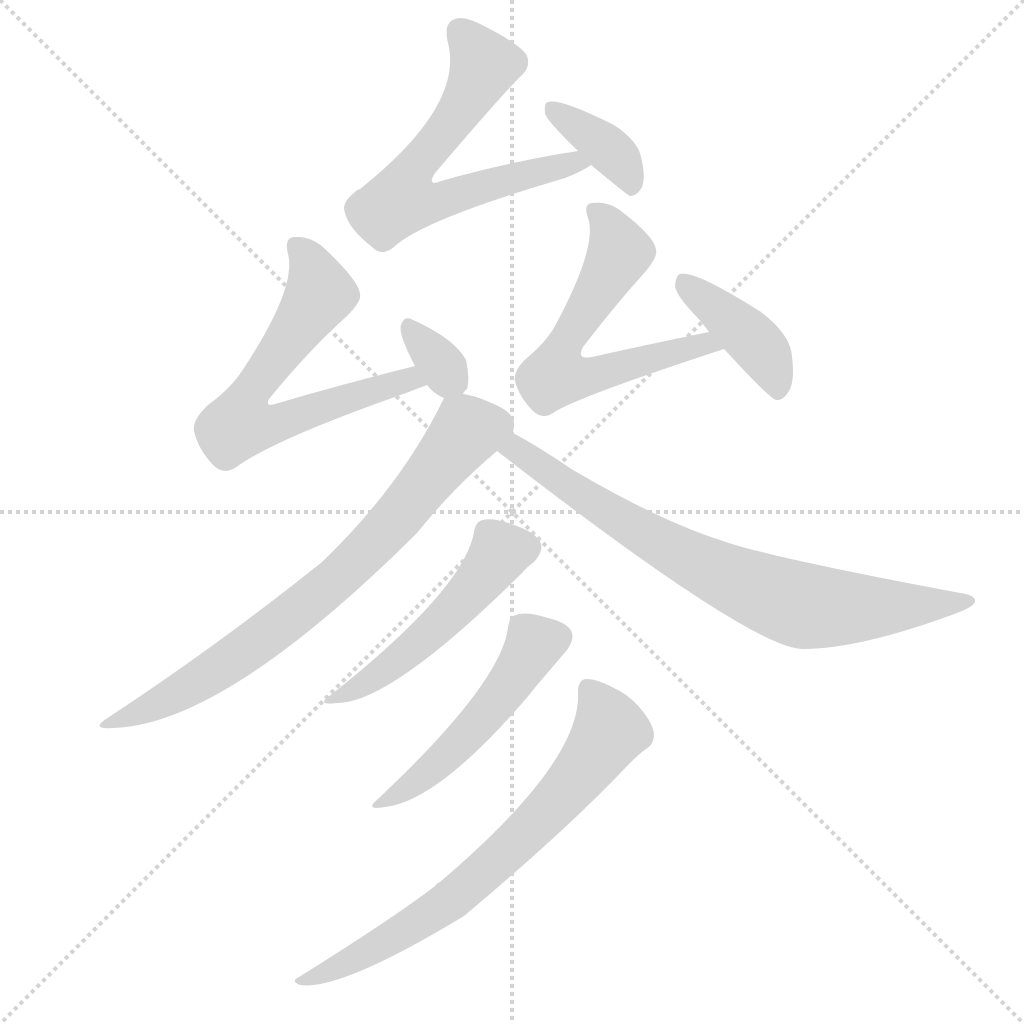
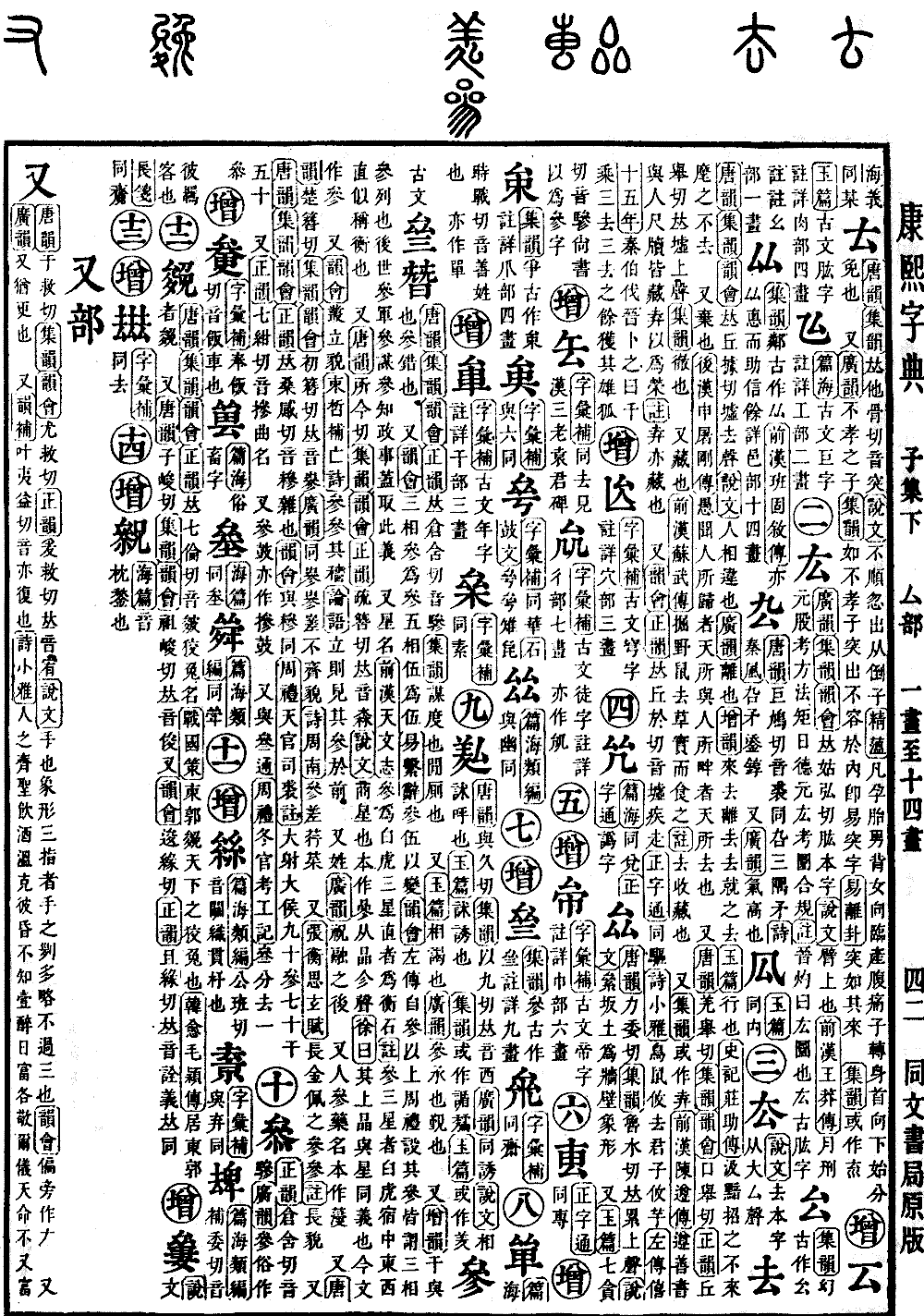
Entry: Can
Kangxi dictionary stroke count: 11
Page 164, Entry 28
Ancient form: Can
Tang Rhymes (Tangyun), Collected Rhymes (Jiyun), Dictionary of Rhymes (Yunhui), and Correct Rhymes (Zhengyun) state the pronunciation is can.
Collected Rhymes (Jiyun): To plan or measure; to intersperse or place between.
Jade Chapter (Yupian): To visit or see one another.
Broad Rhymes (Guangyun): To receive or to have an audience with.
Expanded Rhymes (Zengyun): To interfere or participate; to be mixed or staggered.
Dictionary of Rhymes (Yunhui): Three things placed together is called can; five things placed together is called wu.
Book of Changes (Yijing), Appendix: To use three and five to effect change.
Dictionary of Rhymes (Yunhui): In the Zuo Tradition (Zuozhuan), from three upwards. In the Rites of Zhou (Zhouli), established by threes. Both refer to three things arranged together. Later generations used terms such as military advisor (canjun), staff officer (canmou), and assistant administrator (canzhizhengshi), which all derive from this meaning.
Name of a constellation.
History of the Former Han (Qianhan Shu), Treatise on Astronomy: The constellation Can represents the three stars of the White Tiger; the ones in a straight line are the scale beam. Note: The three stars of Can, within the White Tiger mansion, align east to west like a scale beam.
Tang Rhymes (Tangyun) states the pronunciation is sen. Collected Rhymes (Jiyun), Dictionary of Rhymes (Yunhui), and Correct Rhymes (Zhengyun) state the pronunciation is sen.
Explication of Writing (Shuowen Jiezi): The Shang star. Originally written as can, derived from the sound of jing. Xu Shen notes: The jing component on top shares the same meaning as stars. Modern writing uses can.
Dictionary of Rhymes (Yunhui): The appearance of things standing together in a cluster.
Shu Xi, Supplement to the Lost Poems (Buwang Shi): The crops stand in clusters.
Analects of Confucius (Lunyu): When standing, one sees them arranged before one.
A surname. Descendants of Zhurong.
Ginseng. A medicinal name. Originally written as can.
Tang Rhymes (Tangyun) states the pronunciation is cen. Collected Rhymes (Jiyun), Dictionary of Rhymes (Yunhui), and Correct Rhymes (Zhengyun) state the pronunciation is cen.
Broad Rhymes (Guangyun): Same as cen. Cenci, the appearance of being uneven.
Book of Odes (Shijing), Zhou South: The water lettuce is uneven.
Zhang Heng, Rhapsody on Thinking (Si Fu): The long jade pendants are clustered and elegant. Note: Describing the appearance of length.
Tang Rhymes (Tangyun), Collected Rhymes (Jiyun), Dictionary of Rhymes (Yunhui), and Correct Rhymes (Zhengyun) state the pronunciation is san. To mix.
Dictionary of Rhymes (Yunhui): Same as san.
Rites of Zhou (Zhouli), Heaven Officials, Note by the Official of Furs: In grand archery ceremonies, the large targets are ninety, the middle targets are seventy, and the small targets are fifty.
Correct Rhymes (Zhengyun) states the pronunciation is can. Name of a musical piece. Also refers to the can drum, also written as can drum.
Also interchangeable with three. Rites of Zhou (Zhouli), Winter Officials, Artificers' Record (Kaogongji): To divide and remove one.