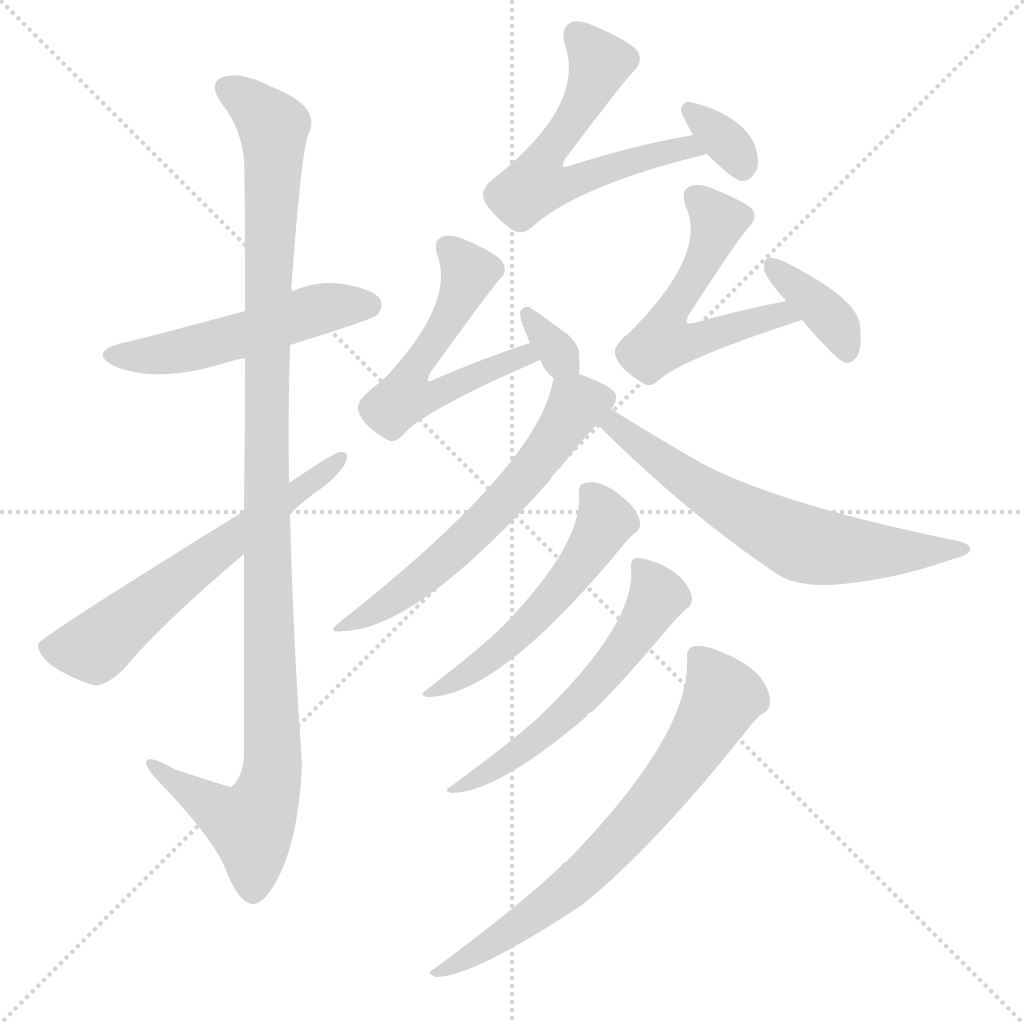
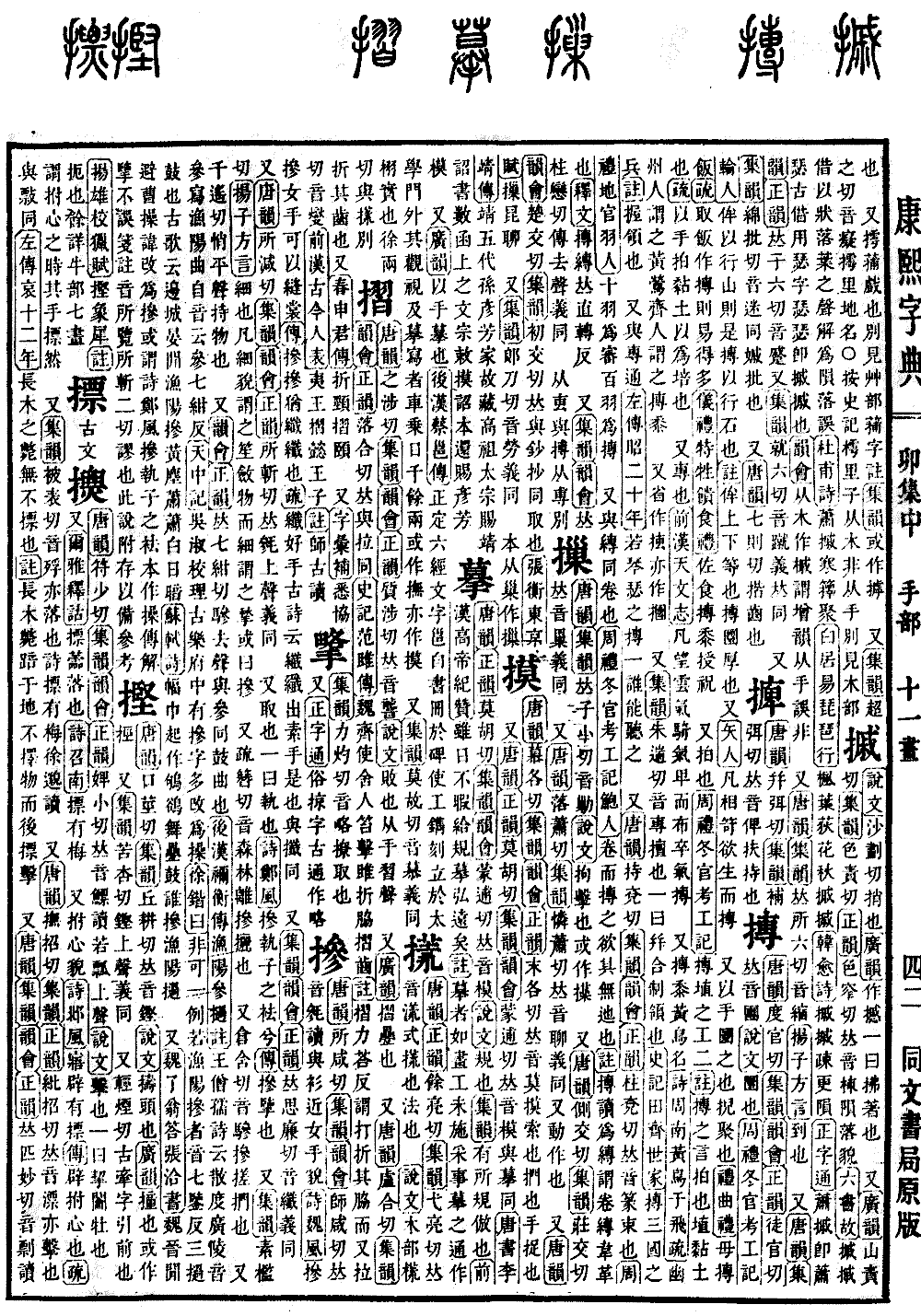
Mao Collection, Middle Volume
Radical: Hand (shǒu)
Kangxi strokes: 15
Page 452, Entry 10
Pronounced san. The sound is close to that of shan. Describes the slender and beautiful hands of a woman.
Book of Odes (Shijing), Odes of Wei: The girl's hands are slender and beautiful, capable of sewing garments.
Commentary: The term means slender.
Sub-commentary: Refers to slender and beautiful hands. Ancient poetry states: Slender hands emerge, which carries the same meaning. This character is the same as the variant form (qian).
Also pronounced xian. The meaning is the same.
Also pronounced san (rising tone). The meaning is the same. It also carries the meaning of to take. Another interpretation is to hold.
Book of Odes (Shijing), Odes of Zheng: I hold the sleeve of your garment.
Commentary: The term means to grasp or hold.
According to the Dialects (Fangyan) by Yang Xiong: Means slender. Anything described as slender is called sheng; to gather things and make them slender is called jiu. Some also say it is called san.
Also pronounced sen. Describes an appearance that is disheveled and scattered.
Also pronounced can. Refers to stroking or caressing.
Also pronounced qiao. Means to hold an object.
Also pronounced can (departing tone). Identical to the character (can). Refers to a drum composition.
History of the Later Han (Hou Hanshu), Biography of Mi Heng, Commentary on Yuyang Canzhao: The poem by Wang Sengru says: Spreading the notes of Guangling, playing the Yuyang music. His own commentary notes: Pronounced can.
Chronicle of the Heavens (Tianzhongji): In the ancient music bureau songs edited by Wu Shu, the character for this entry was mostly changed to (cao).
Xu Kai states: One cannot generalize; for instance, the term in Yuyang can, pronounced can, refers to three beats of a drum. Ancient songs say: The border cities are at peace with the Yuyang drum beats, yellow dust sighs as the white sun darkens.
Su Shi poem: With a headscarf I rise to perform the myna dance, who will beat the Yuyang drum rhythm?
According to the correspondence of Wei Liaoweng to Zhang Qia: During the Wei and Jin dynasties, the character (cao) was changed to this character to avoid the taboo of Cao Cao’s name. Some say the character in the Book of Odes (Shijing), Odes of Zheng, was originally written as (cao), and the commentary defining it as to grasp is correct. The annotations providing two pronunciations are erroneous. This opinion is included here for reference.