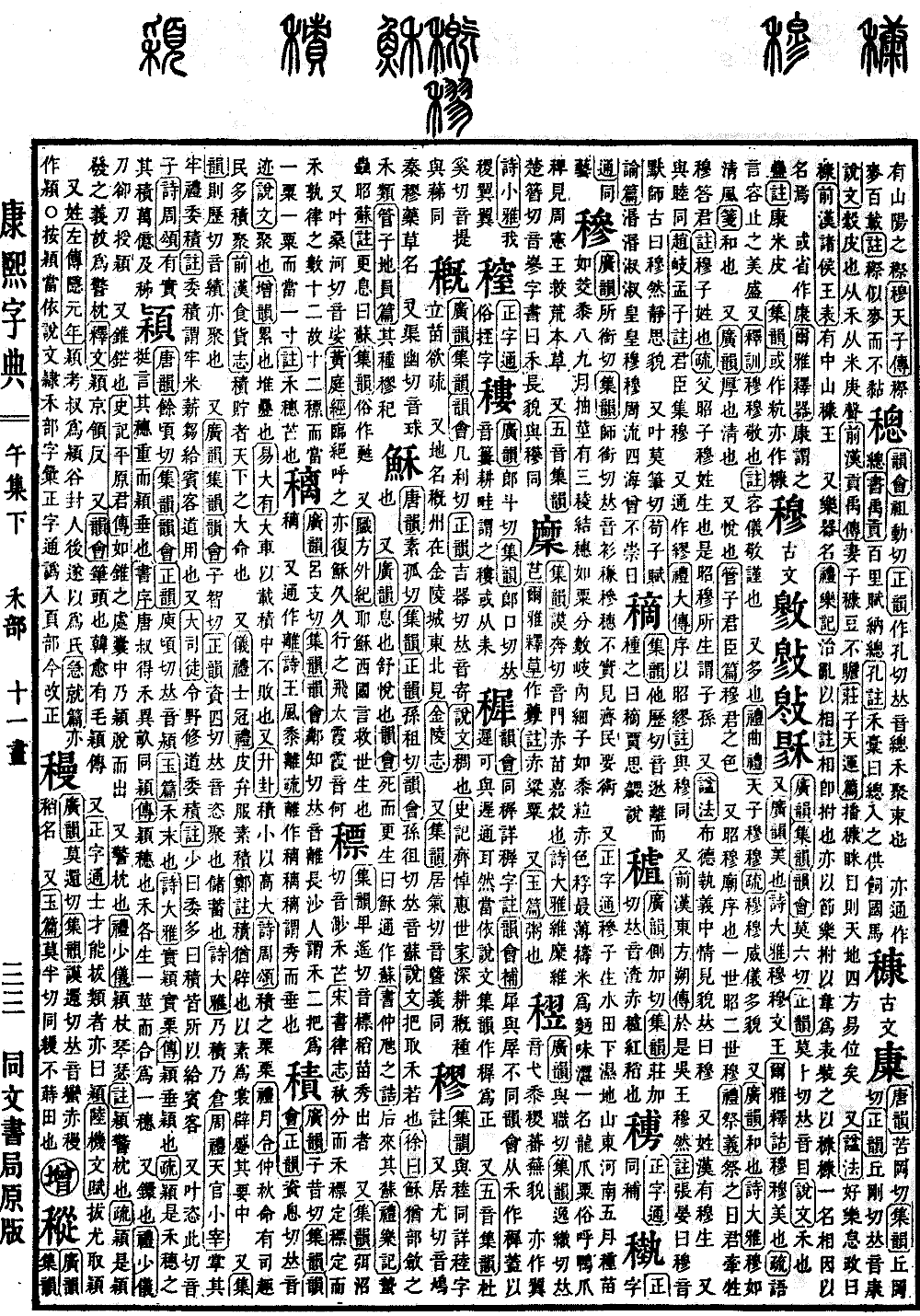
Wu Collection, Lower Volume
Radical: Grain (hé)
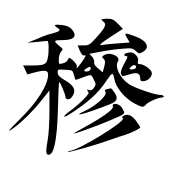
Character: Can
Kangxi stroke count: 16
Page 859, Entry 13
According to the Broad Rhymes (Guangyun), it is pronounced shan. According to the Collected Rhymes (Jiyun), it is pronounced shan. The term jian-can refers to grain ears that are not full. Reference found in Important Arts for the People’s Welfare (Qimin Yaoshu).
Furthermore, the Zhengzitong states: The can-grain plant grows in paddy fields and low-lying, damp areas. In the Shandong and Henan regions, it is sown in the fifth month. The young seedlings resemble wild rice shoots and broomcorn millet. In the eighth or ninth month, it produces stalks with three ridges. The ears resemble those of foxtail millet, branching into several sections containing tiny seeds like broomcorn millet, which are red in color. The husk is extremely thin; when the grain is pounded into flour, the taste is astringent. It is also known as dragon-claw millet and is commonly called duck-claw. Reference found in the Famine Relief Herbal (Jiuhuang Bencao) by Prince Zhou Xian.
Furthermore, according to the Five Sounds Collected Rhymes (Wuyin Jiyun), it is pronounced cen. The dictionary states: The appearance of grain seedlings growing long. This character is identical in meaning to the variant form (can).