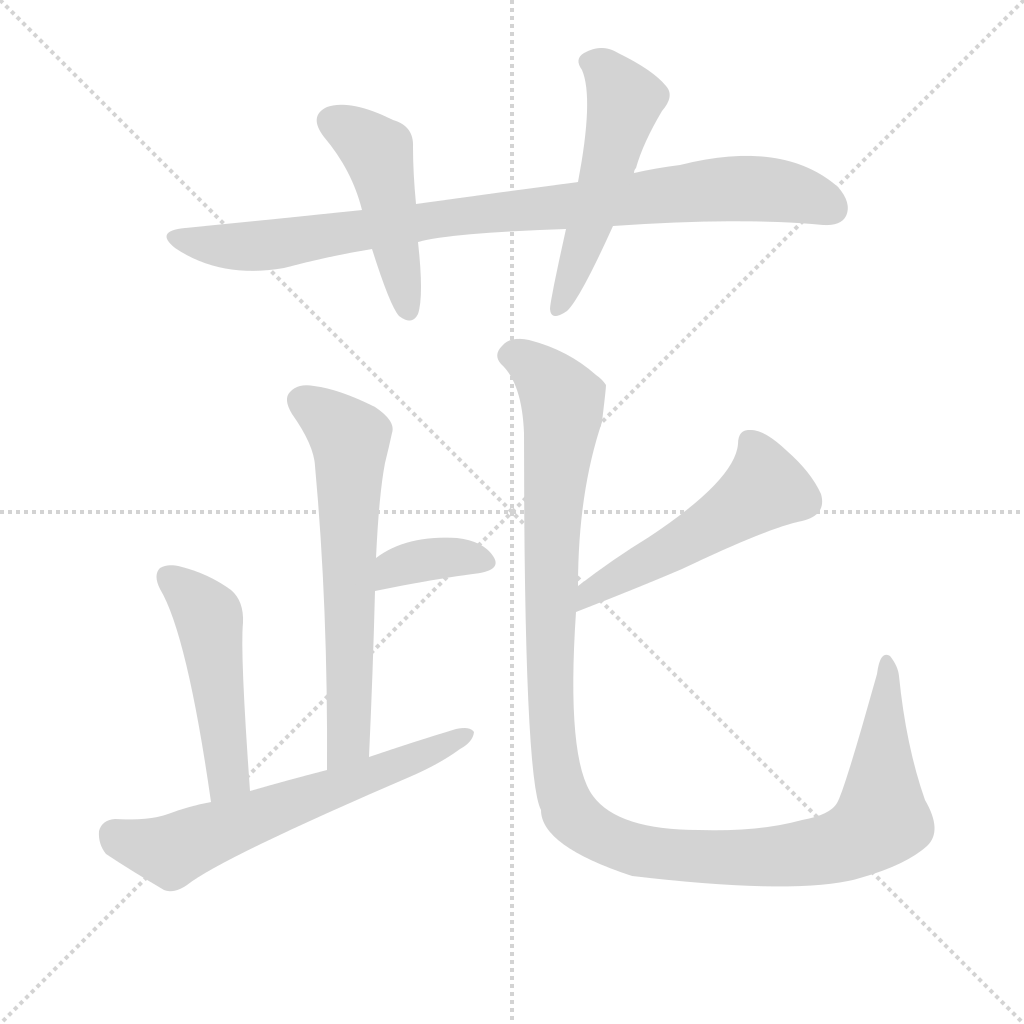
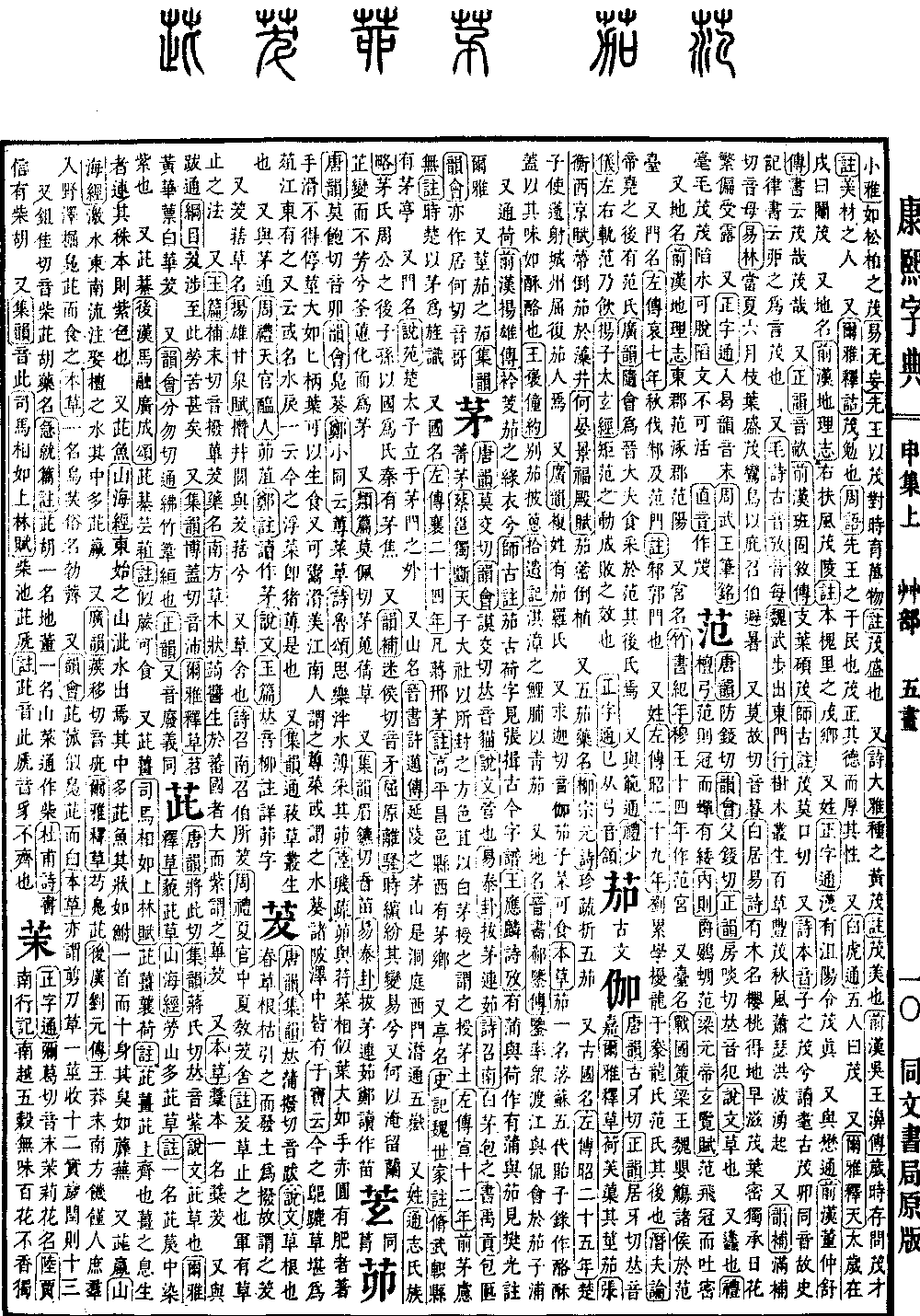
Shen Collection, Upper Volume
Radical: Grass (cǎo)
Kangxi Strokes: 11
Page 1026, Entry 08
Pronounced zi (falling-rising tone).
According to Explaining Graphs and Analyzing Characters (Shuowen Jiezi), this refers to a type of grass.
In the Erya, within the section on explaining grasses, it is stated: miao is the same as the zi plant.
The Classic of Mountains and Seas (Shanhaijing) states: Mount Lao has many zi plants. The commentary notes that it is also called zi and can be used to dye fabrics purple.
Also, zi qi. In the Latter Han Dynasty work Guangcheng Song by Ma Rong, it is mentioned alongside yun ju. The commentary notes it resembles a fern and is edible.
Also, zi jiang. In the Shanglin Fu by Sima Xiangru, it is mentioned alongside rang he. The commentary notes that zi jiang refers to the young shoots of ginger; the part of the ginger newly grown from the rootstock is purple in color.
Also, zi yu (zi fish). The Classic of Mountains and Seas (Shanhaijing) states: The Ci River originates from the East Start Mountain; the water contains many zi fish. Their shape resembles a crucian carp, but they have one head and ten bodies, and their scent is like that of the miwu plant.
Also, zi luo (zi snail). The Classic of Mountains and Seas (Shanhaijing) states: The Ji River flows southeast into the Qutan water, which contains many zi snails.
Pronounced ci (flat tone).
In the Erya, within the section on explaining grasses, it is stated: shao is the same as fu zi. In the Biography of Liu Yuan in the History of the Later Han (Hou Hanshu), it is noted that during the late years of Wang Mang, there was a famine in the south; the common people gathered in the marshes to dig up fu zi for food. The Materia Medica (Bencao) states it is also known as wu fu and is commonly called bo ji.
According to the Yunhui, zi gu resembles fu zi but is white. The Materia Medica (Bencao) states it is also called scissors grass; one stalk produces twelve fruits, and in a leap year, it produces thirteen.
Pronounced chai (rising tone).
Zi hu is the name of a medicinal herb. The commentary to the Jijiupian states: Zi hu is also known as di xun or shan cai, and is commonly written as chai. Du Fu writes in his poetry: The letter contains chai hu.
Pronounced ci (rising tone).
In the Shanglin Fu by Sima Xiangru, it appears as chai chi zi si. The commentary notes that zi is pronounced ci and si is pronounced zhi, meaning uneven or irregular.
Textual Research: The commentary to the Jijiupian mentions zi hu, also known as di dong. According to the original text, this has been corrected to di xun.