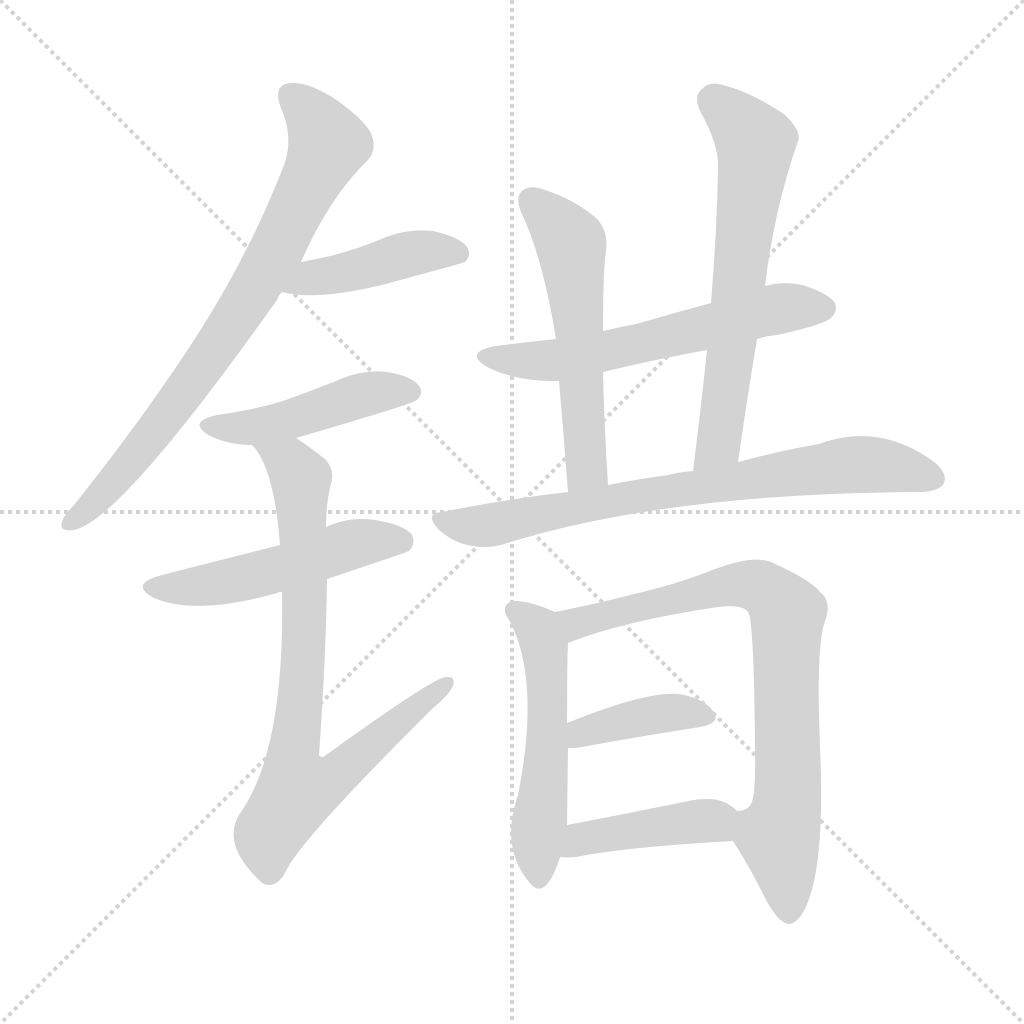
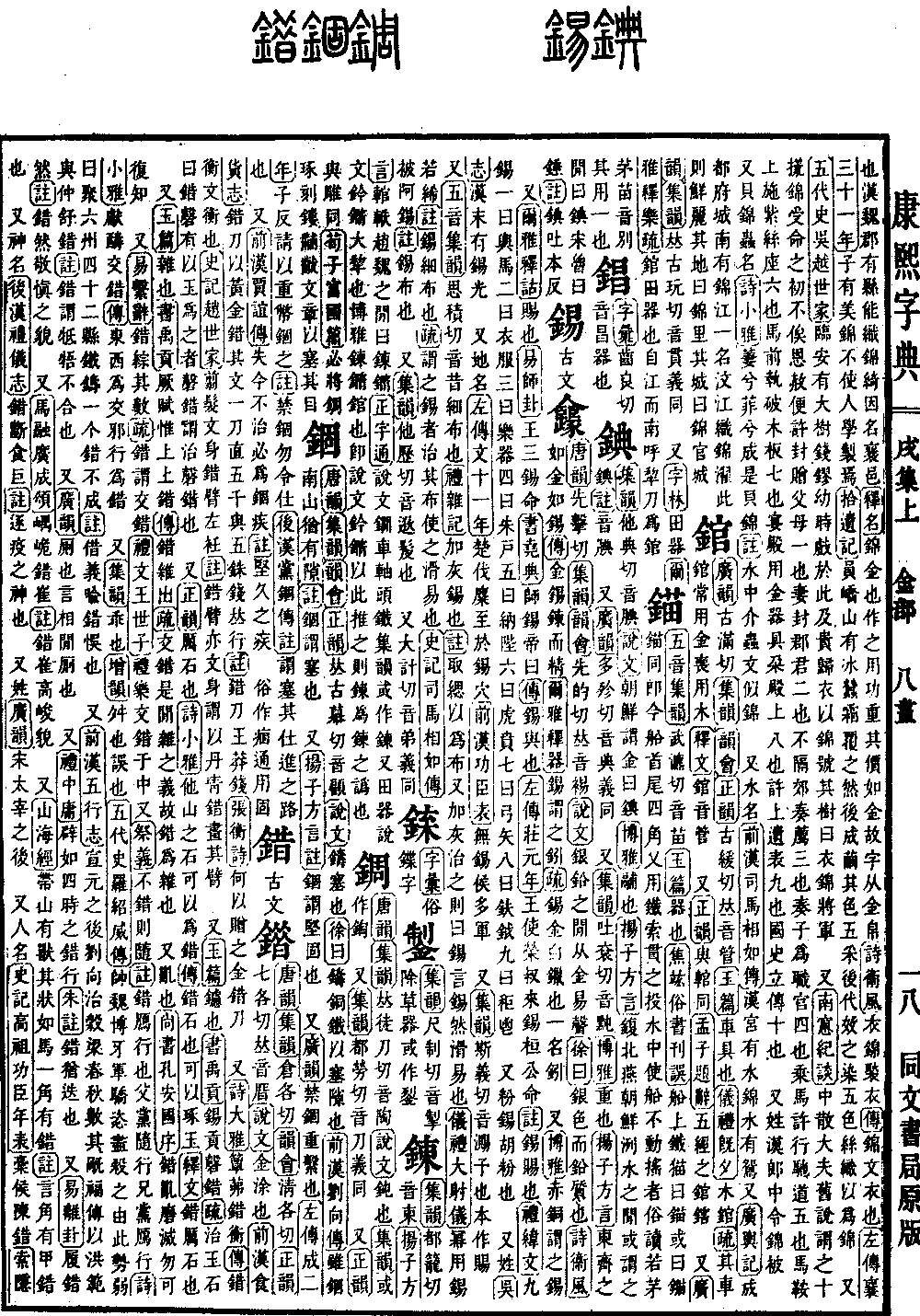
Xu Collection, Upper Volume. Radical: Metal (jīn). Kangxi stroke count: 16. Page 1312, Entry 01.
Pronounced cuò. As recorded in the Tang Rhyme (Tangyun) and the Collection of Rhymes (Jiyun), the pronunciation is a combination of cang and ge. As recorded in the Rhyme Treasury (Yunhui), the pronunciation is a combination of qing and ge. As recorded in the Orthodox Rhyme (Zhengyun), the pronunciation is a combination of qi and ge. The sound is cuò.
In the Explaining Graphs and Analyzing Characters (Shuowen Jiezi), it refers to gold plating. In the History of the Former Han (Qianhan Shu), Treatise on Food and Money, it mentions the "cuo-knife," which had gold inlaid in its patterns; one knife was worth five thousand, circulating alongside the five-zhu coins. The commentary notes that the cuo-knife was a currency of Wang Mang. In the poem by Zhang Heng, it is written: "What shall I use to bestow upon him? A gold-inlaid knife."
In the Book of Odes (Shijing), it is used to describe the patterned cross-bar of a carriage. The commentary states that a patterned cross-bar is a decorated cross-bar. In the Records of the Grand Historian (Shiji), Biography of the House of Zhao, it refers to cutting hair and tattooing the body, with arms patterned. The commentary explains that this means the arms were decorated with patterns made of cinnabar and green pigment.
According to the Jade Chapters (Yupian), it is a whetstone. In the Book of Documents (Shujing), Tribute of Yu, it mentions the tribute of stone chimes and whetstones. The commentary explains that treating jade and stone is called cuo. Therefore, the chimes refers to processing stone chimes.
According to the Orthodox Rhyme, it is a grinding stone. In the Book of Odes (Shijing), it says: "The stones from other hills can be used to polish jade." The commentary notes that cuo refers to a grinding stone that can be used to carve jade. The Explanatory Text (Shiven) confirms that cuo is a grinding stone.
According to the Jade Chapters, it means mixed. In the Book of Documents (Shujing), Tribute of Yu, it mentions the assessment being of the highest-highest, mixed level. The commentary notes that cuo means mixed output. The commentary further explains that intersection implies mixture, thus cuo means mixed.
It also means disordered. In the Preface to the Book of Documents by Kong Anguo, it speaks of things being in disorder and worn away, such that they cannot be known again. In the Book of Changes (Yijing), Appended Remarks, it mentions the interlacing and complicating of numbers. The commentary explains that interlacing refers to crossing over. In the Book of Rites (Liji), Record of the Heir Apparent, it mentions rites and music intersecting in the middle.
In the Book of Rites (Liji), Record of Sacrifice, it says: "If they are not in order, then follow." The commentary notes that cuo refers to the formation of wild geese. The father’s kin follow in a line, and the brother’s kin follow in a wild-goose formation. In the Book of Odes (Shijing), Minor Odes, it speaks of the exchanging of toasts and the crossing of paths. The commentary explains that crossing from east to west is called jiao, while crossing diagonally is called cuo.
According to the Collection of Rhymes (Jiyun), it means contrary. According to the Amplified Rhymes (Zengyun), it means erroneous or mistaken. In the History of the Five Dynasties (Wudai Shi), Biography of Luo Shaowei, it mentions how he commanded the arrogant guards of Weibo and had them all killed, which weakened his power, saying: "Even if I gathered all the iron from six provinces and forty-two counties to cast a cuo, it would not work." The commentary notes this is a borrowed meaning, used as a metaphor for a mistake.
In the History of the Former Han (Qianhan Shu), Treatise on the Five Elements, it notes that after the reigns of Emperor Xuan and Emperor Yuan, Liu Xiang studied the Guliang Commentary on the Spring and Autumn Annals and compared it with the Great Plan (Hongfan), and with Dong Zhongshu, it was cuo. The commentary notes that cuo here means discordant or not in agreement.
According to the Broad Rhymes (Guangyun), it means to intersperse or to be located between. In the Book of Rites (Liji), Doctrine of the Mean, it compares this to the alternating movement of the four seasons. The commentary of Zhu Xi notes that cuo here means alternating.
In the Book of Changes (Yijing), Li Hexagram, it mentions walking in a cautious manner. The commentary notes that cuo-ran describes a respectful and cautious appearance. In the poem Guangcheng Song by Ma Rong, it describes the high and steep nature of mountains.
In the Classic of Mountains and Seas (Shanhaijing), it is written that on Dai Mountain there is a beast resembling a horse, with one horn, and it has a cuo. The commentary says this means the horn has overlapping scales.
It is also the name of a deity. In the History of the Later Han (Houhan Shu), Treatise on Rituals, it mentions a deity that wards off pestilence.
It is also a surname, descended from the Grand Minister of the Song state.
It is also used in personal names. In the Records of the Grand Historian (Shiji), Table of Merits of the High Ancestor, it mentions the Marquis of Gao, Cuo. The commentary notes that in the Han records it is written as Kai, pronounced kai.
It is also the name of an insect. In the Supplement to the Vocabulary (Zihuibu), it refers to a type of bush cricket, which the people of Youzhou call a pu-cuo.
It is often used interchangeably with the character cuo (to place). In the History of the Former Han (Qianhan Shu), Treatise on Geography, it speaks of the five directions being mixed, with customs not being uniform. The commentary notes that cuo and cuo were used interchangeably in ancient times.
Pronounced cuò. As recorded in the Broad Rhymes (Guangyun) and other rhyme dictionaries, the pronunciation is a combination of cang and gu, which is cuo. According to the Collection of Rhymes (Jiyun), gold plating is called cuo. It is also a surname.
According to the Boya, it means to store. In the Songs of Chu (Chuci), Nine Declarations, it says: "Among the lives of the myriad people, each has a place to be settled." The commentary notes that cuo means to be settled. In the Records of the Grand Historian (Shiji), Biography of Sima Xiangru, it speaks of expanding one's office and setting up one's career. Cuo is pronounced cuo.
In the Book of Changes (Yijing), Appended Remarks, it says: "If one places it on the ground, then it is fine." The commentary explains that cuo means to place. The Explanatory Text notes the pronunciation is cuo. In the Records of the Grand Historian (Shiji), Basic Annals of Zhou, it says that during the reigns of Cheng and Kang, the world was peaceful, and for over forty years, things were left as they were and not used. The commentary says cuo means to set aside. In the Records of the Grand Historian (Shiji), Biography of Zhang Yi, it suggests that the alliance between Qin and Wei can be stopped. The commentary says cuo means to stop, pronounced cuo.
In the History of the Later Han (Houhan Shu), Biography of Han Lang, it says: "The two of them were startled and unable to respond." The commentary notes that cuo combined with the following character means a state of panic or urgency.
According to the Dialect (Fangyan) by Yang Xiong, it means to extinguish. In the regions of Zhou and Qin, it is called cuo.
It is also used interchangeably with the character for vinegar. In the Guanzi, it says to put soy sauce and vinegar on food.
According to the Collection of Rhymes (Jiyun), pronounced que, it refers to the coarseness of physical objects.