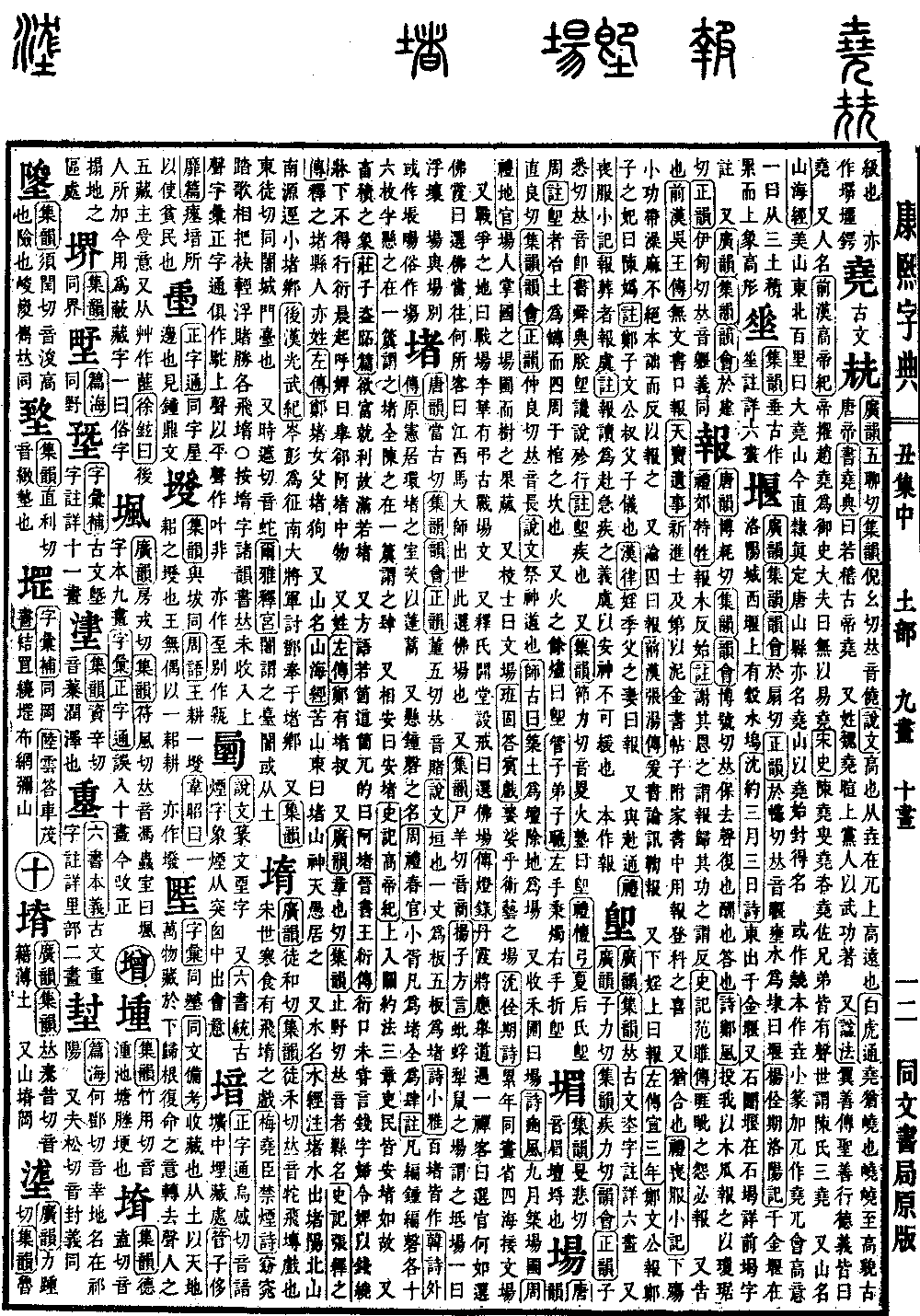
Chou Collection, Middle Volume
Radical: Earth (tǔ)
Entry: Chang
Kangxi stroke count: 12
Page 234, Entry 01
Pronounced chang.
As defined in Explaining and Analyzing Characters (Shuowen Jiezi), it refers to a path for sacrificing to spirits. Shigu states that earth is piled to form an altar, and the cleared ground is called a chang. It also refers to a garden for harvesting grain. As mentioned in the Book of Odes (Shijing), Binfeng section, in the ninth month, the threshing grounds and gardens are built. In the Rites of Zhou (Zhouli), Earth Office section, the official known as the Changren oversees the state grounds and gardens, planting fruits and gourds there.
It also refers to literary examinations, known as the literary arena. In Ban Gu's Response to the Guest's Jest (Da Bin Xi), it describes roaming through the arenas of arts and crafts. In a poem by Shen Quanqi, it mentions having served together in the imperial secretariat for many years, meeting across the literary arenas of the world.
A place of warfare is called a battlefield. Li Hua wrote the Lament for the Ancient Battlefield (Diao Gu Zhanchang Wen).
In Buddhism, the hall where precepts are bestowed is called the selection arena for Buddhas. In the Records of the Transmission of the Lamp (Chuandeng Lu), it is recorded that Danxia was on his way to take the imperial examination when he met a Chan master who asked, what is selecting an official compared to selecting a Buddha. Danxia asked where one should go to select a Buddha. The guest replied that the Great Master Ma of Jiangxi had appeared in the world, and that this place was the arena for selecting Buddhas.
Also pronounced shang.
In the work Dialect (Fangyan) by Yang Xiong, the mound created by ants and rats is called a chichang, also known as floating soil. Chang is distinct from yi. Sometimes also written in a variant form (chang). Commonly written in a variant form (chang).