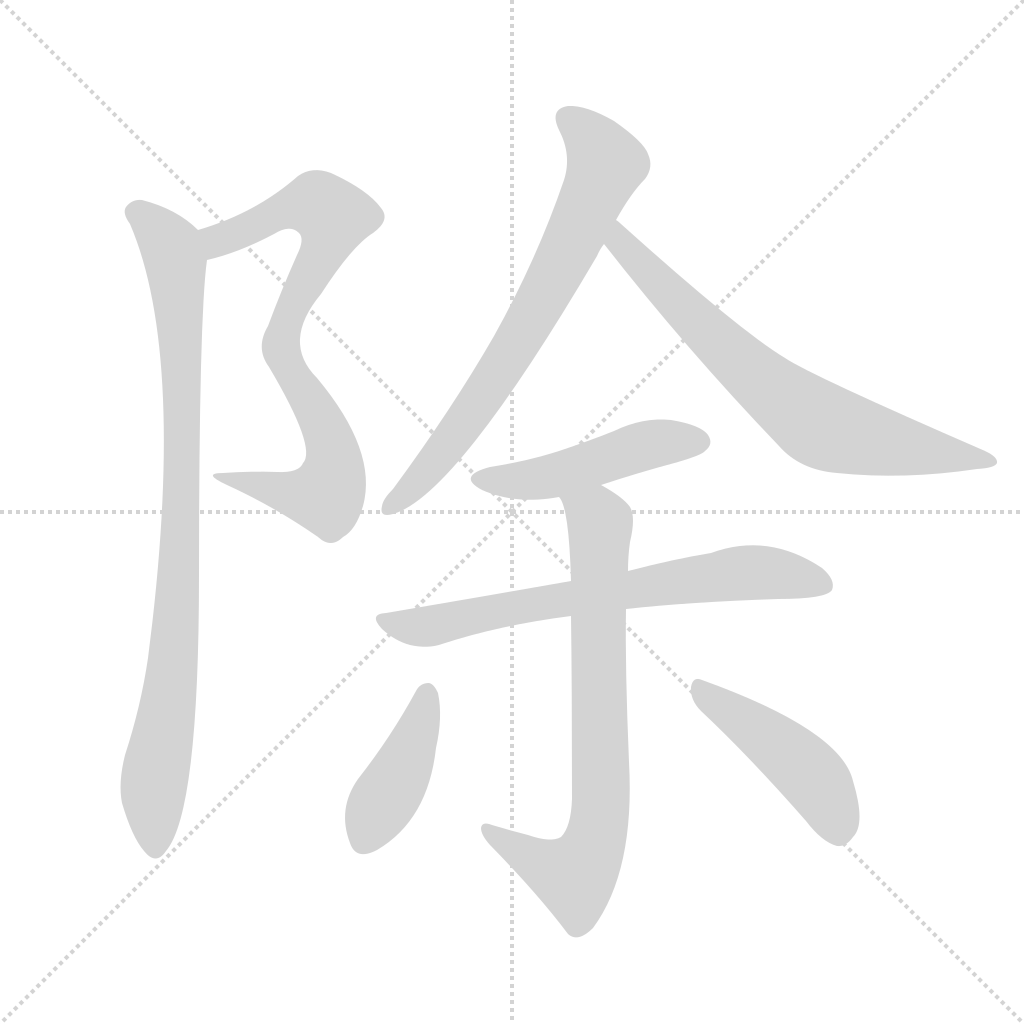
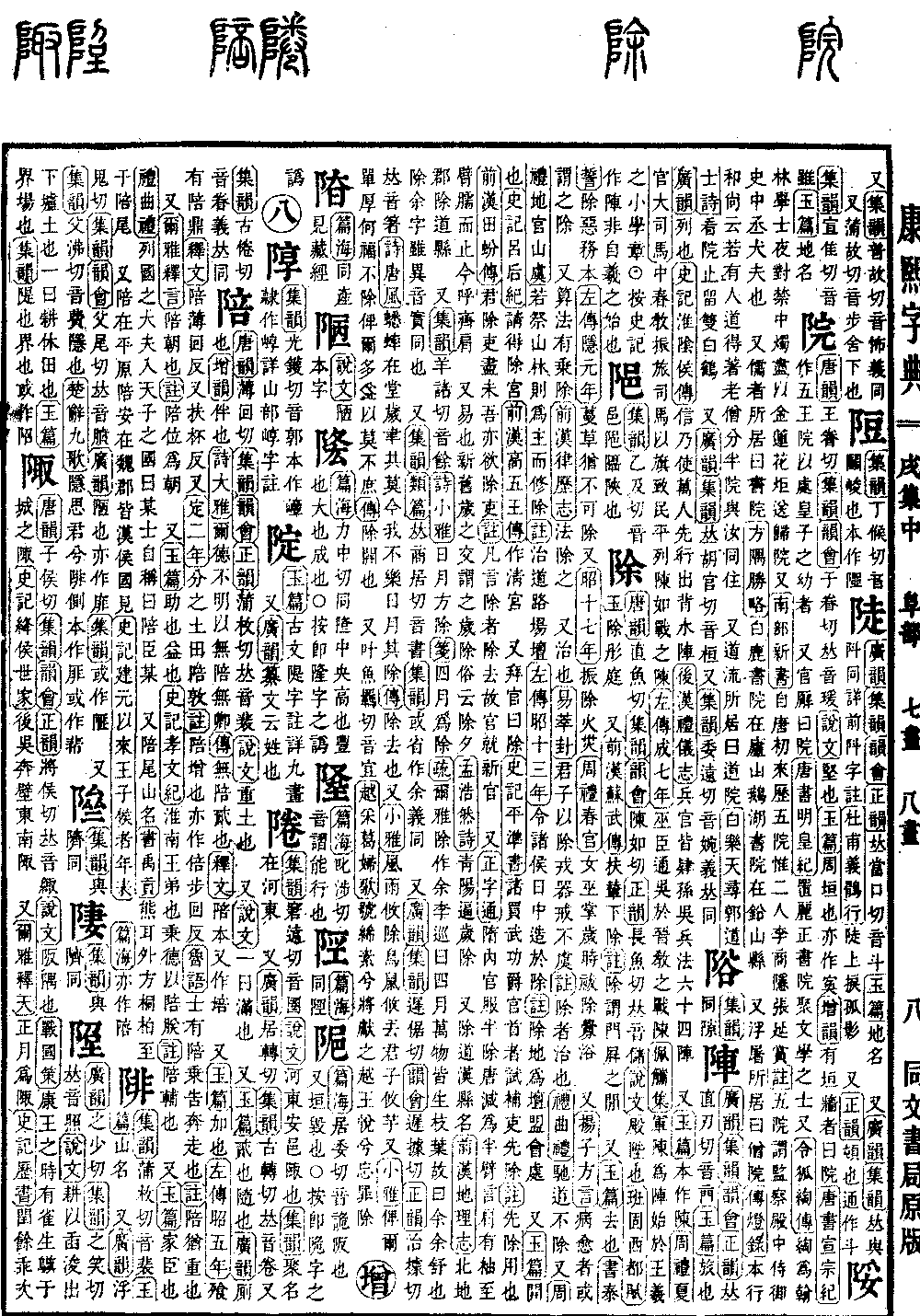
Xu Collection, Middle Volume. Radical: Mound (fu). Chu. Kangxi strokes: 15. Page 1352, Number 08.
According to the Tang Rhymes (Tangyun), it follows the phonetic fanqie of zhi and yu. According to the Collected Rhymes (Jiyun) and the Rhyme Assembly (Yunhui), it follows ru and qie. According to the Standard Rhymes (Zhengyun), it follows zhang and yu. It is pronounced similarly to chu. The Explication of Graphs and Analysis of Characters (Shuowen Jiezi) defines it as the steps of a palace hall. Jade steps and cinnabar courtyard — Rhapsody on the Western Capital (Xidu Fu) by Ban Gu.
Also, in the Biography of Su Wu in the Book of Han (Hanshu), it is written: Assisting the carriage down the steps. The commentary notes that chu refers to the space between the gate and the screen.
The Jade Chapters (Yupian) defines it as to remove. In eliminating evil, one must act at the root — Great Declaration (Taishi) in the Book of Documents (Shujing). Even spreading weeds cannot be removed — Zuo Tradition (Zuozhuan), first year of Duke Yin.
In the seventeenth year of Duke Zhao in the Zuo Tradition, it says: To shake off and remove fire disasters. The Rites of Zhou (Zhouli), Ministry of Rites, states: The female shamans oversee the seasonal rites of purification and ritual bathing.
In the Dialects (Fangyan) by Yang Zi, it is noted that recovering from an illness is sometimes called chu.
In calculation, there are multiplication and division. Using the method to divide it — Treatise on Rhythm and the Calendar in the Book of Han.
It also means to govern or repair. The superior man repairs the weapons of war to guard against the unforeseen — Hexagram Cui in the Book of Changes (Yijing). The commentary notes that chu means to govern. The imperial carriage road is not repaired — Summary of the Rules of Propriety (Quli) in the Book of Rites (Liji).
The Rites of Zhou, Ministry of Education, states: When sacrificing to the mountains and forests, one acts as the host and prepares the site. The commentary notes this means to repair roads and prepare the altar grounds. The Zuo Tradition, thirteenth year of Duke Zhao, states: Commanded the feudal lords to meet at the chu at midday. The commentary notes this means clearing the ground to make an altar for meetings and alliances.
The Jade Chapters defines it as to open. The Annals of Empress Lü in the Records of the Grand Historian (Shiji) states: Asking to clear the palace. In the Book of Han, Biographies of the Five Sons of Emperor Gao, this is written as qing gong, meaning a cleared or pure palace.
Also, appointing an official is called chu. Those who bought titles of military merit and were eligible for office were first tested and then appointed — Treatise on the Balanced Standard in the Records of the Grand Historian. The commentary notes that first chu means to employ. Have you finished appointing all the officials? I also wish to appoint some — Biography of Tian Fen in the Book of Han. The commentary notes that generally, chu means removing the old office to take up the new one.
According to the Correct Character Mastery (Zhengzitong), in the Sui Dynasty, palace officials wore a garment called the ban-chu (half-chu), which in the Tang Dynasty was reduced to the ban-bi (half-arm). This refers to a garment where the sleeves begin at the shoulder and end at the upper arm, currently called qijian (shoulder-level).
It also means to change. The transition between the old and new year is called suichu (year's end). It is commonly called chuxi (New Year's Eve). The spring sunlight approaches the end of the year — Poetry of Meng Haoran.
Also, Chudao is the name of a county in the Han Dynasty. Chudao County in Beidi Commandery — Treatise on Geography in the Book of Han.
In the Collected Rhymes, it follows the phonetic fanqie of yang and zhu, pronounced similarly to yu. The days and months are just beginning to pass — Minor Odes of the Kingdom (Xiaoya) in the Book of Odes (Shijing). The commentary notes the fourth month is called chu. The sub-commentary notes that in the Erya, chu is written as yu. Li Xun says: In the fourth month, all things sprout branches and leaves, so it is called yu, meaning surplus or extension. Yu means to stretch or unfold. Although the characters for chu and yu are different, the sounds are identical.
According to the Collected Rhymes and the Category Book (Leipian), it follows the phonetic fanqie of shang and ju, pronounced similarly to shu. The Collected Rhymes notes it is sometimes abbreviated as yu with the same meaning.
According to the Broad Rhymes (Guangyun) and Collected Rhymes, it follows the phonetic fanqie of chi and ju. According to the Rhyme Assembly, it follows chi and ju. According to the Standard Rhymes, it follows zhi and ju. It is pronounced similarly to zhu. The crickets are in the hall, and the year is drawing to a close. If we do not enjoy ourselves now, the days and months will have passed away — Odes of Tang (Tangfeng) in the Book of Odes. The commentary notes that chu means to pass away.
Where the wind and rain are excluded — Minor Odes of the Kingdom.
To make you greatly enriched, what blessing is not opened to you? To give you much increase, so that nothing is not abundant — Minor Odes of the Kingdom. The commentary notes that chu means to open.
It is also used as a rhyming word following the phonetic fanqie of yu and ji, pronounced similarly to yi. I call out to the fine white cloth to be offered; the King of Yue is pleased and forgets to remove my guilt — Song of the Woman Gathering Kudzu in Yue (Yue Caige Fu Ge).