Wei Collection, Middle Volume
Radical: Silk (mì)
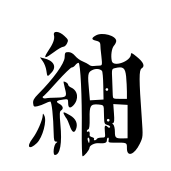
紬
Kangxi strokes: 11
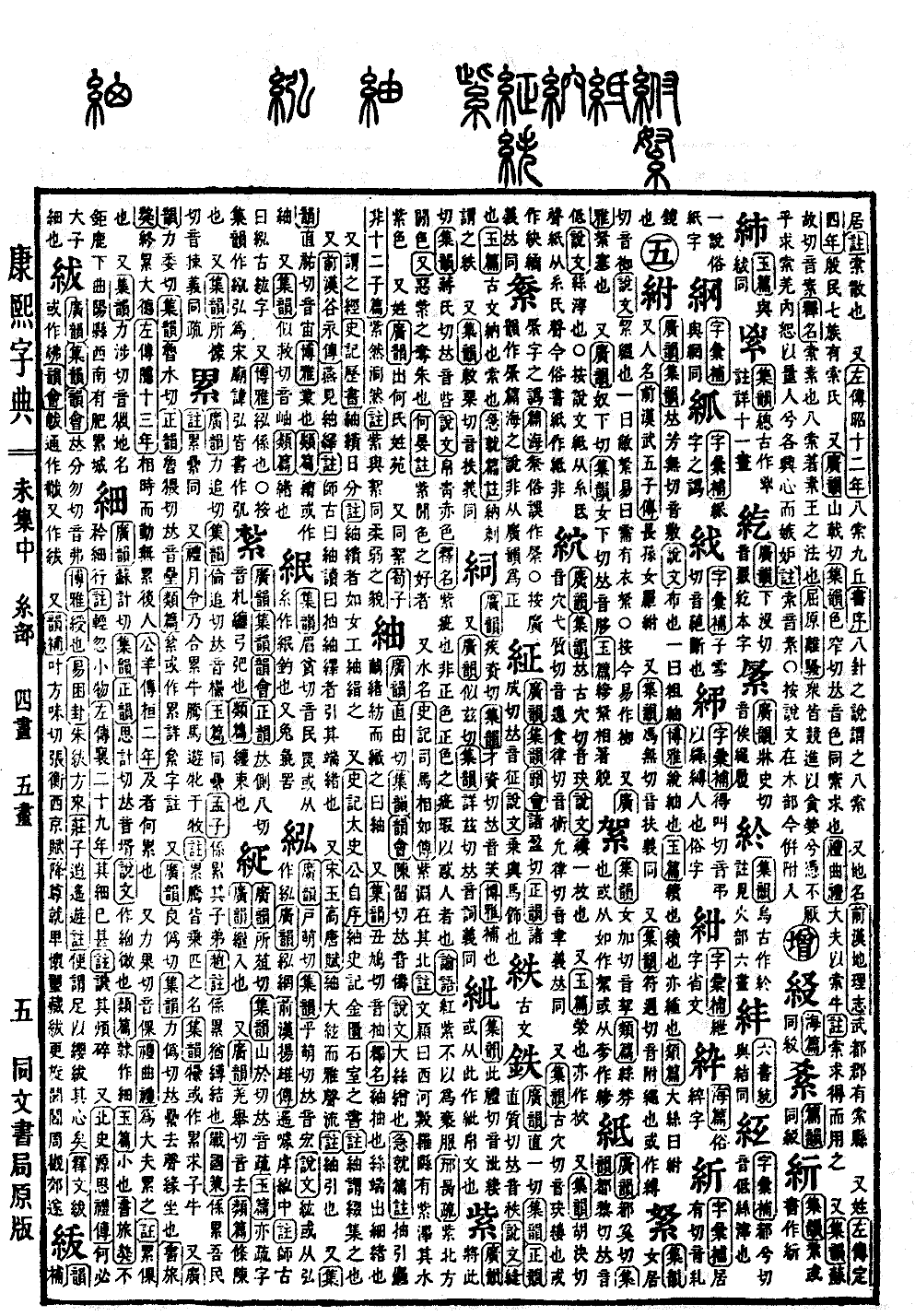
Page 919, Entry 30
Broad Rhymes (Guangyun): Pronounced chou
Collected Rhymes (Jiyun) and Rhyme Collection (Yunhui): Pronounced chou
Explaining Characters (Shuowen): Silk fabric woven from thick threads.
Commentary on the Quick Enrollment (Jijiupian): Drawing out the ends of coarse cocoons, spinning them into thread, and weaving them into fabric is called chou.
Also, Collected Rhymes (Jiyun): Pronounced chou
Explanation of Names (Shiming): Chou means to draw out. It refers to drawing thin threads from the ends of silk fibers. It is also called jing.
Records of the Grand Historian (Shiji), Treatise on the Calendar: To calculate and arrange the degrees of the sun's movement.
Commentary: Chou-ji is like the work of a seamstress drawing out silk to weave.
Also, Records of the Grand Historian (Shiji), Preface of the Grand Historian: To assemble and collect the books from the golden cabinets and stone chambers.
Commentary: Chou means to assemble or collect.
Also, History of the Former Han (Qianhan), Biography of Gu Yong: Meeting during leisure to elaborate on principles.
Commentary: Shigu states that chou is pronounced like chou. Chou-yi means to draw out the threads of an argument and elaborate upon them.
Also, Song Yu, Gaotang Fu: Plucking the large strings to produce flowing, elegant musical sounds.
Commentary: Chou means to pluck or play a stringed instrument.
Also, Collected Rhymes (Jiyun): Pronounced zhou
Extensive Refinements (Boya): Achievement.
Categorized Chapters (Leipian): Sometimes written as a variant form (chou).
Also, Collected Rhymes (Jiyun): Pronounced xiu
Categorized Chapters (Leipian): The ends or beginnings of silk fibers.