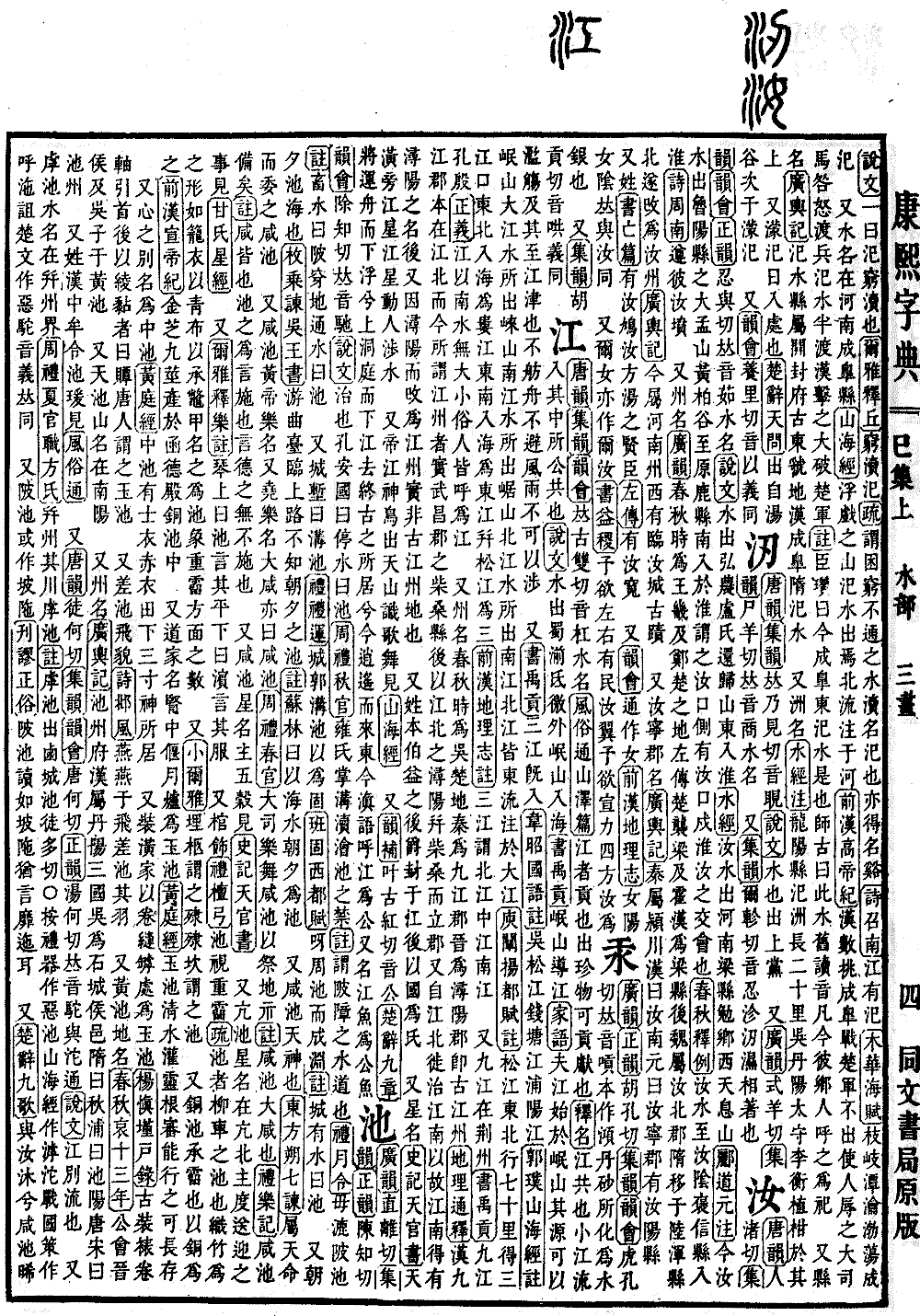
Si Collection, Upper Volume
Radical: Water (shuǐ)
Page 606, Entry 05
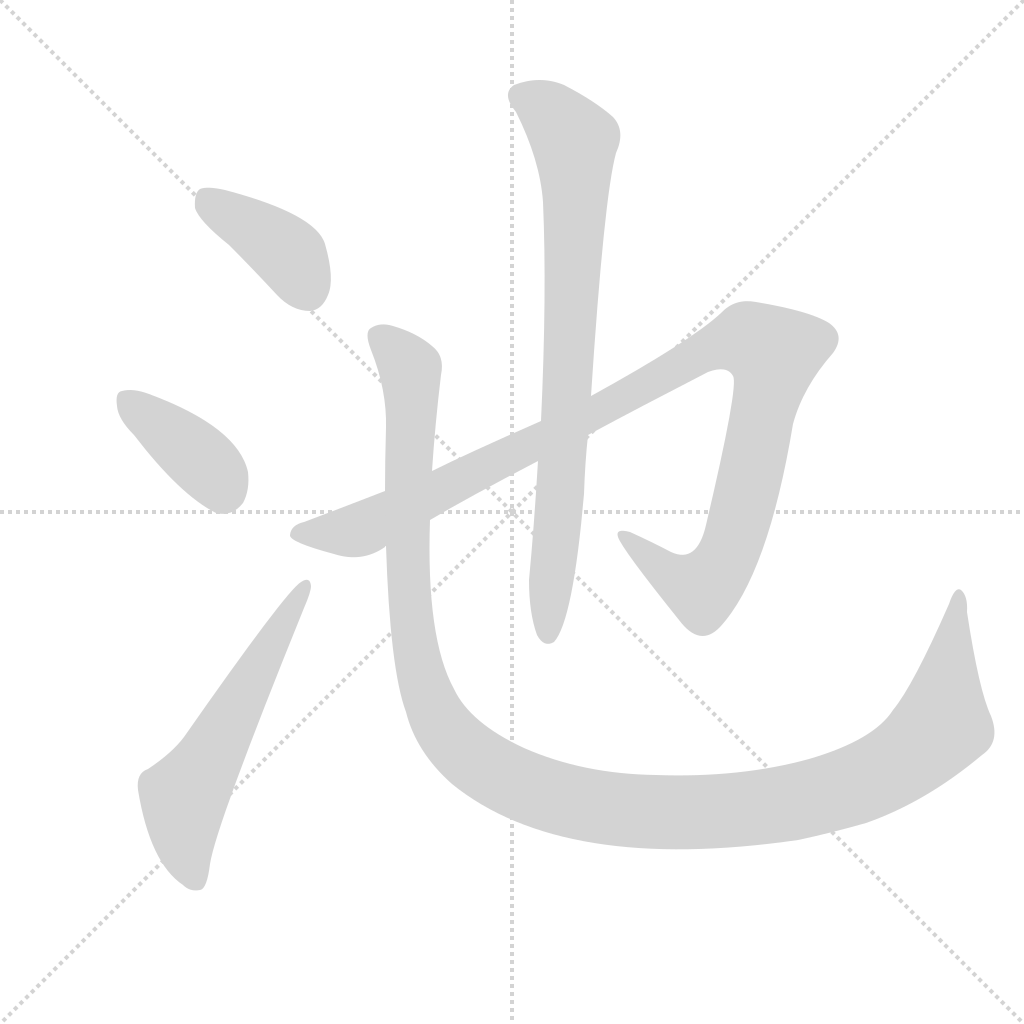
Pronounced chi.
Shuowen Jiezi (Shuowen): To govern. Kong Anguo stated: Still water is called a pool (chi).
Book of Rites (Zhouli), Office of Autumn: The Yong official is in charge of prohibitions concerning canals, sewers, drains, and pools.
Commentary: This refers to water channels controlled by embankments.
Book of Rites (Liji), Monthly Ordinances: Do not drain ponds and pools.
Commentary: Stored water is called a pond (bei); ground excavated to allow water flow is called a pool (chi).
Also, city moats are called channels and pools.
Book of Rites (Liji), Evolution of Rites: The city walls and moats serve as defenses.
Ban Gu, Rhapsody on the Western Capital (Xidu Fu): Opening the surrounding pools to form deep waters.
Commentary: A city with water surrounding it is called a pool (chi).
Also, the morning and evening pool, meaning the sea.
Mei Cheng, Letter Advising the King of Wu: To roam the curved terraces and look over the high roads is not as good as the morning and evening pool.
Commentary: Su Lin stated: Using the rising and ebbing of the sea as a pool.
Also, Xianchi, the name of a heavenly deity.
Dongfang Shuo, Seven Admonitions (Qi Jian): Belonging to heavenly fate and entrusting it to Xianchi.
Also, Xianchi, the name of a musical composition by the Yellow Emperor.
Also, the name of a musical composition by Yao, also known as Da Xian (Great Completion) or Xianchi.
Book of Rites (Zhouli), Office of Spring: The Grand Master of Music performs the Xianchi dance to sacrifice to the earthly spirits.
Commentary: Xianchi is Da Xian.
Book of Rites (Liji), Record of Music: The Xianchi is prepared.
Commentary: Xian means all. Calling it a pool (chi) implies the bestowal of grace, meaning there is no place where virtue is not bestowed.
Also, Xianchi, the name of a star, governing the five grains. See Records of the Grand Historian (Shiji), Treatise on the Celestial Offices.
Also, Kangchi, the name of a star located north of the Kang constellation, governing the reception and sending off of visitors. See Gan's Treatise on the Stars (Gan Shi Xing Jing).
Also, Erya, Commentary on the Explanation of Music: The upper part of the zither is called the pool, referring to its levelness; the lower part is called the shore, referring to its slope.
Also, a type of coffin decoration.
Book of Rites (Liji), Tan Gong: The pool decoration resembles layered eaves.
Subcommentary: The pool is the pool of a willow carriage. Woven bamboo is used to form a cage, covered with blue cloth to support the turtle-shell cover; this is called a pool, symbolizing the count of the layered eaves.
Also, Xiao Erya: Burying a coffin is called yi, and the pit for the coffin is called a pool.
Also, a copper pool, a vessel for catching drippings, made of copper.
History of the Former Han Dynasty (Qian Hanshu), Annals of Emperor Xuan: A golden mushroom with nine stems sprouted in the copper pool of the Hande Palace.
Also, in Taoist terminology, the crescent furnace in the kidneys is called the Jade Pool.
Yellow Court Scripture (Huangting Jing): The clear water of the Jade Pool irrigates the spiritual root; if one can practice this, one may attain longevity.
Also, an alternative name for the heart is the Middle Pool.
Yellow Court Scripture (Huangting Jing): In the Middle Pool dwells a gentleman in red robes, three inches below the fields where the spirit resides.
Also, among mount-makers, the seam of a scroll is called the Jade Pool.
Yang Shen, Jianhu Lu: In ancient mounting of scrolls, the silk attached after the title is called the tai; Tang dynasty scholars called it the Jade Pool.
Also, chachi, describing the appearance of birds in flight.
Book of Odes (Shijing), Beifeng: The swallows are flying, their wings uneven.
Also, Huangchi, a place name.
Spring and Autumn Annals (Chunqiu), 13th Year of Duke Ai: The Duke met the Marquis of Jin and the Viscount of Wu at Huangchi.
Also, Tianchi, a mountain name in Nanyang.
Also, a prefecture name.
Guang Yu Ji: Chizhou Prefecture was under Danyang in the Han dynasty, the fief of the Marquis of Shicheng in the Three Kingdoms Wu period, and called Qiupu or Chiyang during the Sui dynasty; it was called Chizhou during the Tang and Song dynasties.
Also, a surname. Mentioned as Chi Yuan, Magistrate of Zhongmou in the Han dynasty. See Comprehensive Customs (Fengsu Tong).
Also, pronounced tuo. Interchangeable with tuo.
Shuowen Jiezi (Shuowen): A tributary of the Yangtze River.
Also, Huotuo, a water name in the Bingzhou region.
Book of Rites (Zhouli), Office of Summer, Zhifang Shi: Bingzhou, its river is the Huotuo.
Commentary: The Huotuo emerges from Lucheng. Chi is pronounced tuo. Note: Rites Vessels writes it as Echi, Classic of Mountains and Seas (Shanhaijing) writes it as Huotuo, Strategies of the Warring States (Zhan Guo Ce) writes it as Hutu, and the Curses of Chu inscriptions write it as Etuo; the sounds and meanings are identical.
Also, beichi, sometimes written as po tuo.
Kanmiu Zhengsu: Beichi is read like po tuo, meaning sloping or winding.
Also, Chu Ci, Nine Songs (Jiu Ge): Bathing with you at Xianchi, drying your hair on the slopes of the sun.
Yang Xiong, Rhapsody on the Feather Hunt (Yu Lie Fu): We gathered at the Quiet and Obscure Hall to overlook the precious pool, irrigated by the Qi and Liang rivers, and overflowing into the Yangtze and Yellow rivers.
Commentary: Chi is read as tuo.
Also, pronounced che.
Book of Rites (Liji), Tan Gong: The host has already offered sacrifices and performed the ritual (dian che).
Commentary: Dian chi should be read as dian che.