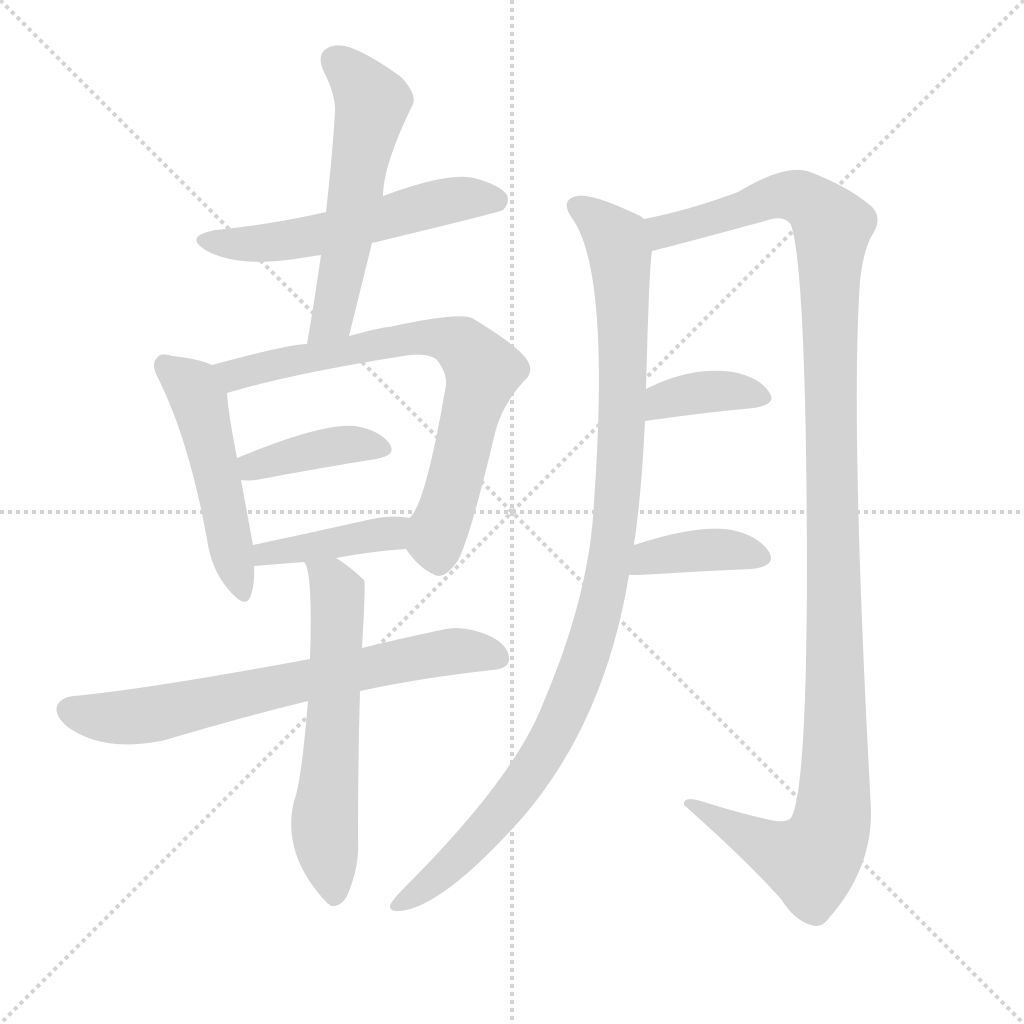
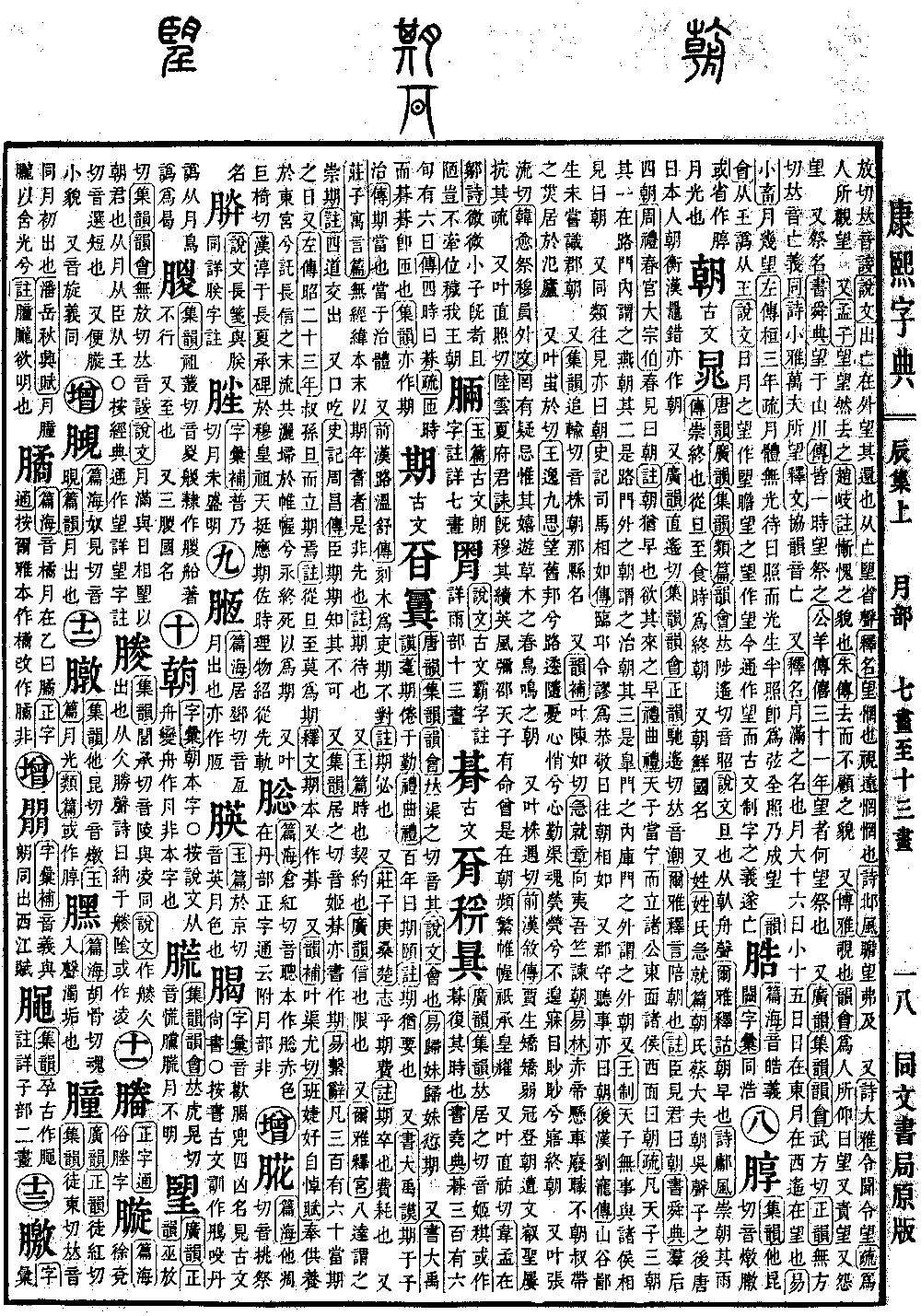
Chen Collection, Upper Volume
Radical: Moon (yuè)
Kangxi Strokes: 12
Page 506, Entry 03
The ancient character is written as cháo.
According to Tang Rhyme (Tangyun), Broad Rhyme (Guangyun), Collection of Rhymes (Jiyun), Classified Anthology (Leipian), and Dictionary of Rhymes (Yunhui), the pronunciation is zhao.
Explained in Explaining Graphs and Analyzing Characters (Shuowen Jiezi) as: morning. The character structure consists of the gan component on the side, and zhou as the phonetic element.
Explained in Literary Expositor (Erya): chao means early.
Book of Odes (Shijing): It is written in the Yong Wind section, "It rained for the whole morning." The commentary states: chong means to end. The duration from dawn until breakfast is referred to as "the whole morning."
Also refers to Korea (Chao-xian), a country name.
It is also a surname. Records from the Urgent Need for Surnames (Xingshi Jijiu Pian) state: The Chao clan are the descendants of Chao Wu, a grand officer of the State of Cai (courtesy name Shengzi). During the Tang Dynasty, there was a Japanese individual named Chao Heng. In the Han Dynasty, Chao Cuo was also written as chao.
According to Broad Rhyme (Guangyun), the pronunciation is chao. According to Collection of Rhymes (Jiyun), Dictionary of Rhymes (Yunhui), and Corrected Rhymes (Zhengyun), the pronunciation is also chao.
Explained in Literary Expositor (Erya): to pay an audience. The commentary notes: A subject paying respects to their ruler is called chao.
Book of Documents (Shangshu): Records "The various princes came to pay audience four times."
Rites of Zhou (Zhouli): Records that audience with the Son of Heaven in the spring is called chao. The commentary notes: chao is like the meaning of "early." It expresses the hope that the feudal lords will come to pay their audience early.
Book of Rites (Liji): Records that the ceremony where the Son of Heaven stands between the gate and the screen, with the dukes facing east and the feudal lords facing west, is called chao. The sub-commentary explains: The Son of Heaven had three places for conducting government: one inside the road gate, called the Yan-chao (leisure audience); the second outside the road gate, called the Zhi-chao (administrative audience); the third inside the Gao gate and outside the Ku gate, called the Wai-chao (outer audience).
Also, according to Book of Rites (Liji), when the Son of Heaven meets with feudal lords in the absence of major affairs, it is also called chao.
Also, meetings between peers can be called chao. Records from the Records of the Grand Historian (Shiji), Biography of Sima Xiangru: The magistrate of Linqiong feigned respect and went to visit Sima Xiangru every day.
Also, the hall where a governor handles official business is called chao. Records from the Book of the Later Han (Hou Hanshu), Biography of Liu Chong: People from the wild and crude regions had never seen the hall of a governor.
According to Collection of Rhymes (Jiyun), the pronunciation is zhu. It refers to Zhaona, a county name.
According to Rhyme Supplement (Yunbu), the pronunciation is chen. Urgent Need (Jijiu Zhang): "Approaching Yi Wu, Zhu Jian chao." Classic of Changes Forest (Yilin): "The Red Emperor hangs his carriage; duties are abandoned, and there is no chao. The calamity of Shu Dai, residing in Fan Lu."
The pronunciation is also chi. Nine Longings (Jiushi) by Wang Yi: "Gazing at the old state, the road is winding; the sorrowful heart is anxious, the mind is diligent. The soul is solitary, unable to sleep; the eyes are dim, awake until the end of the morning."
The pronunciation is also zhang. Miscellaneous Poem by Han Yu: "Without suspicion or jealousy, only playing and roaming. The spring of plants and trees, the morning of birdsong."
The pronunciation is also zhu. Records from the History of the Former Han (Qian Han Shu), Narrative Chapter: "Jia Yi was spirited; at twenty he ascended to the chao. Encountering the wise and sage Emperor Wen, he repeatedly presented his memorials."
The pronunciation is also zhi. Dirge for Administrator Xia by Lu Yun: "Upon fulfilling his performance, his heroic spirit fills the Shao. The Son of Heaven gives his command, thus he is in the chao. Frequently in the royal curtains, respectfully receiving the imperial brilliance."
The pronunciation is also zhi. Poem at Zou by Wei Meng: "Small and humble, already old and crude. How can I pull at my position, and defile my royal dynasty."