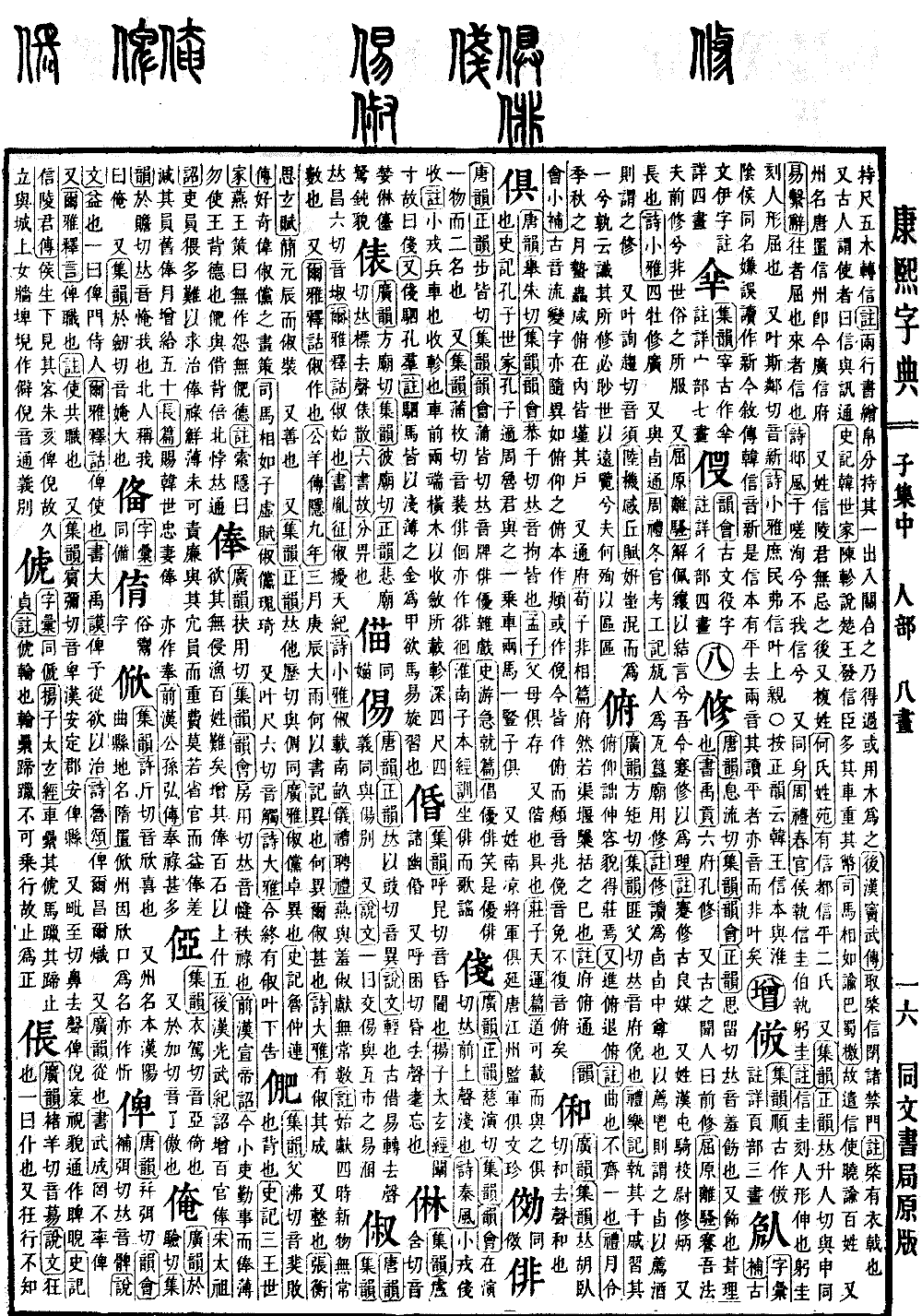
Zi Collection, Middle Volume
Radical: Person (ren)
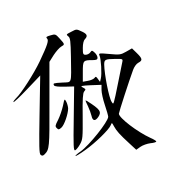
Chu
Kangxi stroke count: 10
Page 106, Number 17
Tang Rhymes (Tangyun) and Collected Rhymes (Jiyun) note the fanqie pronunciation as ch-ang and l-iu, pronounced similarly to shu.
According to the Erya - Explaining Words (Erya), chu means to begin.
The Book of Documents (Shujing) states in the Punitive Expedition of Yin (Yinzheng) that he began to throw the celestial laws into confusion.
The Book of Odes (Shijing) states in the Minor Odes (Xiaoya) that we begin work on the southern acres.
The Book of Etiquette and Ceremonial (Yili) states in the Rites of Missions (Pinli) that at banquets when presenting delicacies for the first time, the offerings have no fixed quantity. The commentary explains that this refers to the first offering of new seasonal items, which has no fixed number.
Also, according to the Erya, chu means to act or build.
The Gongyang Commentary (Gongyangzhuan) states regarding the ninth year of Duke Yin that on the day of gengchen in the third month, it snowed heavily. Why was this recorded? To record an anomaly. What was the anomaly? It began with great intensity.
The Book of Odes states in the Major Odes (Daya) that he began the construction of the city wall.
Also means to arrange or prepare.
Zhang Heng in the Rhapsody on Contemplating the Mystery (Sixuan Fu) writes that on an auspicious day, I prepare my luggage.
Also means good.
Also, the Collected Rhymes and the Correct Rhymes (Zhengyun) note the fanqie pronunciation as t-a and l-i. It is synonymous with the term ti.
The Expanded Erya (Guangya) states that the term chutang means outstanding or extraordinary.
The Records of the Grand Historian (Shiji) states in the Biography of Lu Zhonglian that he was fond of books and strategies that were grand, unusual, and unrestrained.
Sima Xiangru in the Rhapsody of Sir Vacuous (Zixu Fu) describes things as unrestrained, magnificent, and extraordinary.
Also used as a rhyming word with the fanqie pronunciation of ch-i and l-iu, pronounced like chu.
The Book of Odes states in the Major Odes that a good end follows a good beginning. Here it rhymes with the word gao.
Textual Research:
In the Gongyang Commentary regarding the ninth year of Duke Yin, the text stating it rained heavily has been corrected to add the word snow after the word rain, in accordance with the original source.
In the Book of Odes, Major Odes, the word cheng meaning completion has been corrected to the word cheng meaning city wall, in accordance with the original source.