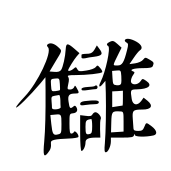
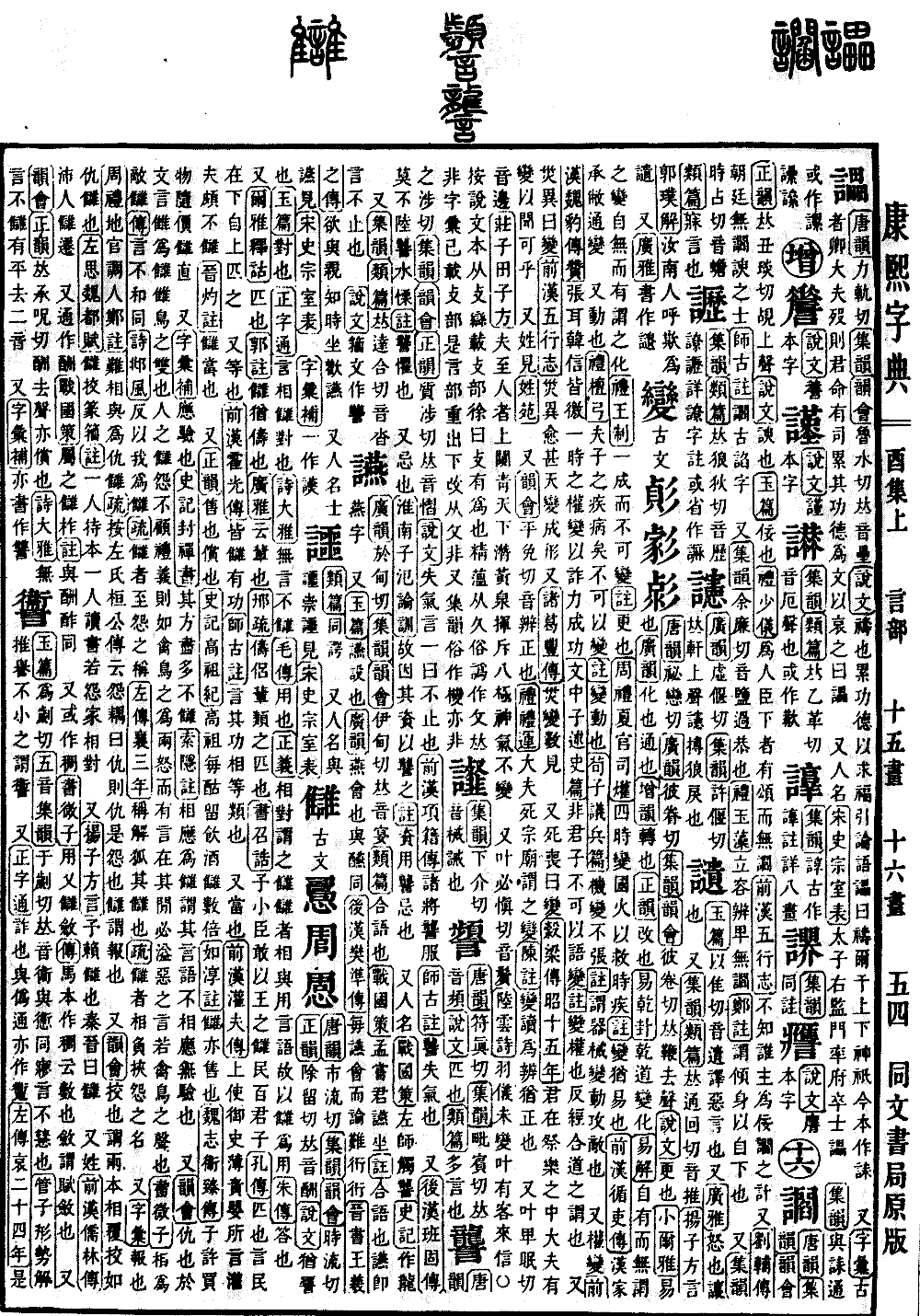
You Collection, Upper Volume
Radical: Speech (yán)
Chou
Kangxi Strokes: 23
Page 1186, Entry 21
Ancient form. Pronounced chou.
Shuowen Jiezi (Shuowen): Means to follow or correspond.
Yupian (Yupian): Means to confront.
Zhengzitong (Zhengzitong): To speak in confrontation.
Book of Odes (Shijing), Great Odes (Daya): There is no word that does not have a response.
Mao Commentary (Mao Zhuan): Means to use.
Correct Meaning (Zhengyi): To face one another is called chou. Chou means to interact using speech, therefore chou is used to mean to use.
Zhu Commentary (Zhu Zhuan): Means to answer.
Also, Erya: Explaining Ancient Terms (Erya): Means a match.
Guo Commentary (Guo Zhu): Chou is like a companion (chou).
Guangya (Guangya): Means a class or group.
Xing Sub-commentary (Xing Shu): Refers to the match of companions or groups.
Book of Documents (Shujing), Announcement of Shao (Zhaogao): I, a minor subject, dare to take the people of the King, and the hundred noblemen.
Kong Commentary (Kong Zhuan): Means a match; it means the people are below, and the ruler matches them from above.
Also, to be equal.
Book of Han (Qianhan), Biography of Huo Guang: All were matched with those who had merit.
Shigu Commentary (Shigu Zhu): It means their merits were equal.
Also, to correspond or be appropriate.
Book of Han (Qianhan), Biography of Guan Fu: The Emperor ordered the Censor to reprimand what Ying had stated, but Guan Fu did not fully respond.
Jin Zhuo Commentary (Jin Zhuo Zhu): Chou means to be appropriate.
Also, Zheng Yun: Means to sell or to repay.
Records of the Grand Historian (Shiji), Annals of Gaozu: Whenever Gaozu went to drink, the sales were several times higher than usual.
Ru Chun Commentary (Ru Chun Zhu): Chou also means to sell.
Records of the Three Kingdoms (Weizhi), Biography of Wei Zhen: Buying goods, one follows the price to repay the value.
Also, Zihuibu (Zihuibu): Means to be verified or fulfilled.
Records of the Grand Historian (Shiji), Treatise on the Feng and Shan Sacrifices (Fengshan Shu): Their methods were mostly not fulfilled.
Suoyin Commentary (Suoyin Zhu): To correspond is called chou; it means their words and reality did not correspond, thus they were not verified.
Also, Yunhui (Yunhui): Means an enemy. In terms of characters, the two birds (chou) make up chou. The two birds (chou) represent a pair of birds. When humans have enmity, they disregard ritual and righteousness, acting like birds, both angry and uttering words, which overflow with malicious speech like the cries of birds.
Book of Documents (Shujing), Announcement of Weizi (Weizi): To be enemies with one another.
Commentary: Means to not be in harmony.
Book of Odes (Shijing), Odes of Bei (Beifeng): Instead, they treat me as an enemy.
Sub-commentary (Shu): Chou is a term for supreme enmity.
Zuo Tradition (Zuozhuan), Third Year of Duke Xiang (Xiang 3): Named Xie Hu as his enemy.
Sub-commentary (Shu): Chou is the name for those who bear enmity against one another.
Also, Zihui (Zihui): Means to report or retaliate.
Rites of Zhou (Zhouli), Earth Office, Section on Adjusters (Tiaoren), Zheng Commentary: It is difficult to be enemies with one another.
Sub-commentary (Shu): According to the Zuo Tradition, Duke Huan’s annals state that a partner in resentment is called chou, so chou means resentment; chou means to retaliate.
Also, Yunhui (Yunhui): To check or compare. It refers to two texts being compared against each other as if they were enemies.
Zuo Si, Rhapsody on the Capital of Wei (Weidu Fu): Checking the Seal and Clerical scripts.
Commentary: One person holds the original text, the other reads it, like enemies facing one another.
Also, Yangzi: Dialect (Fangyan): I rely on the match. In Qin and Jin, it is called chou.
Also, a surname.
Book of Han (Qianhan), Biography of Confucian Scholars (Rulin Zhuan): Chou Qian of Pei.
Also, interchangeably used as chou (to toast).
Strategies of the Warring States (Zhanguoce): Assigned to toast one another.
Commentary: The same as toasting or exchanging cups.
Also, sometimes written as chou (dense).
Book of Documents (Shujing), Announcement of Weizi (Weizi): To govern and collect.
Commentary: The Ma version of the text uses chou, meaning a number; to collect means to levy taxes.
Also, Yunhui (Yunhui) and Zhengyun (Zhengyun): Pronounced chou (falling tone). Also means to repay.
Book of Odes (Shijing), Great Odes (Daya): There is no word that does not have a response. There are both level and falling tone pronunciations.
Also, Zihuibu (Zihuibu): Also written as chou (variant form).