Chen Collection, Lower Volume
Radical: Compare (bǐ)
Kangxi strokes: 9
Page 591, Entry 04
Pronounced mì.
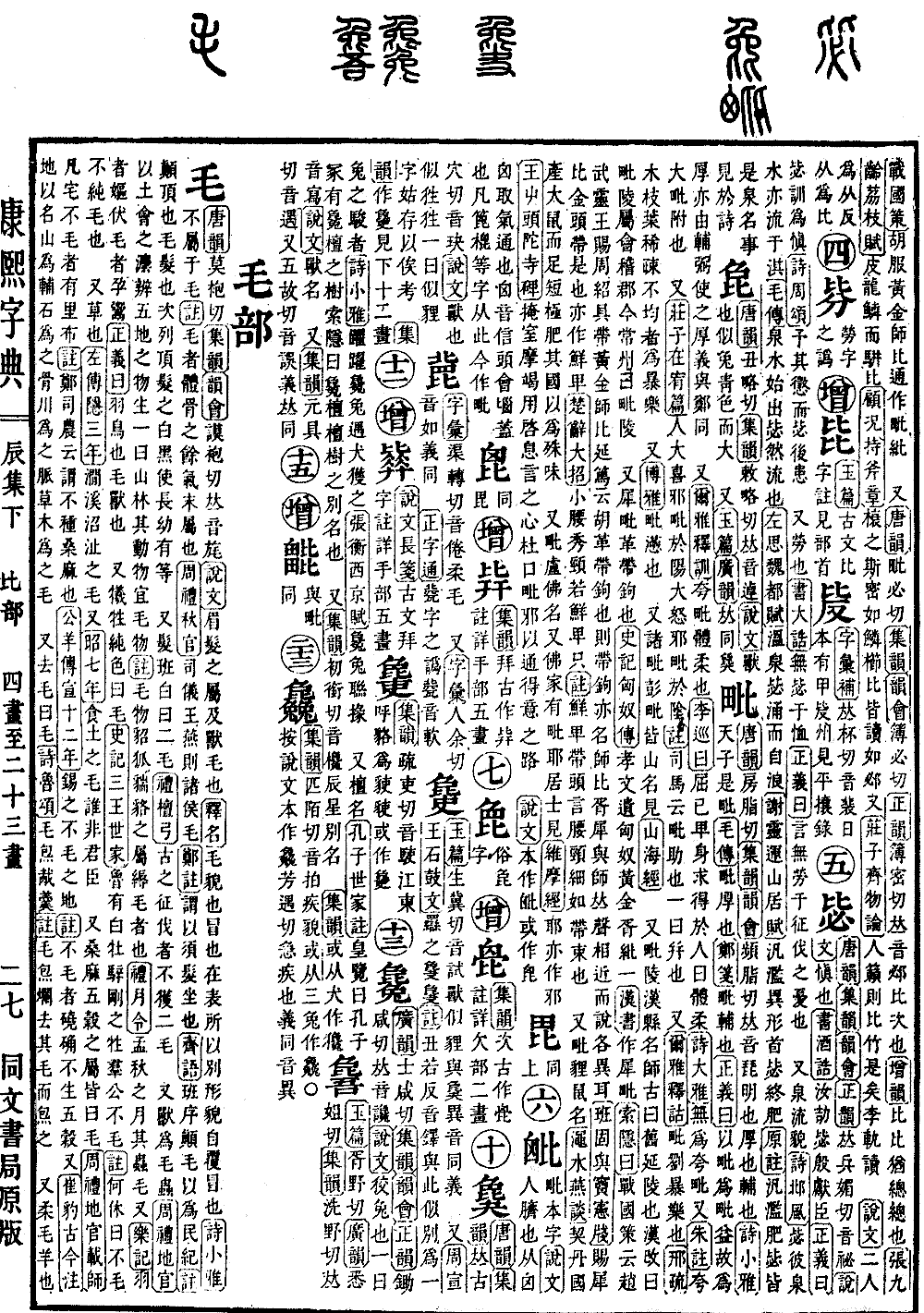
Shuowen Jiezi (Shuowen) defines this as caution. In the Book of Documents (Shangshu), chapter Wine Announcement (Jiugao), it states: You should diligently caution the worthy officials of Yin. The Correct Meaning commentary states: Bi is interpreted as caution. In the Book of Odes (Shijing), section Zhou Odes (Zhousong), it states: I shall take warning and be cautious against future calamities.
Also means to labor or toil. In the Book of Documents (Shangshu), chapter Great Announcement (Dagao), it states: Do not toil over anxieties. The Correct Meaning commentary states: This means do not be burdened by the worries of military expeditions.
Also refers to the appearance of flowing spring water. In the Book of Odes (Shijing), section Odes of Bei (Beifeng), it states: The spring water flows (bi), also flowing into the Qi river. The Mao Commentary states: When spring water first emerges, it flows in a bi manner. Zuo Si, in his Rhapsody on the Capital of Wei (Weidu Fu), writes: The warm springs bubble up (bi) and surge of their own accord. Xie Lingyun, in his Rhapsody on Dwelling in the Mountains (Shanju Fu), writes: Overflowing in strange forms, starting as bi and ending as overflowing. The original annotation notes: Fanlan and feibi are both names of springs; the account is found in the Odes.