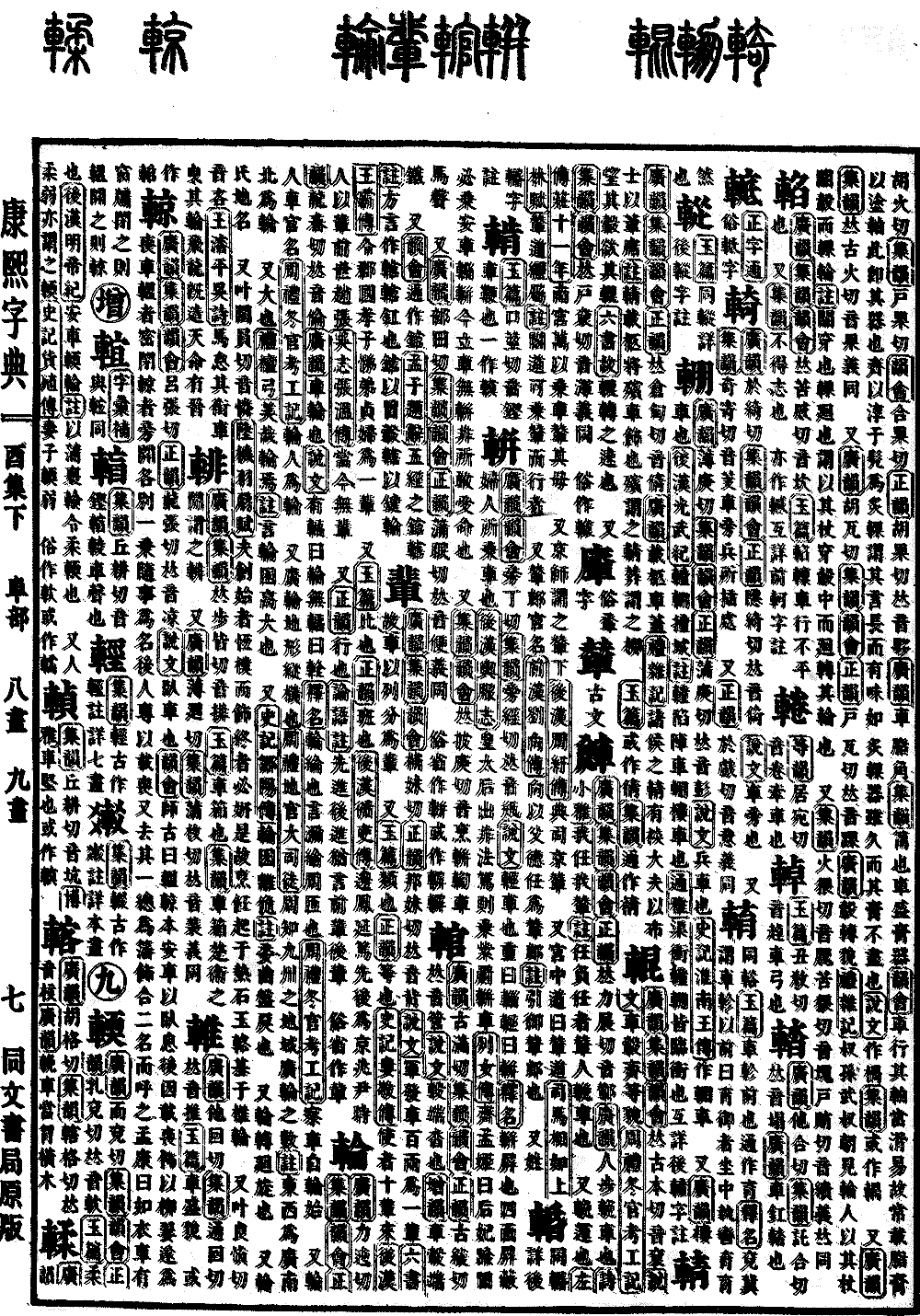
You Collection, Lower Volume
Radical: Carriage (chē)
Kangxi Strokes: 15
Page 1245, Entry 19
Pronounced bei.
According to the Explaining Graphs and Analyzing Characters (Shuowen): A group of one hundred military carriages constitutes a bei.
According to the Six Categories of Writing (Liushugu): Carriages arranged in columns are referred to as bei.
Also, according to the Jade Chapters (Yupian): A category.
According to the Correct Rhymes (Zhengyun): A rank or class.
According to the Records of the Grand Historian (Shiji), Biography of Lou Jing: Ten groups of envoys arrived.
According to the History of the Later Han (Hou Hanshu), Biography of Wang Ba: Ordered the commanderies and kingdoms to group the filial sons, obedient younger brothers, and chaste women into one class.
Also, according to the Jade Chapters (Yupian): A comparison.
According to the Correct Rhymes (Zhengyun): A sequence or row.
According to the History of the Later Han (Hou Hanshu), Biography of Meritorious Officials: Bian Feng and Yan Du served successively as Governors of Jingzhao; people of that time compared them to the ranks of Zhao and Zhang of the previous age.
According to the Records of the Three Kingdoms (Wuzhi), Biography of Zhang Wen: In the present time, there is no equal.
Also, according to the Correct Rhymes (Zhengyun): A generation or succession.
According to the Commentary on the Analects (Lunyu Zhu): Those who advanced earlier and those who advanced later; this is what is meant by senior generation and junior generation. It is commonly abbreviated as the variant form (bèi).