Mao Collection, Middle Volume
Radical: Hand (shǒu)
Kangxi stroke count: 9
Page 423, Entry 08
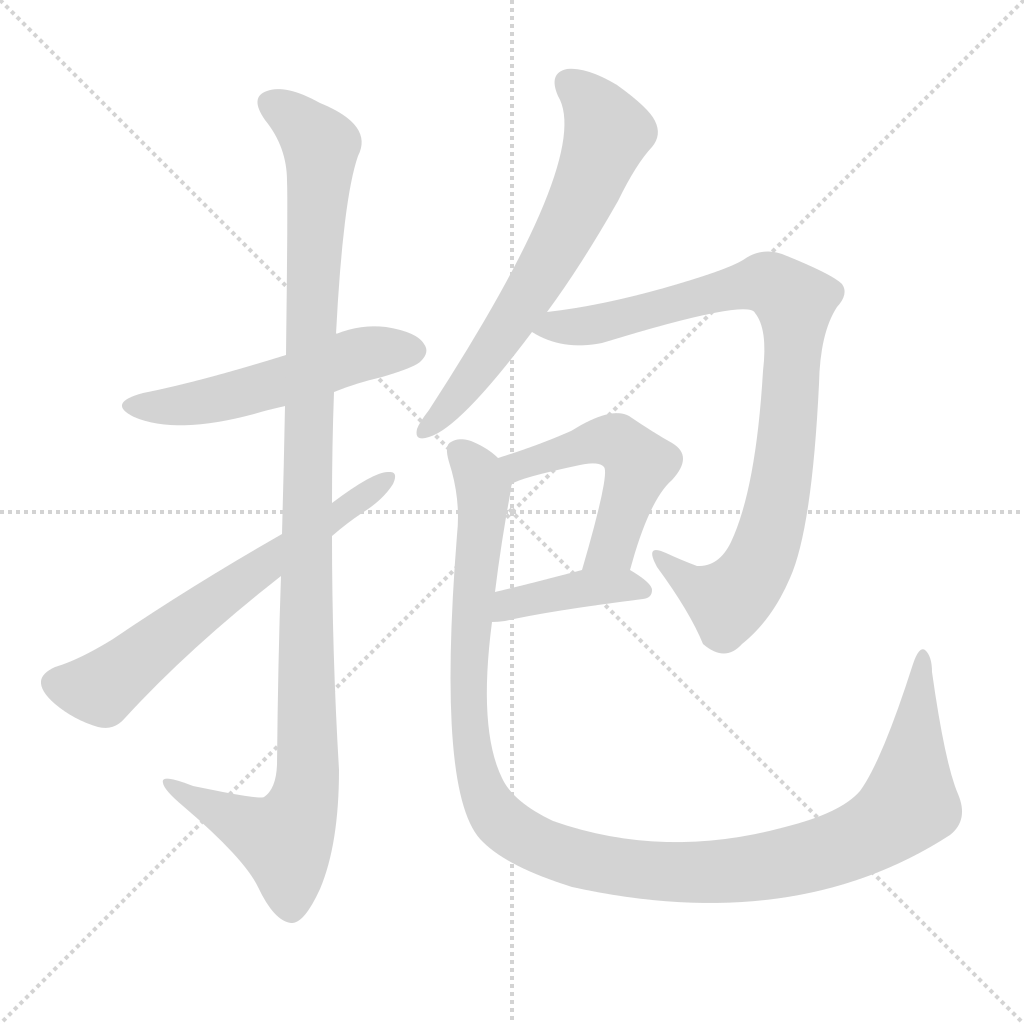
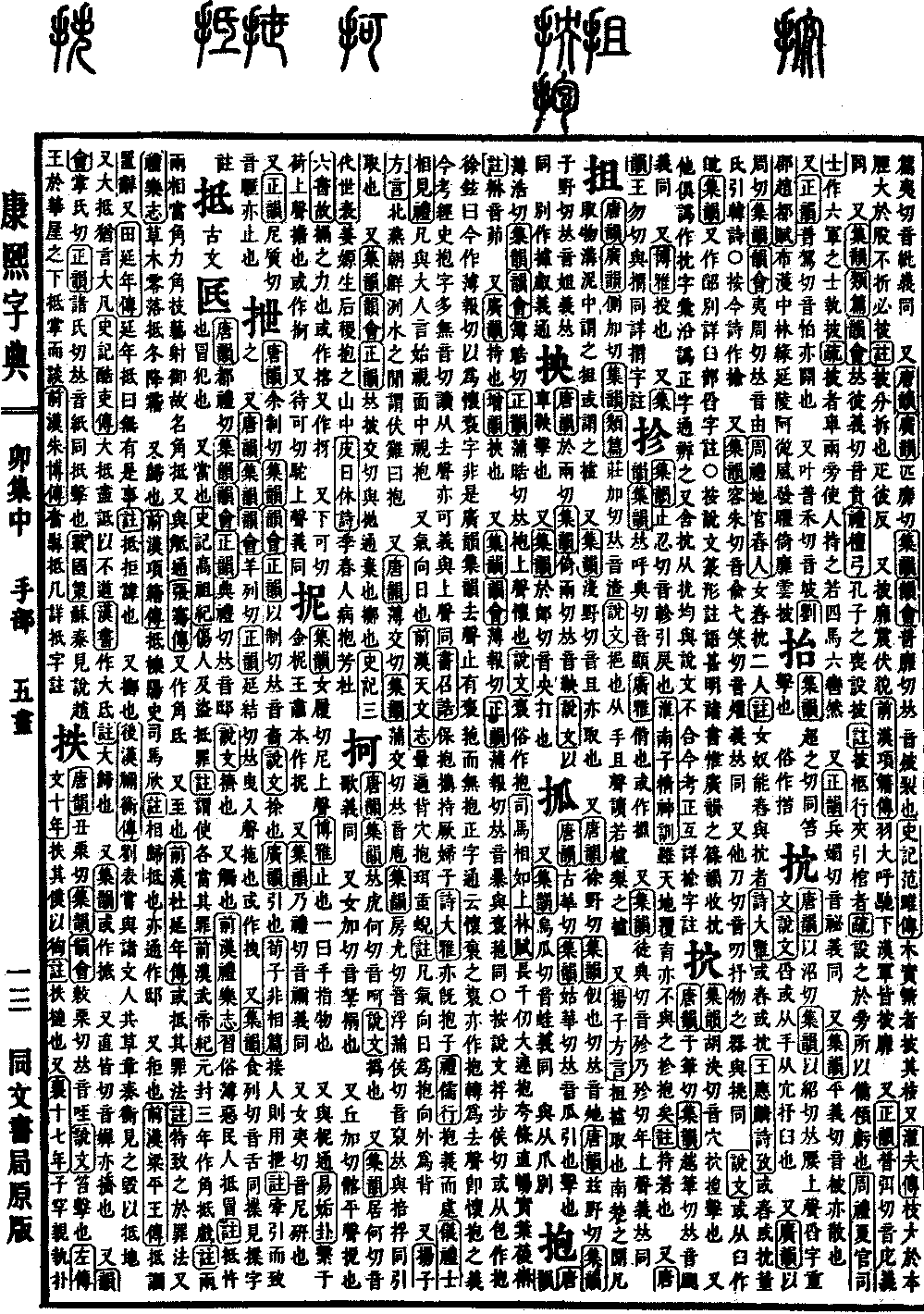
Pronounced bao (rising tone). Meaning: to embrace or hold in the arms. In the Explaining Graphs and Analyzing Characters (Shuowen Jiezi), it is written as a variant form (bao), and it is commonly written as the character here. In the Upper Forest Rhapsody (Shanglin Fu) by Sima Xiangru: Reaching heights of a thousand ren, the tree trunks are so thick they require several people to join hands and embrace them. The branches spread out straight, and the fruits and leaves are lush. Note: The character mao is pronounced the same as mao.
Also, in the Broad Rhymes (Guangyun), it means to hold or grasp. In the Supplemented Rhymes (Zengyun), it means to carry under the arm.
Also, pronounced bao (falling tone). It shares the same meaning as two variant forms (bao) and (bao). According to the Explaining Graphs and Analyzing Characters (Shuowen Jiezi), the character fou is pronounced bou-hou. Some editions write it with the element bao to form the character here. Xu Xuan stated: It is now pronounced bao (falling tone) when used to mean embracing, but this is incorrect. The Broad Rhymes (Guangyun) and the Collected Rhymes (Jiyun), under the falling tone category, contain only the variant forms (bao) and (bao), and do not contain the character here. The Rectification of Characters (Zhengzitong) states: The character (bao) used for embracing is also written as the character here, and when the reading is shifted to the falling tone, it denotes embracing. Examining the classics and historical records, the character here often lacks phonetic notation; reading it in the falling tone is acceptable, as the meaning is the same as when read in the rising tone.
In the Book of Documents (Shujing), specifically the Announcement of the Duke of Shao (Zhaogao): To protect, embrace, assist, and lead their wives and children. In the Book of Odes (Shijing), specifically the Greater Odes (Daya): To have already given birth to a child. In the Book of Rites (Liji), specifically the Conduct of Scholars (Ruxing): To hold firmly to moral principles while residing somewhere. In the Ceremonial Rites (Yili), specifically the Etiquette of Meeting for Scholars (Shi Xiangjian Li): When speaking to someone of higher status, one should initially look at the person’s face, and in the middle of the conversation, look at the person’s chest area.
Also refers to cloud formations oriented toward the sun. In the History of the Former Han (Qian Hanshu), specifically the Treatise on Astronomy (Tianwen Zhi): When there is a solar halo, there may be gaps facing or backing the sun, as well as encircling halos, ear-like glows, and rainbows. Note: Any cloud formation oriented toward the sun is called bao, while those facing away are called bei.
Also, according to the Dialects (Fangyan) by Yang Xiong: In the regions of Northern Yan, Chaoxian, and the Lie River, a chicken hatching eggs is called bao.
Also, pronounced pao.
Also, pronounced fu.
Also, pronounced pou. It is identical in meaning to the characters pou and fou. It means to draw in or to gather together.
Also, interchangeable with the character pao. It means to discard or to cast away. In the Records of the Grand Historian (Shiji), specifically the Table of the Three Generations (Sandai Shibiao): Jiang Yuan gave birth to Houji and abandoned him in the mountains. In a poem by Pi Rixiu: In the late spring season, someone became ill and abandoned the fragrant sweet grass.