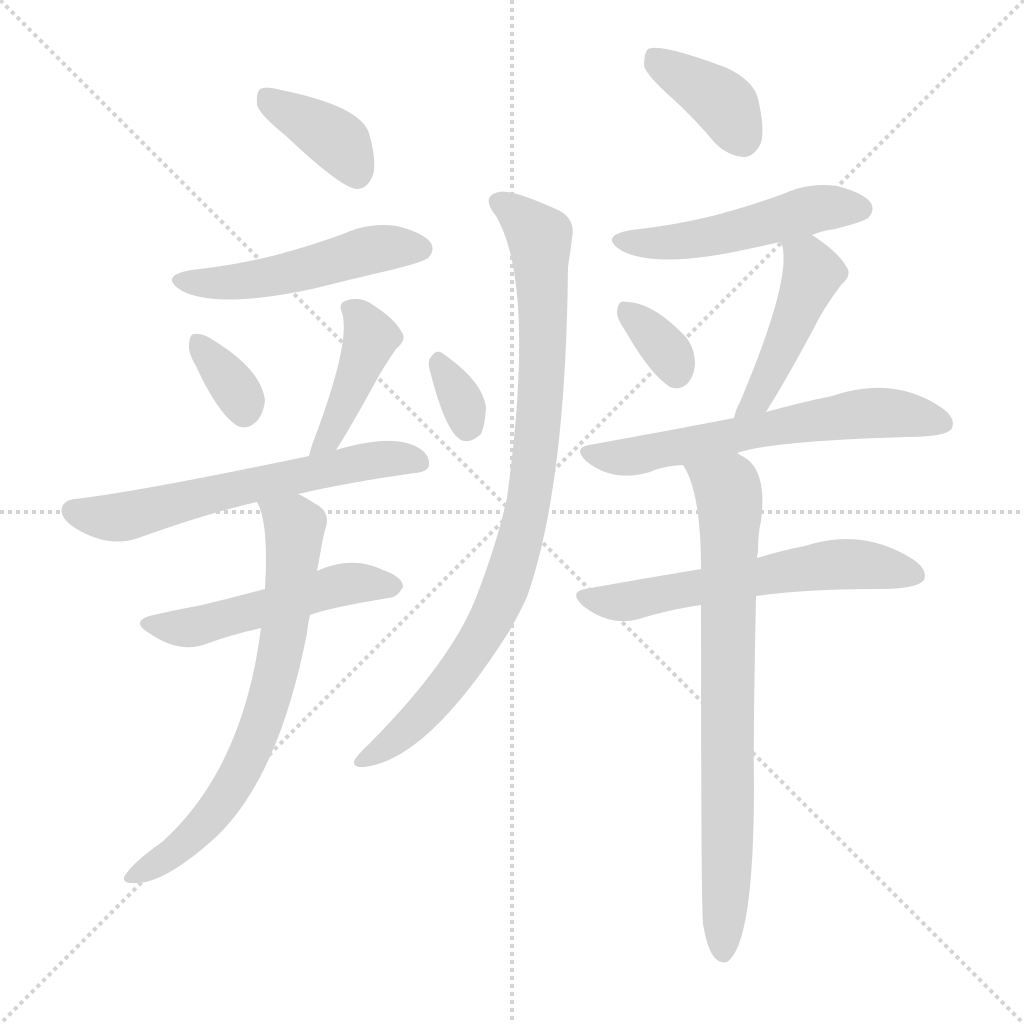
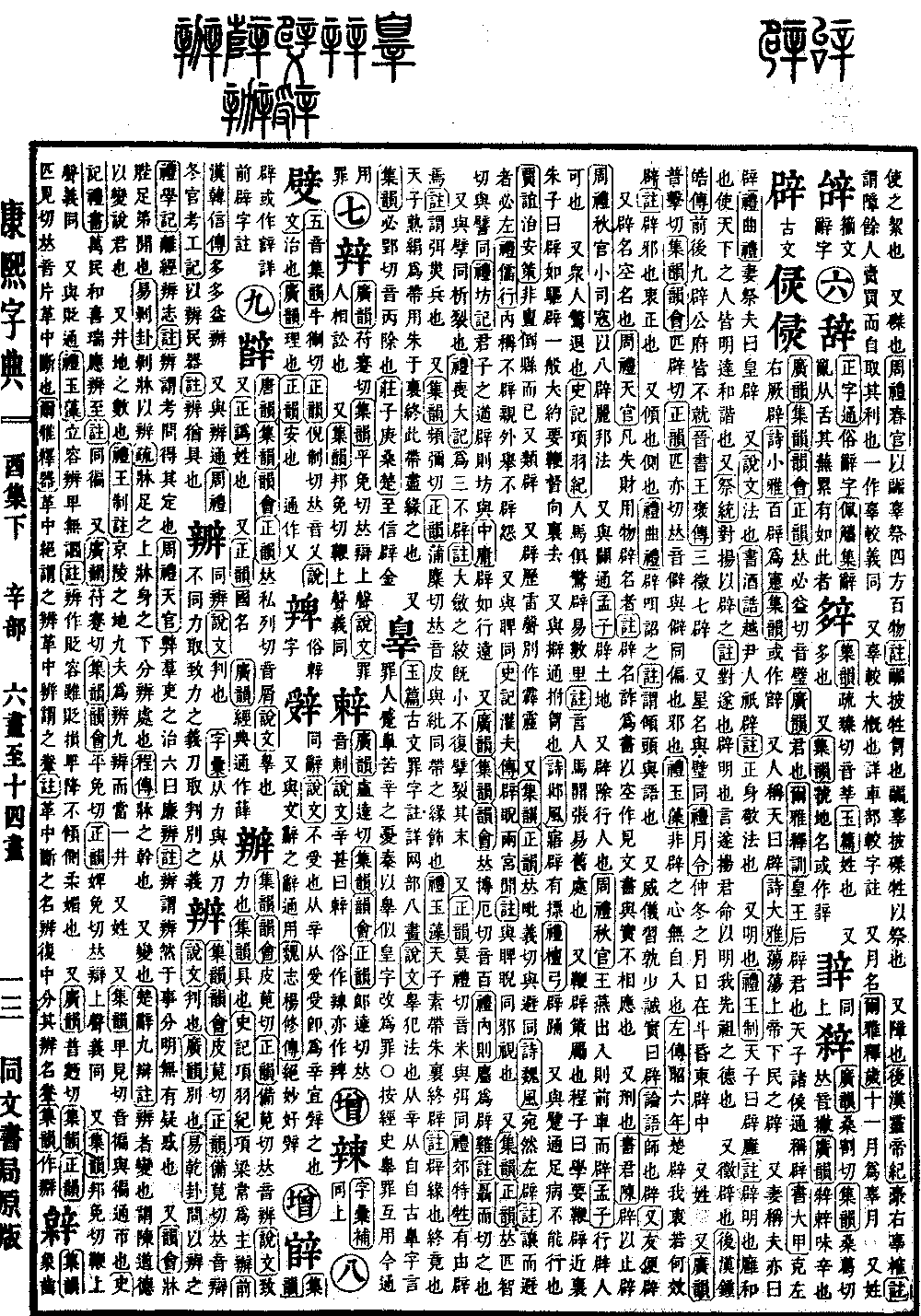
You Collection, Lower Volume
Radical: Bitter (xīn)
Kangxi strokes: 16
Page 1251, Entry 20
Pronounced bian (falling tone).
Shuowen Jiezi (Explanation of Graphs and Analysis of Characters): To judge or differentiate.
Guangyun (Broad Rhymes): To distinguish.
Book of Changes (Yijing), Hexagram Qian: To inquire in order to distinguish.
Book of Rites (Liji), Record of Learning (Xueji): To separate the classic and distinguish the will. Commentary: To distinguish refers to attaining a definitive conclusion through investigation and questioning.
Rites of Zhou (Zhouli), Offices of Heaven: To settle the administration of the various officials; the sixth is to be incorrupt and discerning. Commentary: To distinguish refers to the ability to see matters clearly and distinctly, without confusion.
Also, Yinhui (Collection of Rhymes): Refers to the part between the legs of a bed and the bed frame.
Book of Changes (Yijing), Hexagram Bo: Stripping the bed at its junction. Sub-commentary: The location above the bed legs and below the bed frame that can be distinguished. Cheng’s Commentary: Refers to the framework of the bed.
Also refers to change. Chu Ci (Verses of Chu), Nine Changes (Jiubian) Commentary: To distinguish means to change, referring to persuading a ruler through moral transformation.
Also refers to a unit of the well-field system. Book of Rites (Liji), Royal Regulations (Wangzhi) Commentary: In the Jingling region, nine households equal one bian, and nine bian are equivalent to one well.
Also used as a surname.
Also, Jiyun (Collection of Rhymes): Pronounced bian (falling tone). Interchangeable with bian (pervasive/everywhere). Denotes being thorough or universal.
Records of the Grand Historian (Shiji), Treatise on Rites: The myriad people are harmonious and joyful, and auspicious signs arrive everywhere. Commentary: Same as bian (pervasive).
Also, Guangyun (Broad Rhymes): Pronounced bian (rising tone). Meaning is the same.
Also, Jiyun (Collection of Rhymes): Pronounced bian (rising tone). Meaning is the same.
Also used interchangeably with bian (to demote/debase). Book of Rites (Liji), Jade Precepts (Yuzao): Standing posture is reserved, without obsequiousness. Commentary: Bian is written as bian (to demote). Although the demeanor is humble and restrained, it is not crooked or flattering.
Also, Guangyun (Broad Rhymes): Pronounced pian (falling tone). Refers to leather breaking in the middle. Erya (Approaching Elegance), Explaining Objects: When leather breaks in the middle it is called bian, and when it is divided again from the middle of the bian it is called xuan. Commentary: The name for when leather is broken in the middle is bian, and the name for when that bian is further divided is xuan. Jiyun (Collection of Rhymes) writes it as the character with the leather radical.