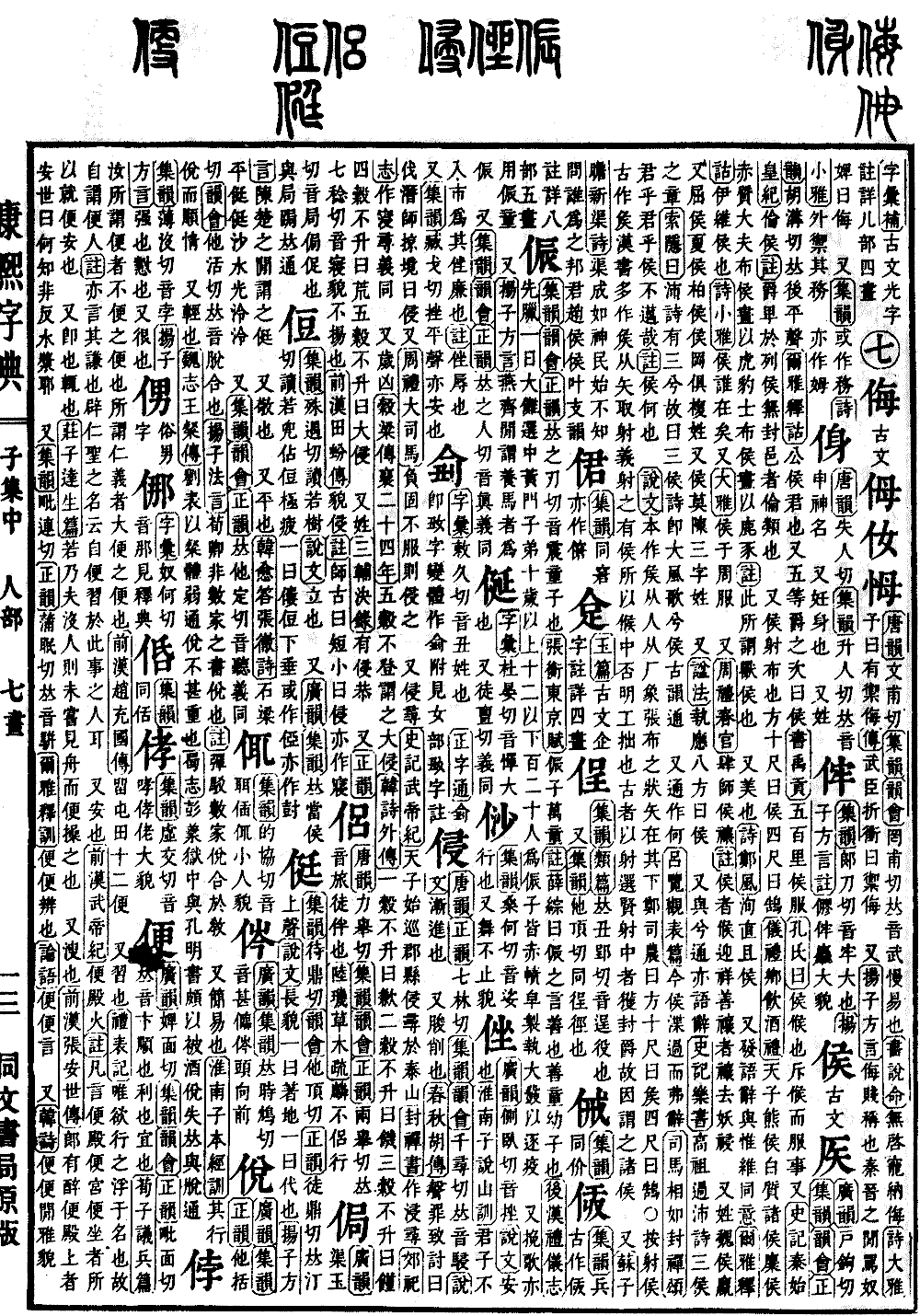
Zi Collection, Middle Volume
Radical: Person (rén)
便
Kangxi stroke count: 9
Page 103, Entry 32
Pronounced biàn. Meaning: smooth, convenient, suitable.
Xunzi (Xunzi), Discussion on Military Affairs: What you call convenient is actually a convenience that is not convenient. What is called benevolence and righteousness is the true great convenience.
History of the Former Han (Qian Han Shu), Biography of Zhao Chongguo: Leaving behind troops for agricultural colonies has twelve benefits.
Also indicates familiarity.
Book of Rites (Liji), Record of Expressions: Only hoping one's conduct exceeds one's reputation. Thus one calls oneself a familiar person. Note: This also indicates humility. Avoiding the name of the benevolent and the saintly, saying one is merely a person familiar with this matter.
Also indicates ease and comfort.
History of the Former Han (Qian Han Shu), Annals of Emperor Wu: The convenience hall caught fire. Note: Anything referred to as a convenience hall, convenience palace, or convenience seat refers to something intended for convenience and comfort.
Also indicates immediately or then.
Zhuangzi (Zhuangzi), Mastery of Life: As for those who are skilled at diving, even if they have never seen a boat, they can immediately operate it.
Also indicates urination.
History of the Former Han (Qian Han Shu), Biography of Zhang Anshi: A court official became drunk and urinated in the convenience hall; Zhang Anshi said: How do you know he did not spill water or broth?
Also pronounced pián.
Erya (Erya), Explanation of Teachings: Bianbian refers to being skilled at speech and debate.
Analects (Lunyu): Skilled at speech and debate.
Also, in the Han Poetry (Han Shi): Bianbian refers to a relaxed and elegant appearance.
Also refers to a plump appearance.
Book of the Later Han (Hou Han Shu), Biography of Bian Shao: Bian Xiaoxian had a large, plump belly.
Also refers to pianpi, meaning excessive flattery and servility.
Book of Documents (Shangshu), Charge to Jiong: Flattering and fawning, obsequious and sycophantic.
Also a surname. In the Han Dynasty, there was a Minister of the Imperial Treasury named Bian Yuecheng.
Also used interchangeably with the character for level or flat (píng).
Book of Documents (Shangshu), Canon of Yao: To regulate and harmonize the people.
Records of the Grand Historian (Shiji), Annals of the Five Emperors: Written as the character for convenience (biàn). Refer to the entry for the character for level (píng) for mutual reference.
Also pronounced pín.
Lin, Rhapsody on the Agate Bowl: Jade wine vessels are not brandished, as one wishes to maintain their preciousness. How can they be like pottery or catalpa wood, intended for the convenience of use?
Shuowen Jiezi (Shuowen): The character structure derives from the character for change (gēng) and the character for person (rén); when a person has an inconvenient matter, they change it.