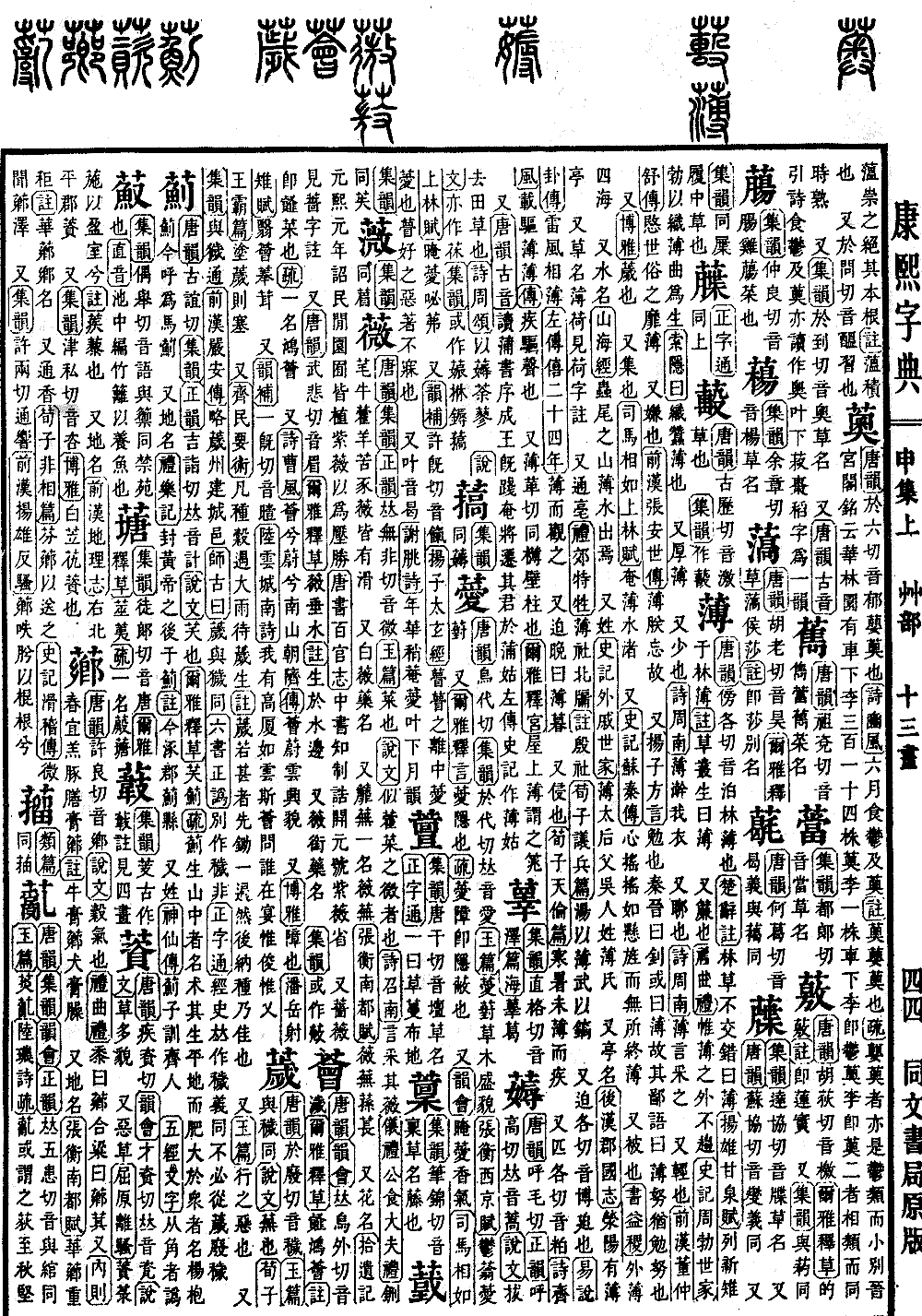
Shen Collection, Upper Volume
Radical: Grass (cǎo)
Kangxi Strokes: 19
Page 1060, Entry 12
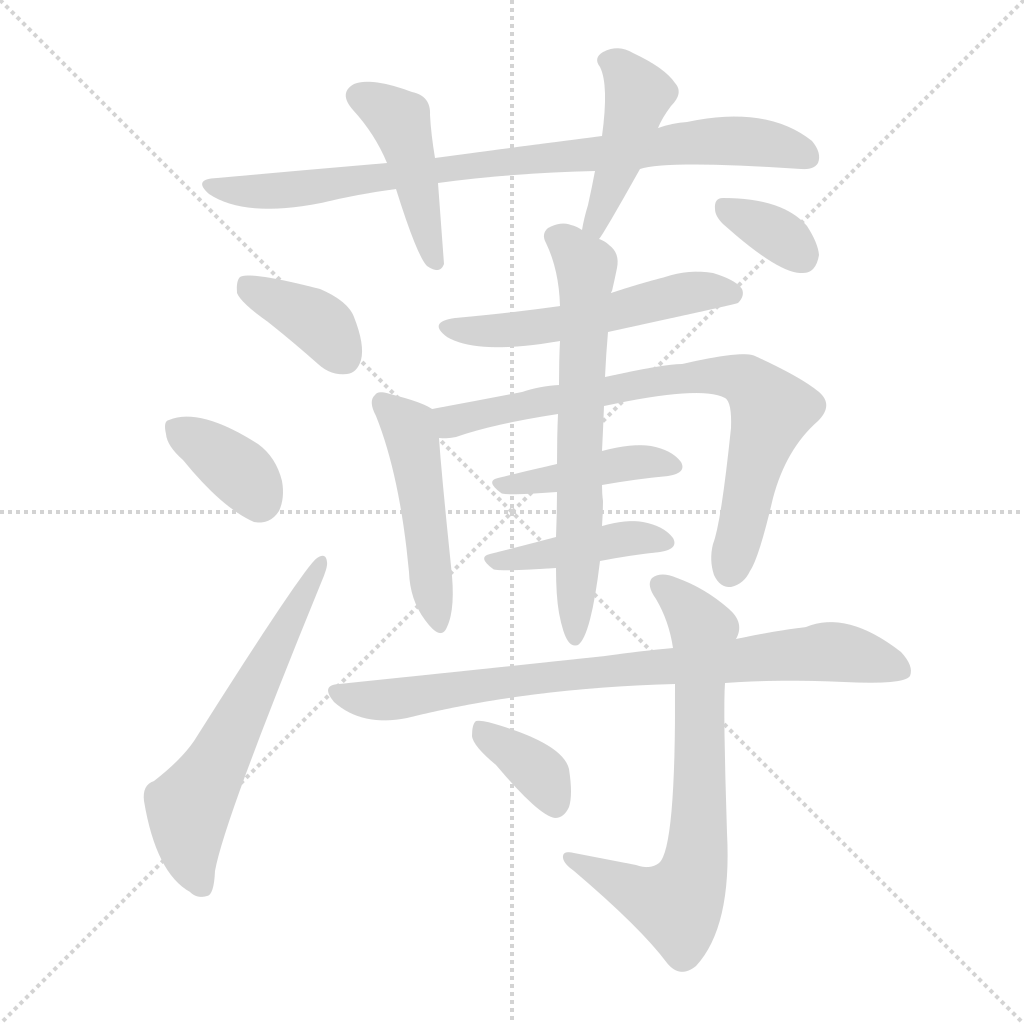
Pronounced bo. Refers to a place where plants and trees grow densely.
Commentary to Songs of the South (Chu Ci): A place where trees and bushes do not grow in an interwoven manner is called bo.
Yang Xiong, Ganquan Rhapsody (Ganquan Fu): Displaying new pheasants in a place where grass and trees grow densely.
Commentary: Dense growth of grass is called bo.
Also refers to a curtain or screen.
Book of Rites (Liji), Songs of Refinement (Quli): Do not walk quickly outside of curtains and screens.
Records of the Grand Historian (Shiji), House of Zhou Bo: Zhou Bo made a living by weaving screens for silkworms.
Commentary on Records of the Grand Historian (Suoyin): This refers to weaving thin mats for silkworms.
Also refers to thickness (degree of thickness). Also refers to scarcity.
Book of Odes (Shijing), Zhou Nan: Briefly wash my clothes.
Also refers to temporarily or for the time being.
Book of Odes (Shijing), Zhou Nan: For the time being, go and pluck it.
Also refers to to disdain or to look down upon.
Book of Han (Qian Hanshu), Biography of Dong Zhongshu: Lamenting the superficiality and frivolity of the world.
Also refers to to dislike or to abandon.
Book of Han (Qian Hanshu), Biography of Zhang Anshi: Disliking me and forgetting old affections.
Also, according to Yangzi, Dialect (Fangyan), refers to to encourage. In the Qin and Jin regions, this is called zhao, or called bo. Thus, the local idiom says bo nu, which is like saying to exert effort.
Also, according to Erudite Encyclopedia (Boya), refers to filth or impurity.
Also refers to to gather.
Sima Xiangru, Rhapsody on the Upper Forest (Shanglin Fu): Covering and gathering on the small islands in the water.
Also, Records of the Grand Historian (Shiji), Biography of Su Qin: The mind is unsettled like a hanging flag, with nowhere to finally attach.
Also refers to to cover.
Book of Documents (Shangshu), Yiji: Extending coverage outward to the four seas.
Also refers to the name of a river.
Classic of Mountains and Seas (Shanhaijing): Chongwei Mountain is where the Bo River originates.
Also refers to a surname.
Records of the Grand Historian (Shiji), Biographies of Relatives of the Imperial Family: Empress Dowager Bo's father was a man from the Wu region, with the surname Bo.
Also refers to the name of a pavilion.
Book of the Later Han (Hou Hanshu), Treatise on Geography (Junguo Zhi): There is a Bo Pavilion in Xingyang.
Also refers to the name of a plant. Peppermint (bohe); see the entry for the character he.
Also interchangeable with bo.
Book of Rites (Liji), Suburban Sacrificial Rituals (Jiaotesheng): The north window of the Bo shrine.
Commentary: Refers to the altar of the Shang dynasty.
Xunzi, Discussion on Warfare (Yibing Pian): Shang Tang relied on Bo, and King Wu of Zhou relied on Hao.
Also pronounced bo. Refers to to approach or to draw near.
Book of Changes (Yijing), Explanation of the Trigrams (Shuogua Zhuan): Thunder and wind approach each other.
Zuo Tradition (Zuo Zhuan), 24th Year of Duke Xi: Approach and observe him.
Also refers to the approach of evening, called bomu.
Also refers to to invade or to assault.
Xunzi, Discourse on Heaven (Tianlun Pian): Before the cold and heat have assaulted, one falls ill.
Also pronounced po.
Book of Odes (Shijing), Odes of Qi (Qifeng): The horse-drawn carriage speeds along, emitting a po po sound.
Commentary: This is the sound of driving a carriage rapidly.
Also pronounced bo, interchangeable with bo (wall column).
Literary Expositor (Erya), Explaining Palaces (Shigong): The bo on a roof is called zao.
Also, according to Tangyun Ancient Pronunciation, read as pu.
Preface to the Book of Documents (Shangshu): King Cheng of Zhou had already pacified the Yan state and intended to move their ruler to Pugu.
Zuo Tradition (Zuo Zhuan) and Records of the Grand Historian (Shiji) write it as Bogu.
Textual Research: In Xunzi, Discourse on Heaven (Tianlun Pian), "Before the cold and heat have bo, one falls ill." I have carefully corrected this to Discourse on Heaven (Tianlun Pian) based on the original text.