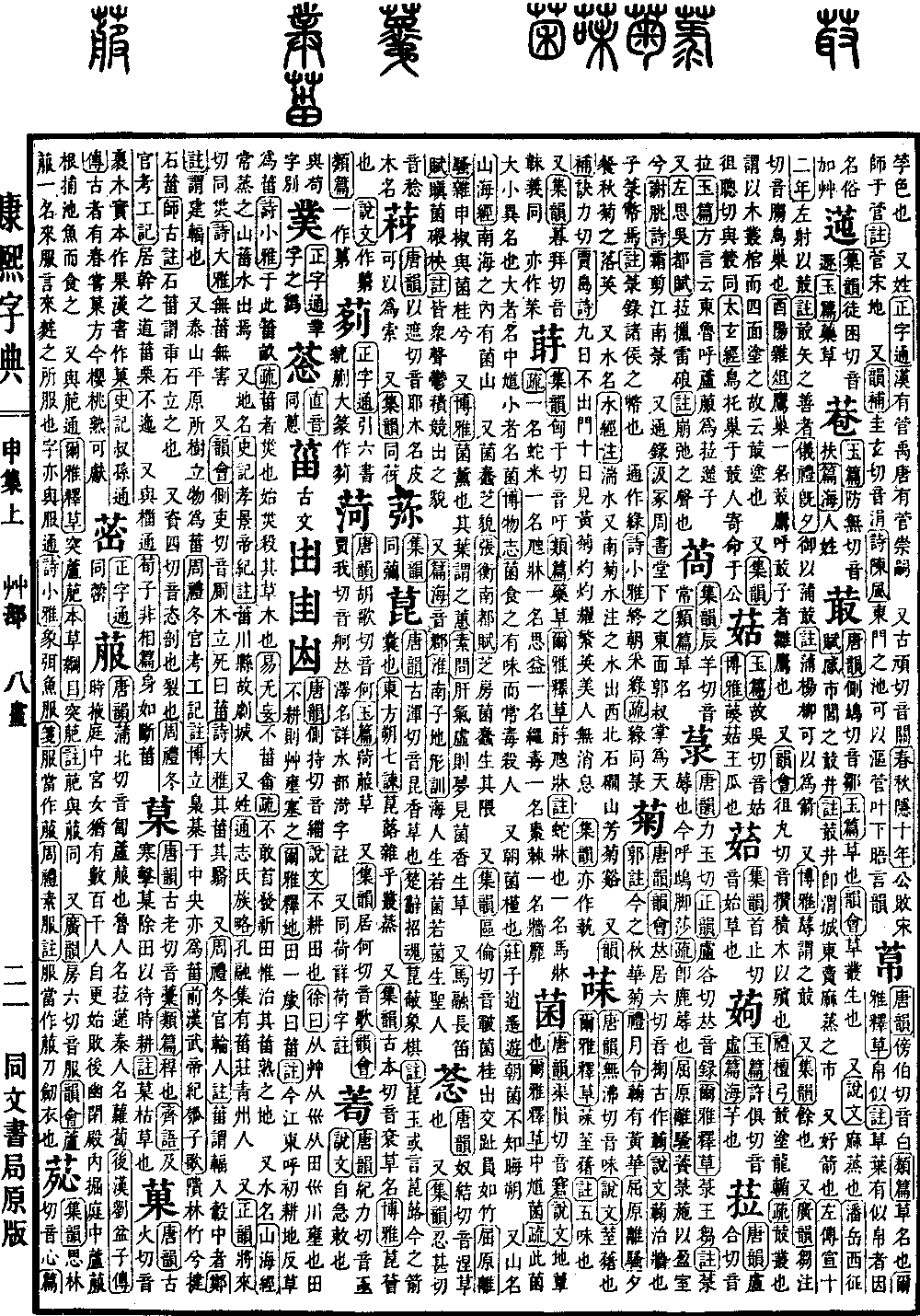
Shen Collection, Upper Volume
Radical: Grass (cǎo)
Zi
Kangxi stroke count: 14
Page 1037, Entry 24
Ancient script
Tang Dynasty Dictionary (Tangyun): Pronounced zi.
Explaining Graphs and Analyzing Characters (Shuowen): Uncultivated fields.
Xu says: Composed of grass and field. When a river is blocked, and fields are not cultivated, grass chokes them.
Approaching Classics (Erya): One-year-old fields are called zi.
Commentary: In the region east of the Yangtze River, this refers to land that is first cultivated and the weeds are turned over.
Book of Odes (Shijing): In these zi fields.
Sub-commentary: Zi means disaster, beginning with the destruction of grass and trees.
Book of Changes (Yijing): Neither zi nor she fields.
Sub-commentary: One does not dare to break new land, but only tends to cultivated zi land.
Also a river name.
Classic of Mountains and Seas (Shanhai Jing): From the Changzheng Mountain, the Zi River flows.
Also a place name.
Records of the Grand Historian (Shiji): Zichuan County, formerly the city of Ju.
Also a surname.
Comprehensive Treatise on Clans and Lineages (Tongzhi Shilue): In the Collected Works of Kong Rong, there is a Zizhuang, a man from Qingzhou.
Also, Correct Rhymes (Zhengyun): Pronounced zai, the same as disaster.
Book of Odes (Shijing): No zi, no harm.
Also, Collected Rhymes (Yunhui): Pronounced ce. Trees standing dead are called zi.
Book of Odes (Shijing): The zi and the yi trees.
Rites of Zhou (Zhou Li): Examining the zi and the mortise, if not loose, the wheel will not warp even when worn.
Zheng's commentary: Zi refers to the part of the spoke inserted into the hub, also called the building of the spoke. Objects erected in the plains of Mount Tai are called zi. The sound is like the word for sliced meat (zi). Placing the owl game piece upright is also called zi.
History of the Former Han (Qianhan Shu): Bamboo felled and stones erected as zi.
Shigu's commentary: Stone zi refers to stones standing upright.
Also, pronounced zi. To split or crack.
Rites of Zhou (Zhou Li): The way of storing timber, the zi and chestnut wood should not slant.
Also used interchangeably with the character for piled-up firewood (zi).
Xunzi: A body like a severed zi.
The characters zi, zi, and zi are used interchangeably.
Textual research: In the Rites of Zhou, the commentary on the wheel-maker mentions the spoke insertion into the hub; Zheng's commentary says this is the building of the spoke. Objects erected on the plains of Mount Tai are called zi. Rites of Zhou, Artificer's Record commentary: Placing the owl game piece in the center is also called zi. According to the original text and commentary, the forty characters starting from zi to center have been revised to read: examining the zi and the mortise, if not loose, the wheel will not warp even when worn. Zheng's commentary says this is the building of the spoke. Objects erected on the plains of Mount Tai are called zi. The sound is like the word for sliced meat. Placing the owl game piece upright is also called zi.