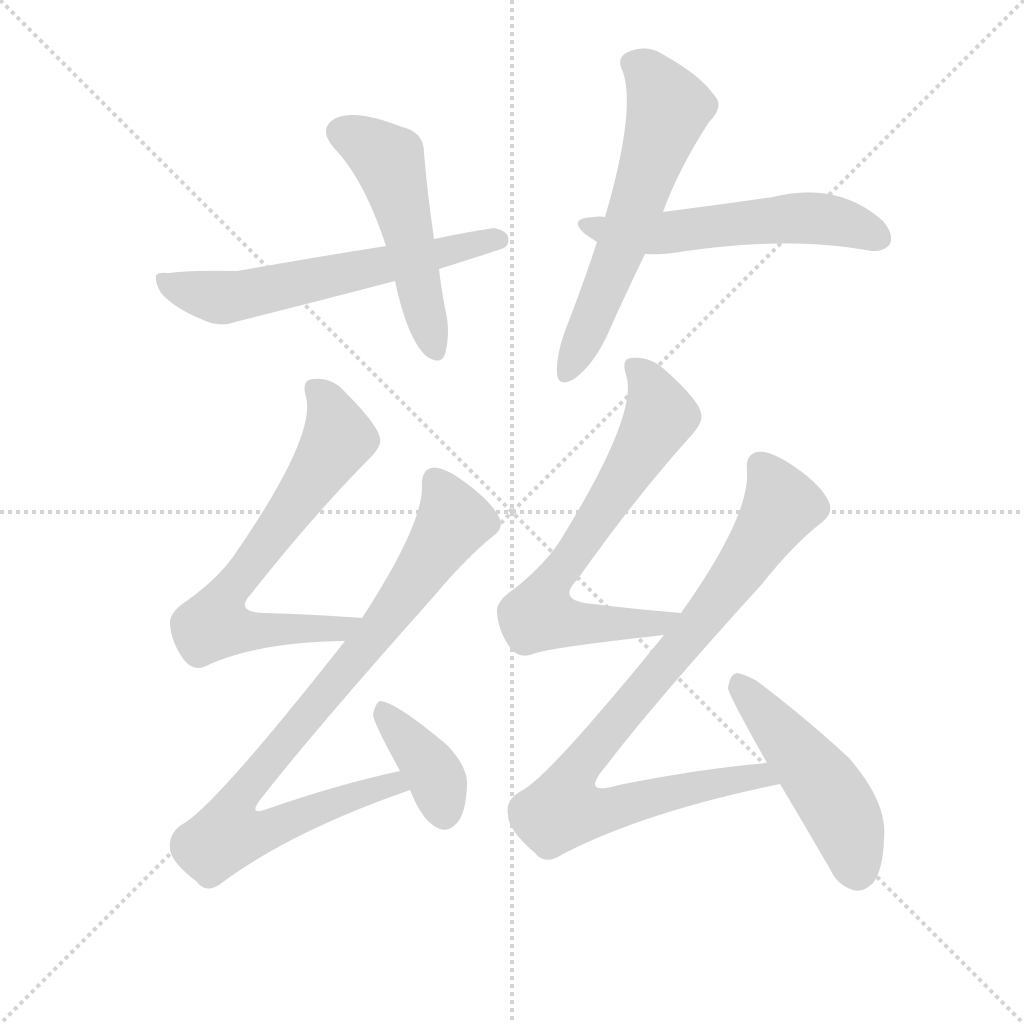
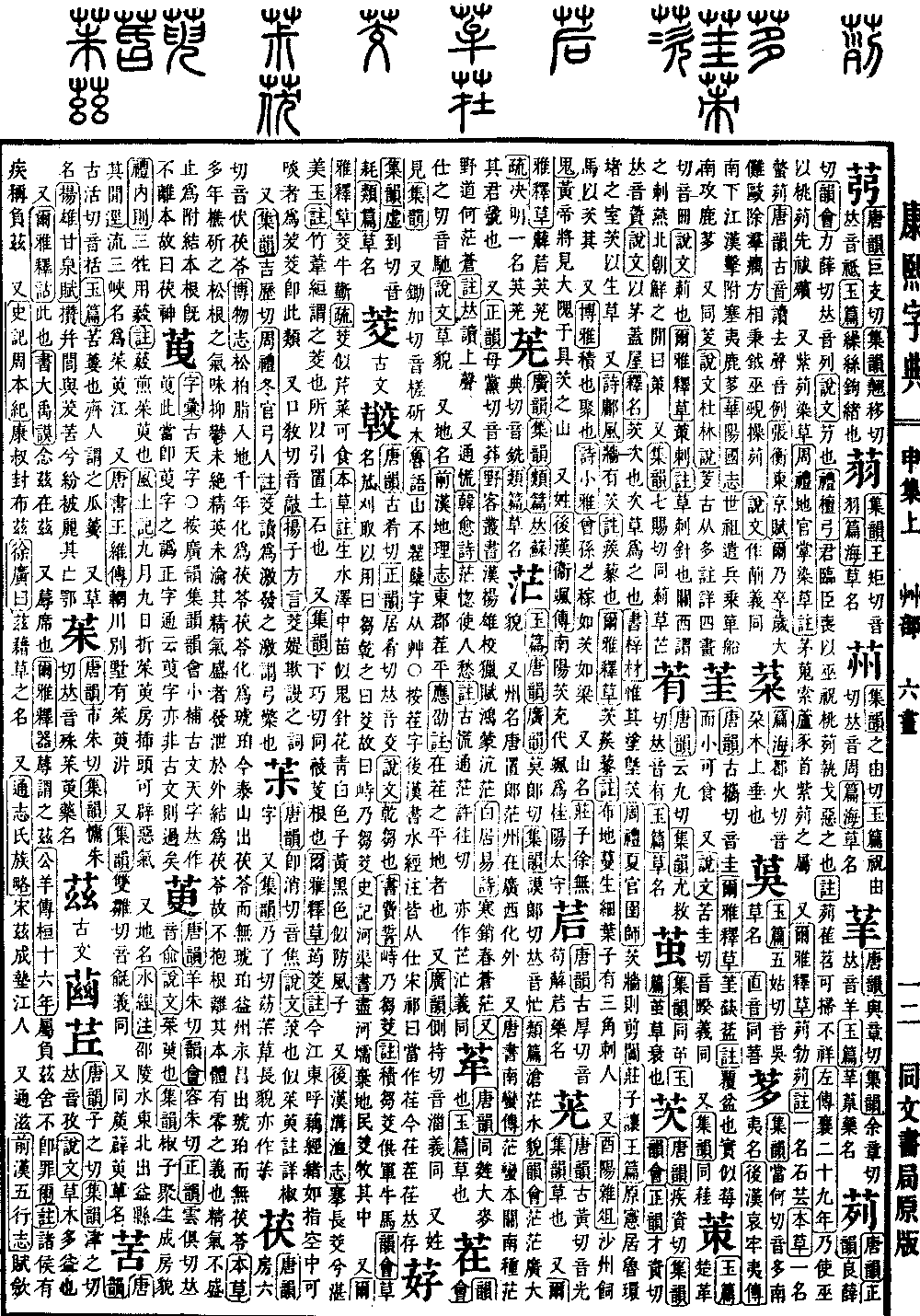
Shen Collection, Upper Volume
Radical: Grass (cǎo)
Kangxi strokes: 12
Page 1028, Entry 29
Ancient form written as (li).
Tang Rhymes (Tangyun): Pronounced zi.
Collected Rhymes (Jiyun): Pronounced jin.
Pronounced zi.
Explanation from Explaining Graphs and Analyzing Characters (Shuowen Jiezi): The appearance of trees and grass growing lushly.
Also, from Erya: Explaining Ancient Words (Erya Shigu): This, here.
From Book of Documents (Shujing), Counsels of the Great Yu (Dayu Mo): Example: Thinking of this, residing in this.
Also refers to a woven mat.
From Erya: Explaining Objects (Erya Shiqi): A woven mat is called zi.
From Commentary of Gongyang (Gongyang Zhuan), 16th Year of Duke Huan: Recorded: After entrusting the laying of mats, there was no immediate inquiry of guilt.
Commentary: Explains: Feudal lords falling ill is called fu-zi.
Also from Records of the Grand Historian (Shiji), Annals of Zhou (Zhou Benji): Recorded: Kang Shu was enfeoffed and laid out mats.
Xu Guang says: Zi is the name of the matting grass.
Also from Comprehensive Treatise on Clans (Tongzhi Shizu Lue): Recorded: In the Song dynasty there was Zi Cheng, who was from Dianjiang.
Also used as a loan character for zi (meaning to grow or increase).
From History of the Former Han (Qianhan Shu), Treatise on the Five Phases (Wuxing Zhi): Recorded: Taxes and levies became even more burdensome.
From Yangzi: Great Mystery (Taixuanjing): Recorded: Heaven does not cause it to increase.
Also from Xunzi, Rectifying Names (Zheng Lun Pian): Recorded: Langgan and longxu.
Commentary: Identifies it as the same as the character for beard (zi).
From Sea of Characters (Pianhai): Pronounced ci.
Qiuci is the name of an ancient state in the Western Regions.