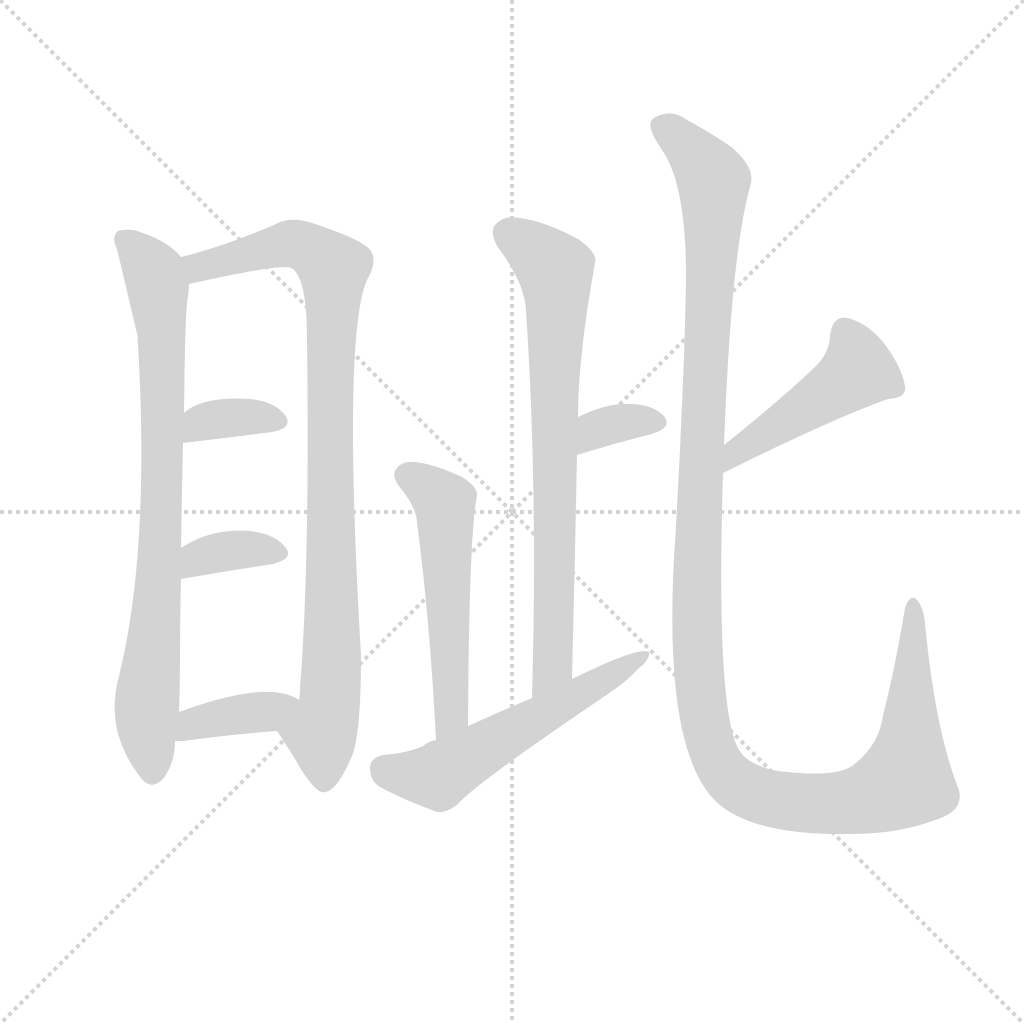
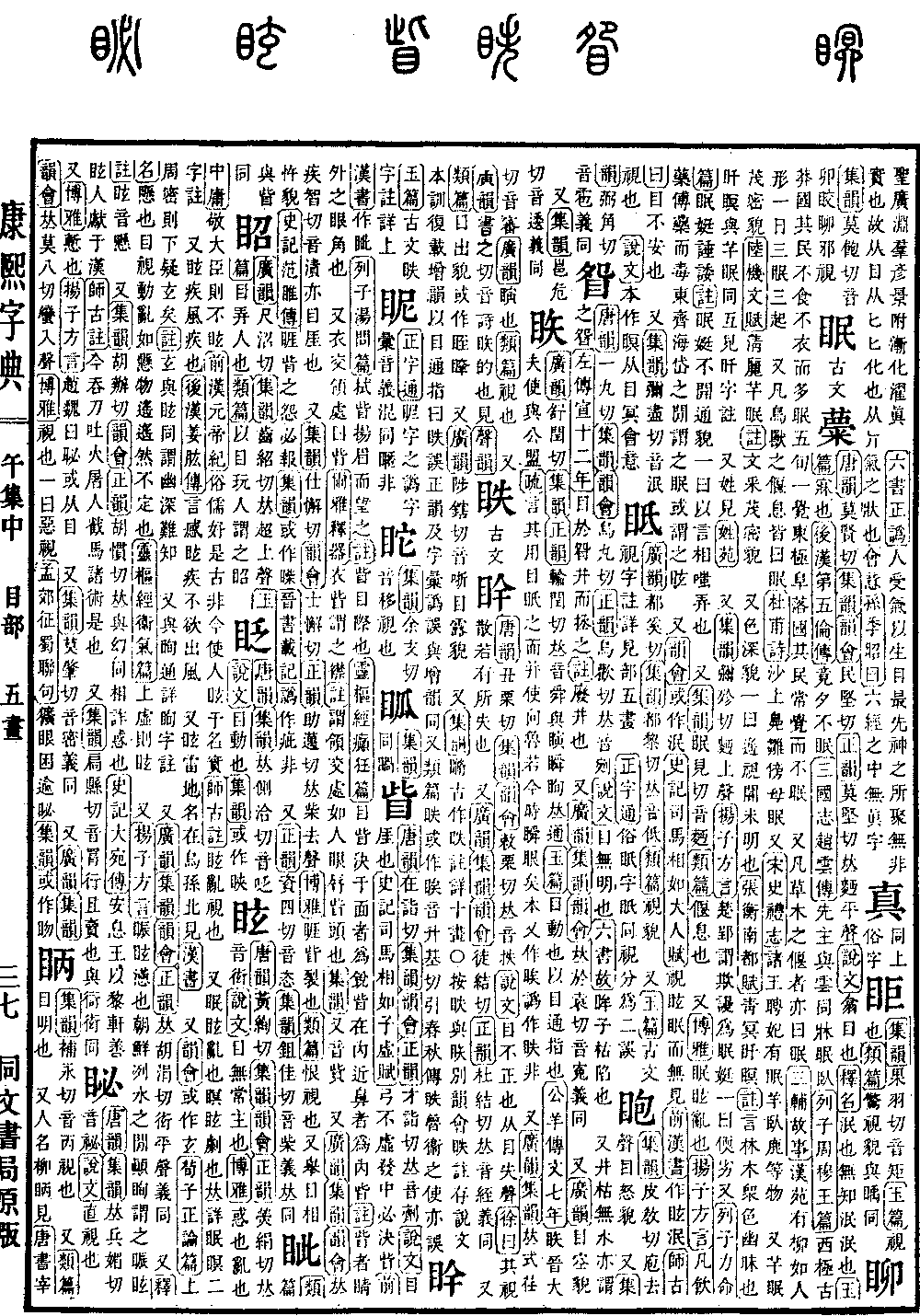
Wu Collection, Middle Volume. Radical: Eye (mù). 10 strokes. Page 805, Entry 17.
According to the Classified Chapters (Leipian), it is the same as the character for eyelid corner.
Pronounced ji (falling tone).
As defined in the Analytical Dictionary of Characters (Shuowen): Refers to the edges of the eye sockets.
As written in the Records of the Grand Historian (Shiji), specifically the Rhapsody on Sir Fantasy (Zixu Fu): A bow is not drawn in vain; when the arrow hits, it must cause the eye sockets to split.
In the History of the Former Han (Qian Hanshu): Written as the variant form.
In the Book of Master Lie (Liezi), specifically the Questions of Tang chapter: To wipe the eye sockets and raise the eyebrows to gaze into the distance. Commentary: The character refers to the margins of the eyes.
In the Spiritual Pivot (Lingshu Jing), specifically the Madness chapter: Where the eye socket splits on the face is called the sharp corner; the side near the nose is called the inner corner. Commentary: The character refers to the outer corner of the eye.
Also refers to the place where the lapels of a garment meet. In the Approaching the Elegant (Erya), specifically the Explaining Implements chapter: The seam of a garment is called the lapel. Commentary: Refers to where the collars cross, similar to the eyes, lips, corners of the eyes, or the head.
Also pronounced zi (level tone).
Pronounced zi (falling tone). Also refers to the edges of the eye sockets.
Pronounced chai (falling tone). As defined in the Broad Refinement (Boya): Glaring in anger until the eye sockets seem to split. According to the Classified Chapters (Leipian): Refers to a hateful, fixed stare. Also describes two people looking at each other in conflict. In the Records of the Grand Historian (Shiji), specifically the Biography of Fan Ju: Even a minor grievance such as a single glare must be repaid.
May also be written in a variant form. In the History of the Jin (Jinshu), specifically the Records of the Carriers: Erroneously written as the character for defect, which is incorrect.
Also pronounced zi (falling tone). Also pronounced chai (level tone). The meanings are the same.