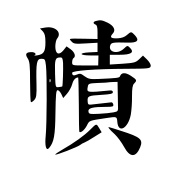
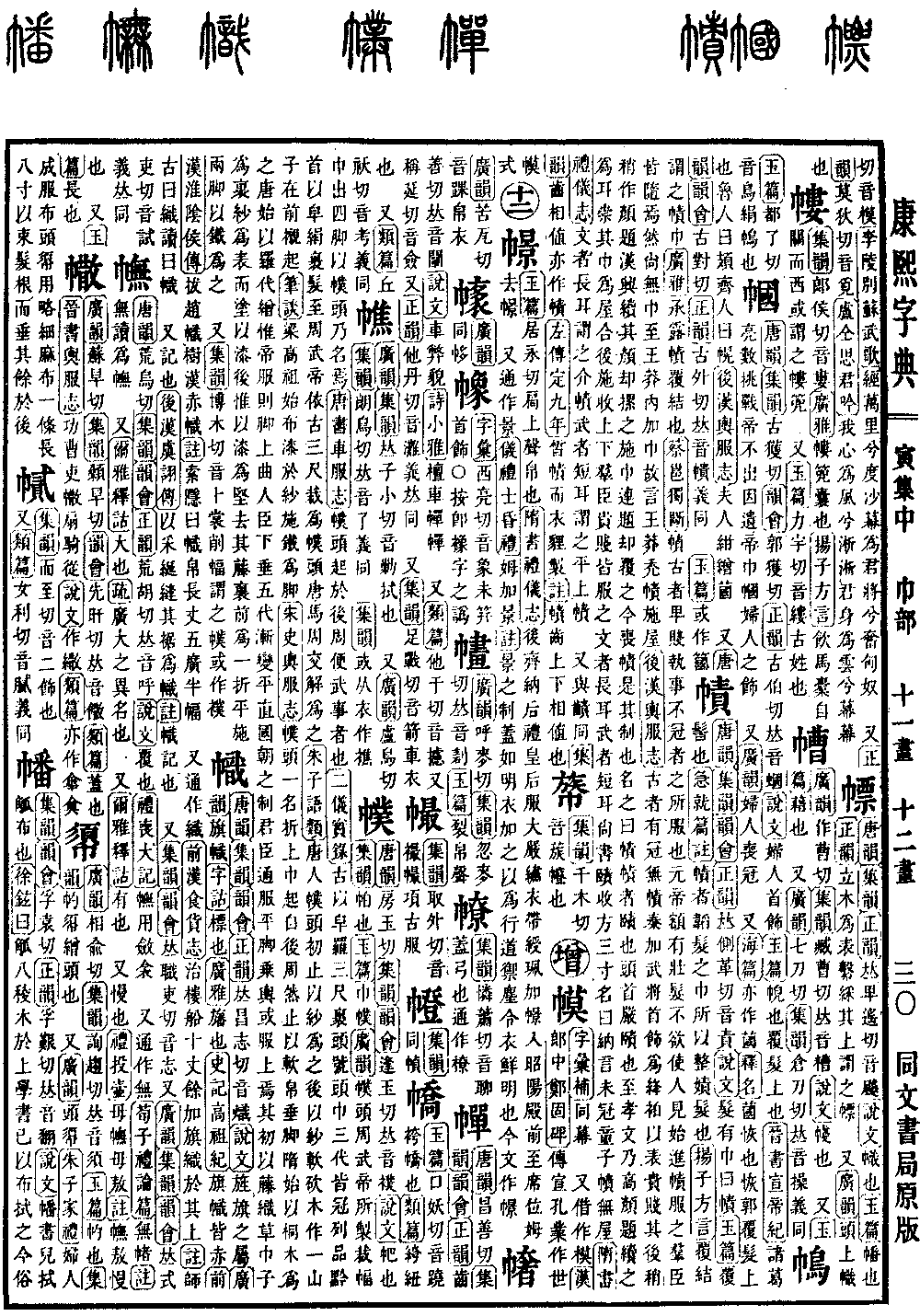
Yin Collection, Middle Volume. Radical: Cloth (jīn). Zi. Kangxi stroke count: 14. Page 336, Entry 06.
Tang Dynasty Rhymes (Tangyun), Collected Rhymes (Jiyun), Dictionary of Rhymes (Yunhui), and Rectified Rhymes (Zhengyun) state the pronunciation is ze.
Shuowen Jiezi states that a cloth wrapped around the hair is called a ze.
Yupian states it is a cover for a hair bun.
Notes to the Quick Reference Chapter (Jijiu Pian Zhu) state that a ze is a cloth used to bind the hair and tidy up messy locks.
Yang Xiong's Regional Speech (Fangyan) states that a covering for a hair bun is called a ze jin.
Guangya states that a dew-catching ze is a cover for a hair bun.
Cai Yong's Unique Decisions (Duduan) states that the ze was originally worn by low-ranking officials and those who did not wear caps. Emperor Yuan of Han had thick hair on his forehead and did not want it to be seen, so he began wearing a ze to cover it, and his officials followed suit. At that time it did not yet have a top covering. By the time of Wang Mang, a top was added to the inside, and it is said that Wang Mang added this top because he was bald.
Book of the Later Han (Hou Hanshu), Treatise on Carriages and Clothing (Yufu Zhi) states that in ancient times there were caps but no ze. The Qin dynasty added a crimson head cloth to the headgear of military officers to distinguish social status. Later, a frontal piece was gradually developed. After the establishment of the Han dynasty, the frontal piece was maintained, wrapped toward the back, and a cloth was added to connect with the front. It covered the back of the head, and the ze used in funeral rites today follows this form. Ze means to be tight, implying that it keeps the head disciplined and dignified. By the time of Emperor Wen of Han, the frontal piece was heightened and extended to form ear-like flaps; a top was added, and the front and back were joined with a binding strap to secure them. Officials, regardless of status, wore them. Civil officials wore ze with long ears, while military officials wore ze with short ears. The binding part of the ze worn by the Imperial Secretariat (Shangshu) was three inches wide and was called a na yan. Ze worn by young children lacked a top.
Book of Sui (Suishu), Treatise on Rituals (Liyi Zhi) states that the ze with long ears worn by civil officials is called a jie ze. The ze with short ears worn by military officials is called a ping shang ze.
It is also the same as the character with the same pronunciation.
Collected Rhymes (Jiyun) states that it refers to teeth being aligned. It is also written in a variant form.
Zuo Tradition (Zuo Zhuan), Ninth Year of Duke Ding: White skin, neat teeth, wearing a raccoon dog fur garment. The commentary states that ze refers to teeth being aligned.