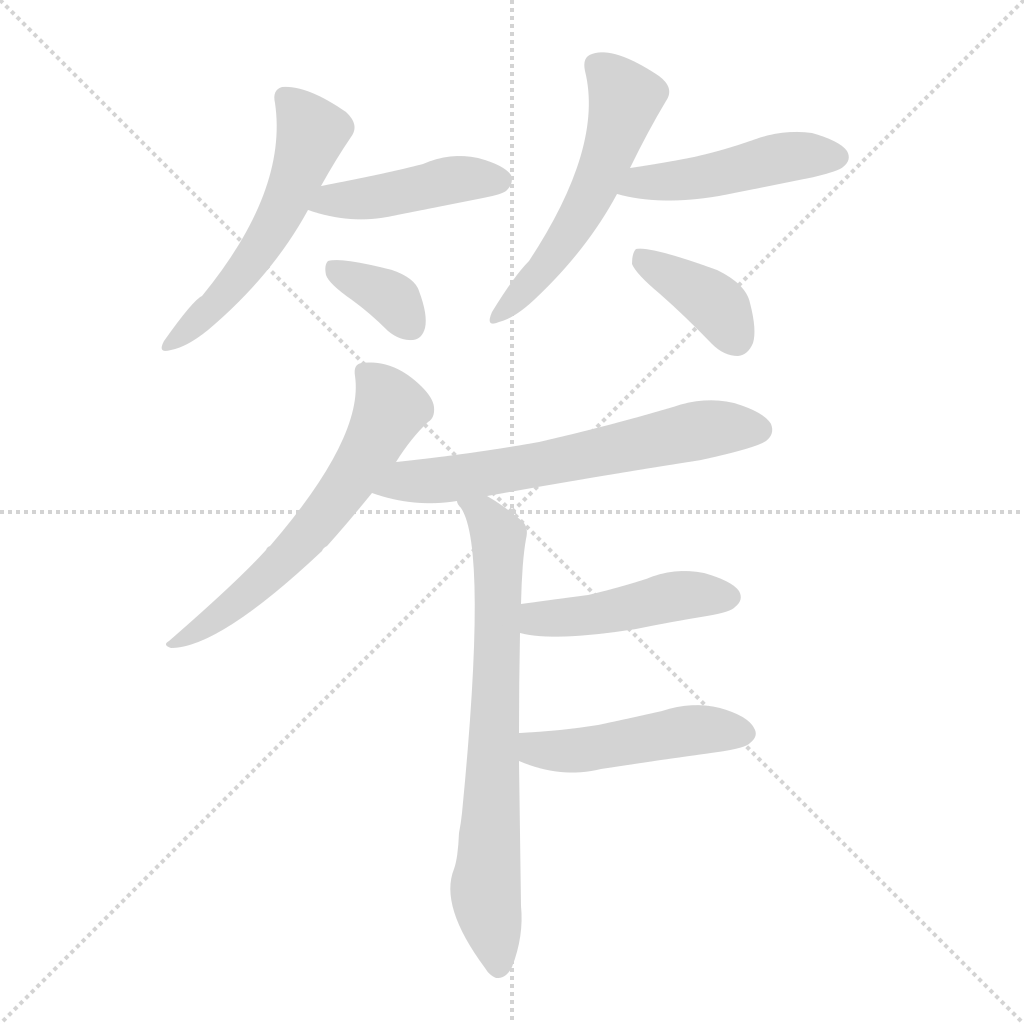
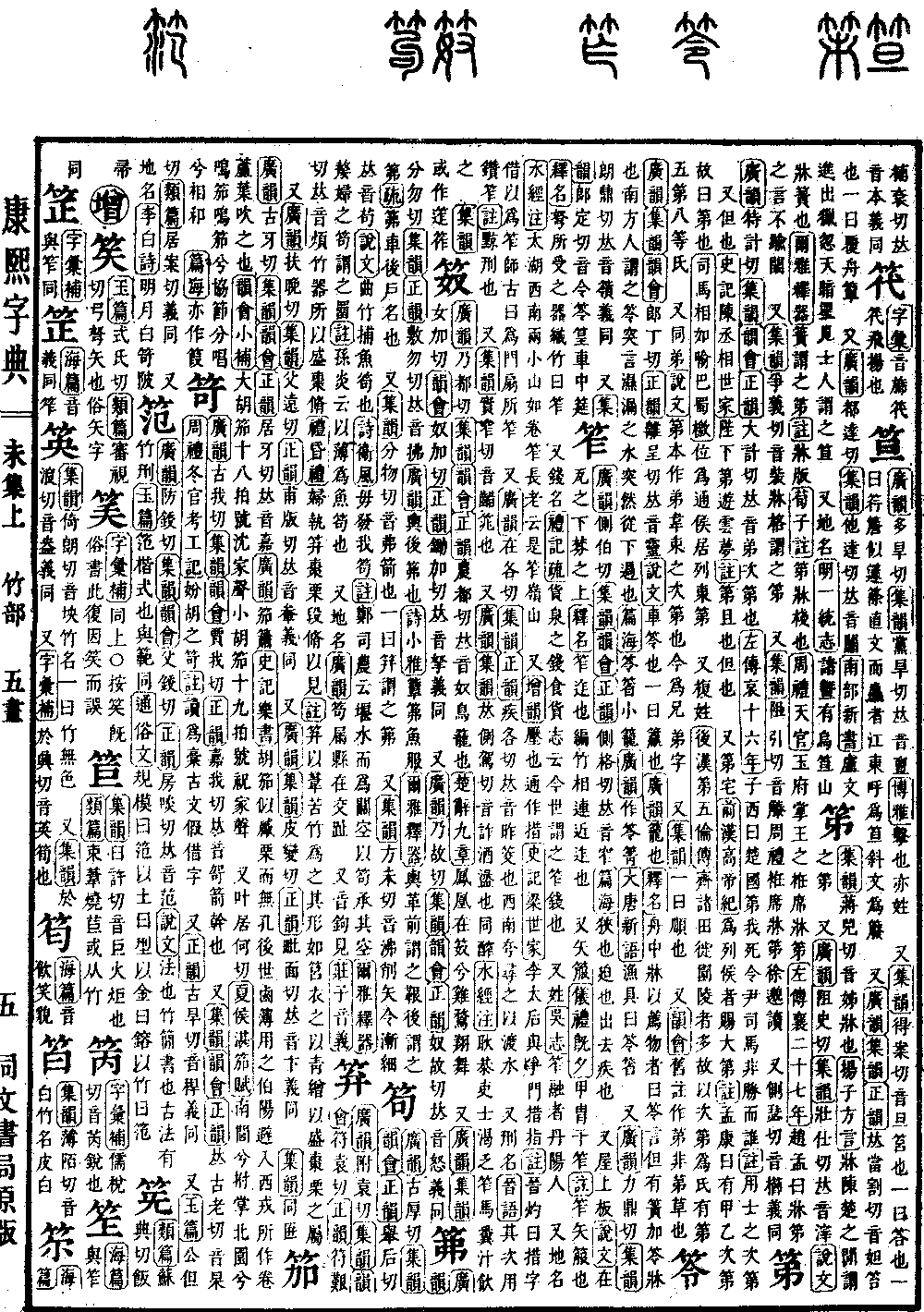
Wei Collection, Upper Volume
Radical: Bamboo (zhú)
Pronounced zhai
Page 881, Entry 06
According to the Extensive Rhymes (Guangyun), the Collected Rhymes (Jiyun), the Rhyme Compendium (Yunhui), and the Correct Rhymes (Zhengyun), the pronunciation is zhai. According to the Compilation of Seas (Pianhai), it means narrow or forced. It also means to press out or to expel. It also refers to boards on a roof.
According to the Explaining Characters (Shuowen), it is located beneath the tiles and above the rafters.
According to the Explanations of Names (Shiming), it means to be crowded together, where bamboo is woven and connected in close proximity.
It also refers to a quiver. According to the Book of Etiquette and Ceremonial (Yili), in the section on the day after the funeral, it mentions helmets and quivers (ze). The commentary states that this refers to a quiver. According to the Explanations of Names (Shiming), the device that holds a crossbow, made of woven bamboo, is called ze.
It is also the name of a type of coin. According to the Commentary on the Book of Rites (Liji shu), in the section on economics and commerce, it states that in the present age, these are called ze coins.
It is also a surname. According to the Records of Wu (Wu zhi), Ze Rong was a man from Danyang.
It is also the name of a place. According to the Commentary on the Classic of Waterways (Shuijing zhu), to the southwest of Lake Tai are two small mountains shaped like rolled-up mats, which the elders say are the Ze Ridge mountains.
According to the Additional Rhymes (Zengyun), it also means to press. It is sometimes used interchangeably with the word for to place (cuo). According to the Records of the Grand Historian (Shiji), in the chapter on the House of Liang, it describes the Empress Dowager Li struggling over a gate and having her fingers pressed. The commentary by Jin Zhuo says the word for to place is used as a loan for ze; Yan Shigu says it means to be pressed by a door leaf.
According to the Extensive Rhymes (Guangyun), it is also pronounced zuo. It refers to a bamboo raft, which people in the southwest use to cross water.
It is also a name. According to the Discourses of Jin (Jinyu), the next step uses the drilling method. The commentary explains this as a form of tattooing (qing).
According to the Collected Rhymes (Jiyun), it is also pronounced ze. It refers to a weaving reed.
According to the Extensive Rhymes (Guangyun) and the Collected Rhymes (Jiyun), it is also pronounced zha. It refers to wine or a wine press. It is the same as the character for wine press (zha). According to the Commentary on the Classic of Waterways (Shuijing zhu), when the soldiers were thirsty, they pressed horse manure to extract the juices for drinking. The Collected Rhymes (Jiyun) notes it is sometimes written as the variant form (ze).