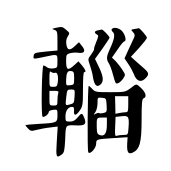
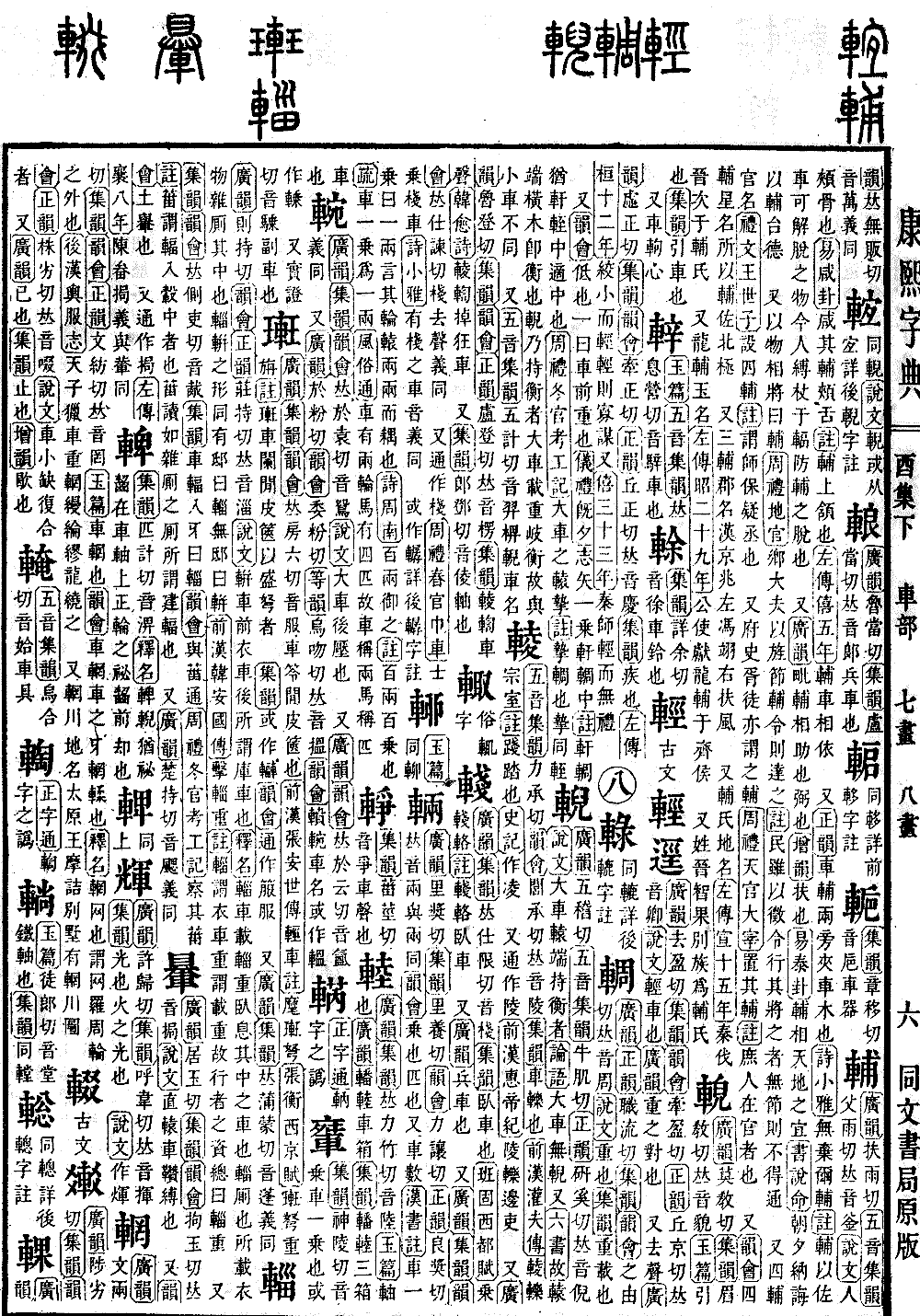
You Collection, Lower Volume
Radical: Carriage (chē)
Kangxi Strokes: 15
Page 1244, Entry 26
Guangyun (Dictionary of Rhymes): Pronounced zī.
Yunhui (Collection of Rhymes): Pronounced zī.
Zhengyun (Correct Rhymes): Pronounced zī.
Shuowen (Explaining Graphs): A carriage with a front covering and a rear covering for clothing, known as a store-carriage.
Shiming (Explication of Names): A carriage for baggage, in which one can lie down and rest. The term derives from a word meaning to mix, as clothes and goods are stored mixed together within it. The shape of this carriage and the light covered carriage are the same; the one with a floor is called a baggage carriage, and the one without is called a light carriage.
History of the Former Han (Qian Han Shu): Attack the baggage and supplies.
Commentary: The baggage carriage refers to a carriage for clothing; heavy supplies refers to the load. Therefore, the total resources of those traveling are collectively called baggage and supplies.
Also: Jiyun (Collection of Rhymes), Yunhui (Collection of Rhymes): Pronounced zì.
Jiyun (Collection of Rhymes): The part of the carriage spoke that enters the rim is called the baggage carriage part.
Yunhui (Collection of Rhymes): Interchanged with the term for the spoke-tenon.
Rites of Zhou (Zhouli), Winter Officials, Record of Artificers: Inspect its spoke-tenon.
Commentary: The spoke-tenon refers to the part of the spoke that enters the hub. This is read as the word for mix or mingle, as mentioned previously; it is what is known as the established spoke.
Also: Guangyun (Dictionary of Rhymes): Pronounced sī.
The meaning is the same.