Si Collection, Upper Volume
Radical: Water (shuǐ)
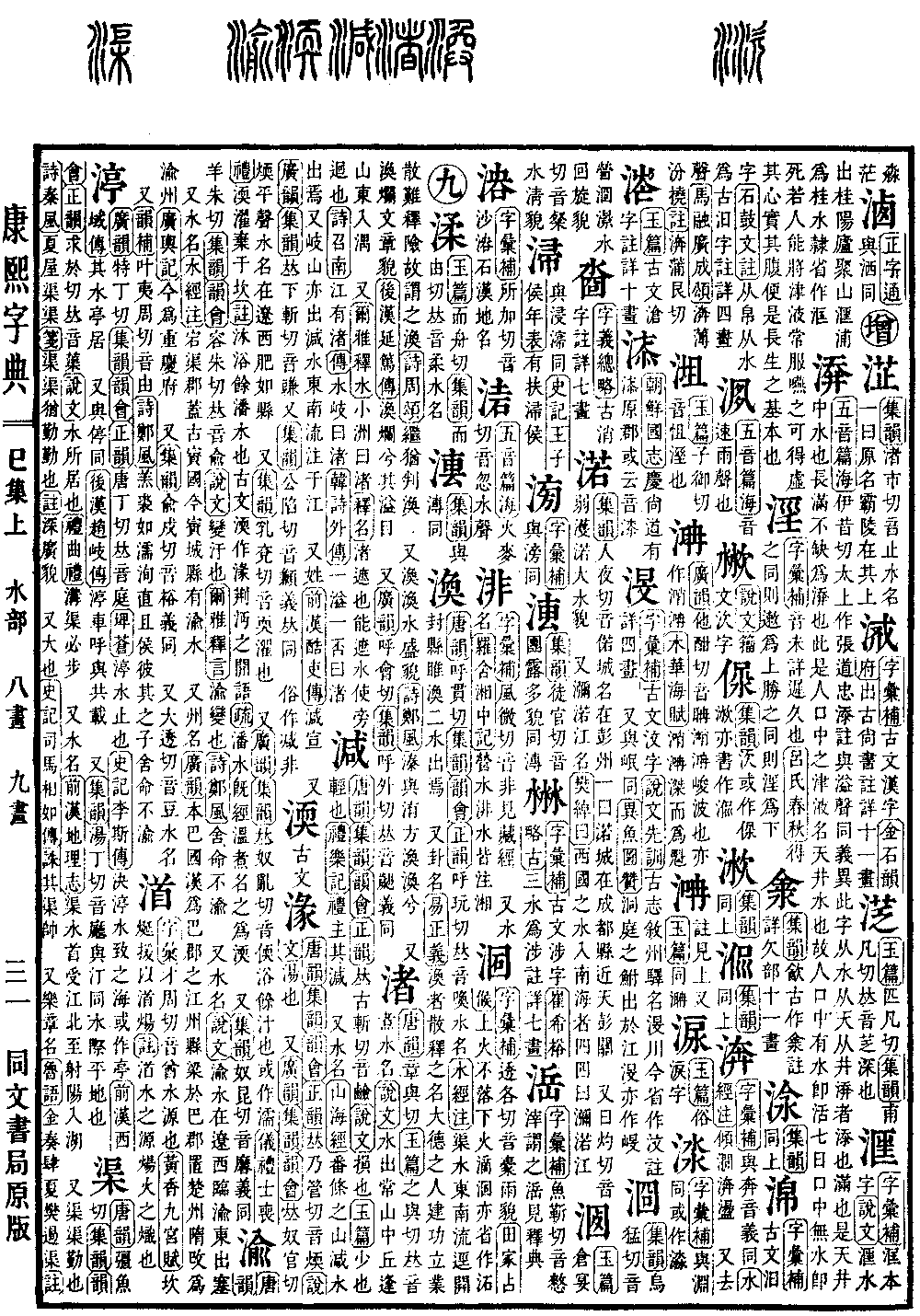
渚
Kangxi Strokes: 13
Page 633, Entry 41
Pronounced zhǔ. The name of a river.
According to the Explaining Graphs and Analyzing Characters (Shuowen Jiezi), this river originates in Mount Feng in Zhongqiu, Changshan, and flows east into the Yu River.
Furthermore, the Literary Expositor (Erya), in the section Explaining Water, defines a small piece of land within water as a zhu.
The Explaining Names (Shiming) states: A zhu refers to something that provides an obstruction. It causes the current to be obstructed and flow around to the side.
The Book of Odes (Shijing), in the section Odes of Shao, contains the line: "In the Yangtze there are islets."
The Mao Commentary (Mao Zhuan) annotates: A sandbank formed at a fork in the water is called a zhu.
The Explanatory Text (Shiwen) cites the Han School of Odes (Hanshi): The place where water alternately overflows and dries up is called a zhu.
Critical research: In the Book of Odes (Shijing), Odes of Shao, the original Mao Commentary note read "a river fork is called a zhu." This has been carefully corrected to read "forms a zhu" according to the original text. The original record in the Han School of Odes Biography (Hanshi Waizhuan) stated "one overflow and one not is called a zhu." Careful examination shows this sentence comes from the Han School of Odes Chapters and Sentences (Hanshi Zhangju), not the Han School of Odes Biography (Hanshi Waizhuan); it has now been changed to "The Explanatory Text cites the Han School of Odes."