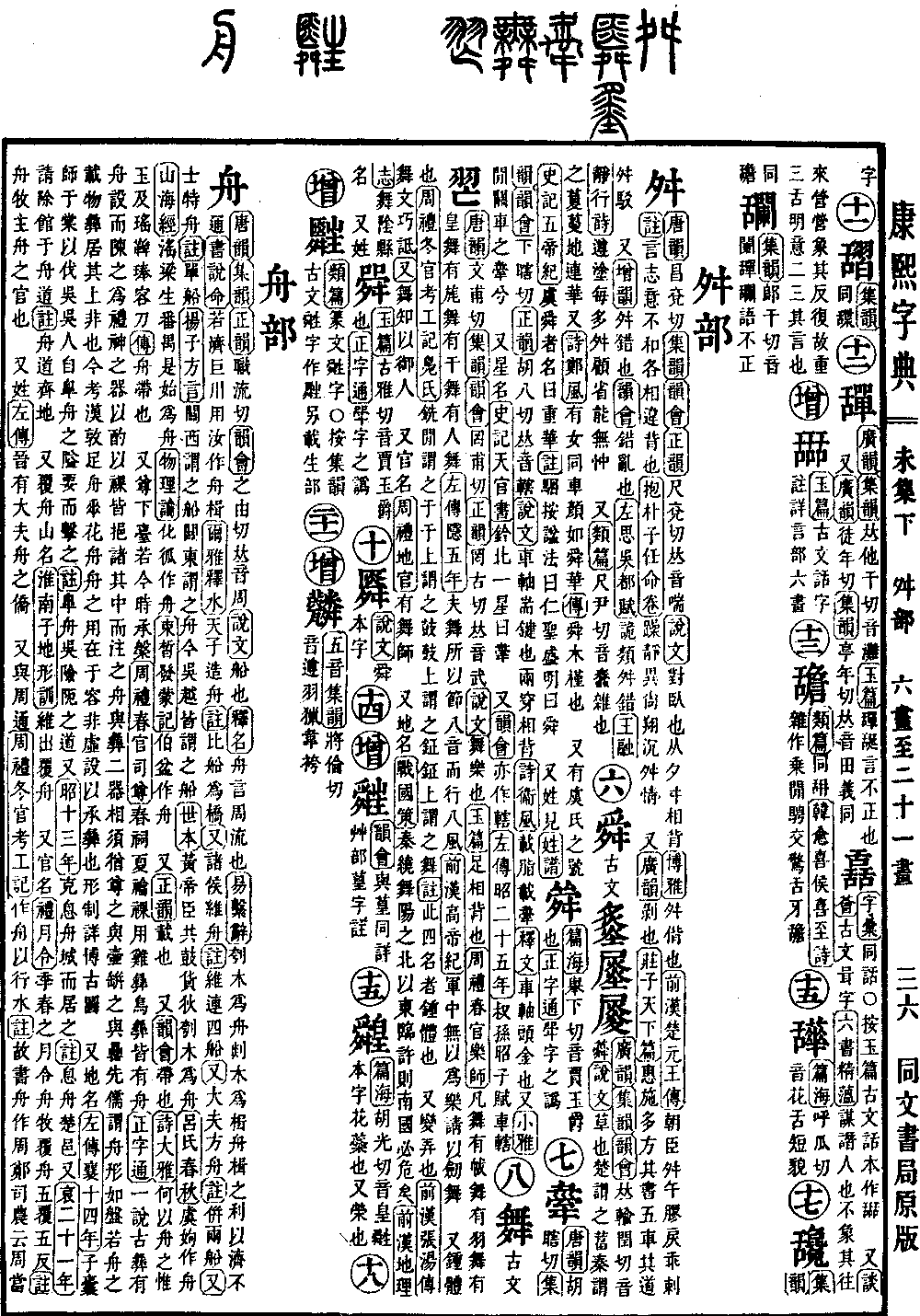
Wei Collection, Lower Volume
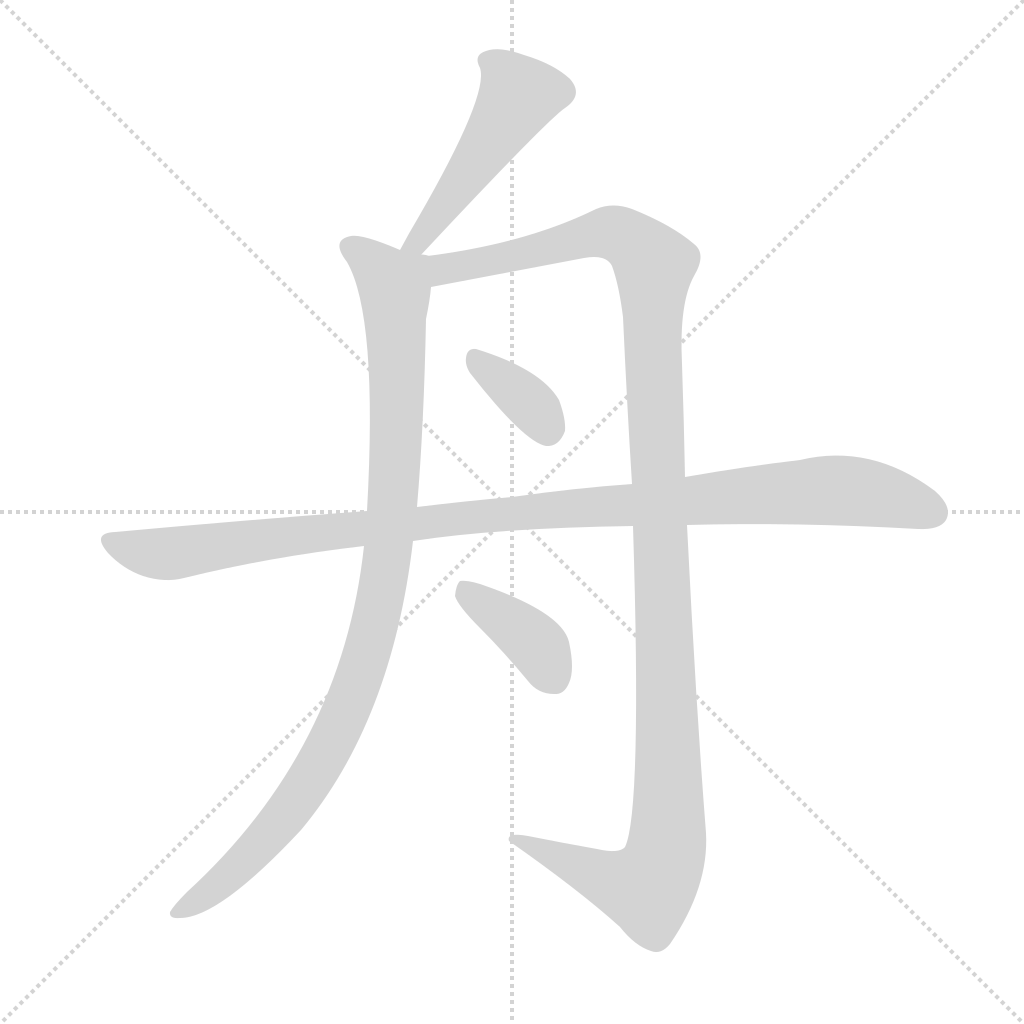
Radical: Boat (zhōu)
6 strokes
Page 1008, Entry 24
Pronounced zhōu.
According to the Explaining Graphs and Analyzing Characters (Shuowen Jiezi), it means a vessel. According to the Explaining Names (Shiming), the meaning of a boat is to flow and turn about everywhere.
In the Book of Changes (Yijing), section Appended Remarks (Xici), it is said: Carving wood to make boats and sharpening wood to make oars; the benefit of boats and oars is for crossing where there is no passage.
In the Book of Documents (Shujing), section Charges to Yue (Shuoming), it is said: If you are to cross a great river, use me as your boat and oar.
In the Literary Expositor (Erya), section Explaining Water (Shishui): The Son of Heaven uses boats connected as a bridge. Commentary: Boats are placed side by side to form a bridge. Also: Feudal lords use four boats connected. Commentary: They use ropes to connect four boats. Also: Grandees use two boats side by side. Commentary: Two boats are joined together. Also: Scholars use a single boat. Commentary: A solitary boat.
In Yang Xiong's Regional Speech (Fangyan): In the region west of the passes it is called a ship, in the region east of the passes it is called a boat. Now in the Wu and Yue regions, both are called ships.
In the Genealogy of Generations (Shiben): The Yellow Emperor's ministers Gong Gu and Huo Di carved wood to make boats.
In the Spring and Autumn of Master Lu (Lushi Chunqiu): Yu Xu invented the boat.
In the Classic of Mountains and Seas (Shanhaijing): Yinliang gave birth to Fanyu, and Fanyu began to build boats.
In the Treatise on Natural Principles (Wulilun): Huayigua invented the boat.
In Shu Xi's Record of Initiating Enlightenment (Fayongji): Bopen invented the boat.
Also, per the Correct Rhymes (Zhengyun), it means to carry.
Also, per the Rhyme Collection (Yunhui), it means to wear as an accessory.
In the Book of Odes (Shijing), section Greater Odes of the Kingdom (Daya): With what shall one wear it? Only with jade and yao, and the decorations on the scabbard. Commentary: Zhou means to wear.
It also refers to the base beneath a sacrificial vessel, like the modern implement used to hold a plate. In the Rites of Zhou (Zhouli), section Spring Offices, Official of Sacrificial Vessels (Sizun): During the spring and summer sacrifices, the libation ceremony uses chicken and bird-shaped vessels, and below them are the boat-shaped stands.
According to the Correct Meaning Encyclopedia (Zhengzitong), one view holds that ancient sacrificial vessels had such stands for display, acting as implements for ritual reverence. They were used to scoop wine for libations, drawing from the vessel and pouring it out. The two implements, the boat-stand and the sacrificial vessel, complemented one another, much like the relationship between a tall vessel and a pot, or a vase and a jar. Previous scholars said the boat-stand was shaped like a dish, like a boat carrying items, with the vessel placed upon it; this view is incorrect. Modern examination of Han dynasty bronze vessels, stands, and ornate boat-stands shows that the purpose of the boat-stand was for containment, not merely as an empty base to hold a vessel. Specific shapes and standards are detailed in the Illustrated Antiquities (Bogutu).
It is also a place name. In the Zuo Tradition (Zuozhuan), 14th year of Duke Xiang: Zi Nang stationed troops at Tang to attack the state of Wu. The people of Wu intercepted them at the strategic pass of Gaozhou. Commentary: Gaozhou is a strategic road in the state of Wu.
Also, 13th year of Duke Zhao: Conquered Xizhou city and resided there. Commentary: Xizhou is a city in the state of Chu.
Also, 21st year of Duke Ai: Requested to prepare lodgings at Zhoudao. Commentary: Zhoudao is a place in the state of Qi.
It is also the name of a mountain, Fuzhou. In the Huainanzi, section Treatise on Topography (Dixingxun): The Wei River originates from Mount Fuzhou.
It is also a title. In the Rites of Zhou, section Monthly Ordinances (Yueling): In the last month of spring, the order is given to the Boat Overseer to inspect the vessels repeatedly, checking five times in total. Commentary: The Boat Overseer is the official in charge of vessels.
It is also a surname. In the Zuo Tradition: There was a grandee of the state of Jin named Zhou zhi Qiao.
It is also interchangeable with the character for week (zhōu). In the Rites of Zhou, section Winter Offices, Record of Trades (Kaogongji): Constructing boats for travel upon the water. Commentary: The old version wrote this character as week (zhōu). Zheng Sianong said: Zhou should be boat (zhōu).
Also, per the Rhyme Supplement (Yunbu), the pronunciation is shifted, pronounced zhū.
In the Daoist Canon Songs (Daozang Ge): Jade tortoises in the seven-treasure forest, chanting praises and wishing to share the same boat. The red glow shines upon the pupils, causing my heart to hesitate.
Also in the Book of Odes, section Greater Odes: With what shall one carry it? Zhu's commentary: Pronounced yáo, and rhymes with the following word "dao" (sword).