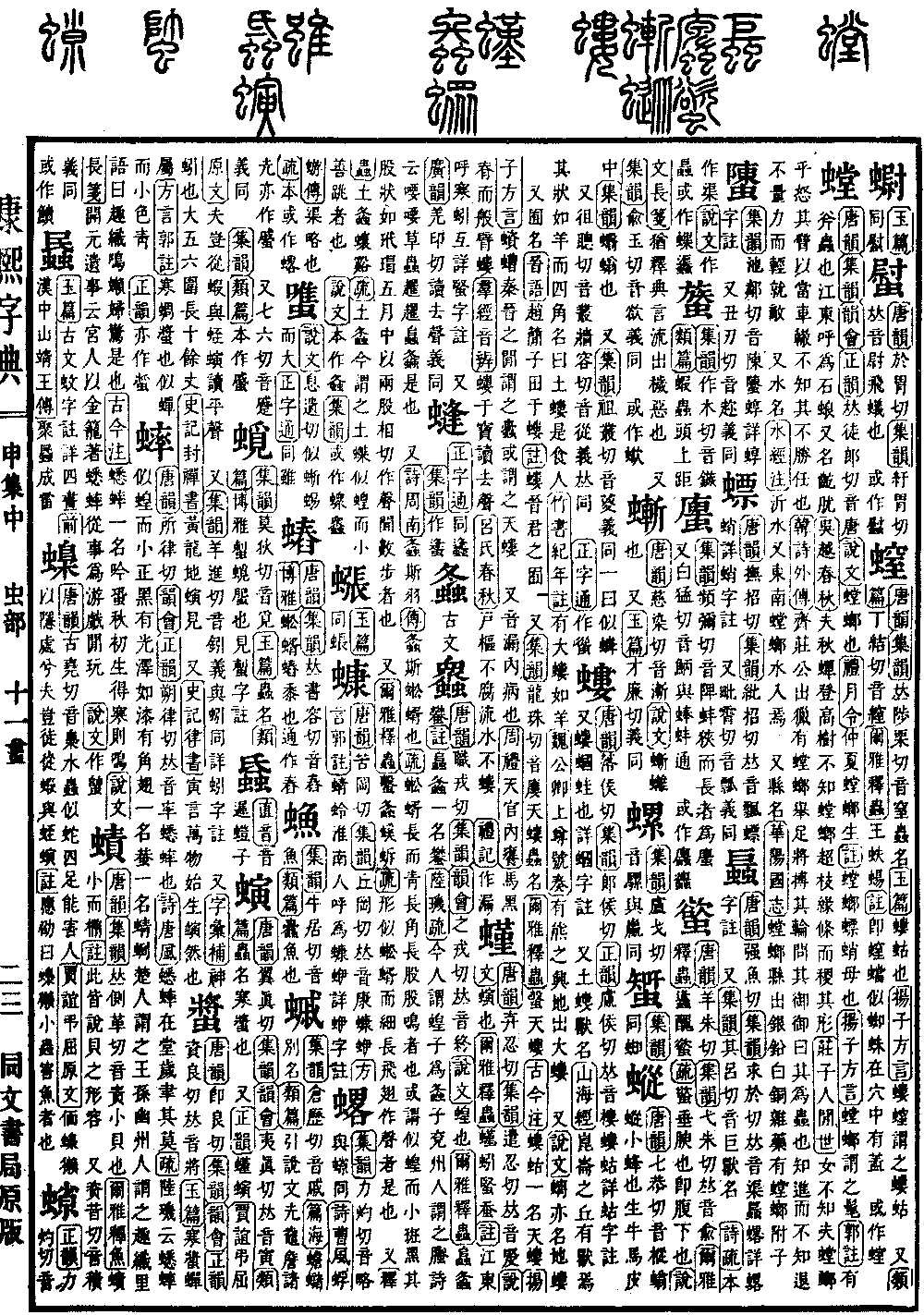
Shen Collection, Middle Volume. Radical: Insect (chóng). Kangxi Stroke Count: 17. Page 1095, Entry 18. Ancient form. Pronounced zhong. In the Explaining Graphs and Analysis of Characters (Shuowen Jiezi), it refers to a locust. In the Erya: Explaining Insects, it is defined as a fan. The commentary states that the insect is also called fan. Lu Ji states in his commentary that people today call the young of a locust a zhong-zi, while in Yanzhou it is called a teng. The Book of Odes (Shijing) says: the grass insects chirp, the zhong hop about. Also in the Book of Odes (Shijing), Zhou Nan section: the wings of the zhong-si. The commentary says the zhong-si is the zhong-xu. The sub-commentary states that the zhong-xu is long and green, with long antennae and long legs, and produces sound by rubbing its legs together. Some say it resembles a locust but is smaller and black-spotted. Its legs are shaped like tortoise shell, and in the fifth month, they rub their legs together to make a sound that can be heard several paces away. Also in the Erya: Explaining Insects, the qi-zhong is identified as the xi-e. The sub-commentary states that this is an insect shaped like a zhong-xu but more slender and elongated, which makes sound with its flying wings. Also in the Explaining Insects, the tu-zhong is identified as the xiang-xi. The sub-commentary states that the tu-zhong, known today as the tu, resembles a locust but is smaller and excels at jumping. The Explaining Graphs and Analysis of Characters (Shuowen Jiezi) notes that this character was originally written in a variant form. The Collected Rhymes (Jiyun) notes that it is sometimes also written in a variant form.