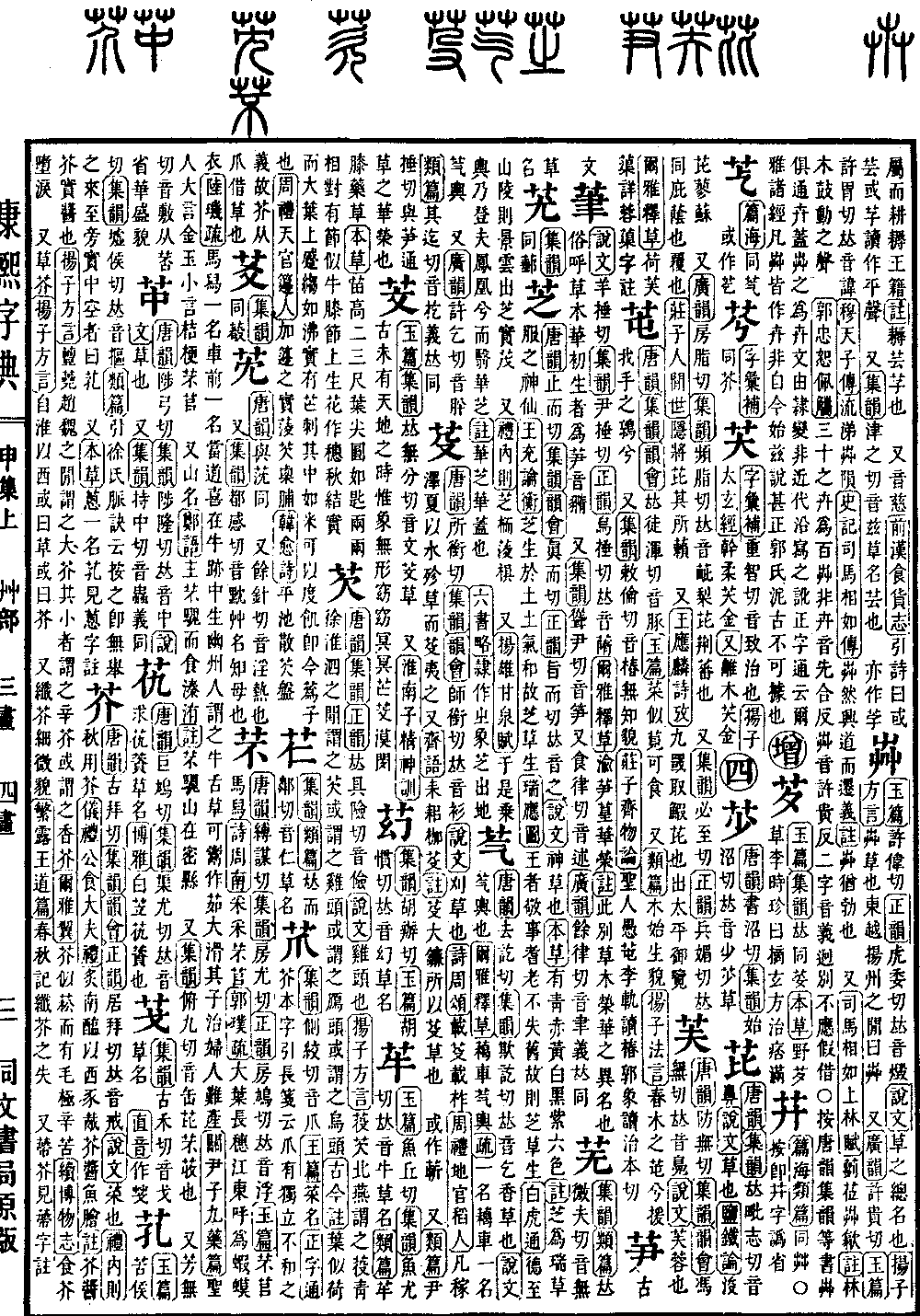
Shen Collection, Upper Volume
Radical: Grass (cǎo)
Zhi
Kangxi stroke count: 10
Page 1019, Entry 15
Pronounced zhi.
According to the Explaining Graphs and Analyzing Characters (Shuowen Jiezi), it is a divine plant.
According to the Materia Medica (Bencao), there are six colors: blue, red, yellow, white, black, and purple.
Note: The zhi is an auspicious plant; consuming it leads to immortality.
According to Wang Chong in the Discourse Evaluations (Lunheng), the zhi grows from the soil; when the soil's energy is harmonious, the zhi plant grows.
According to the Illustrations of Auspicious Responses (Ruiying Tu), when a ruler treats the elderly with respect and does not neglect old customs, the zhi plant grows.
According to the Comprehensive Discussions in the White Tiger Hall (Baihu Tong), when virtue reaches the mountains and hills, auspicious clouds emerge and the zhi plant flourishes.
Also appears in the Book of Rites (Liji), Inner Chapters: zhi mushrooms, wood mushrooms, water chestnuts, and Japanese raisin tree fruits.
Also in Yang Xiong's Rhapsody on the Sweet Springs Palace (Ganquan Fu): At this time, the imperial carriage ascended toward the phoenix to provide shade with the flowery canopy.
Note: Flowery canopy refers to a magnificent state carriage cover.
According to the Summary of the Six Writings (Liushu Lue), the clerical script form is written as a depiction of the zhi emerging from the ground.