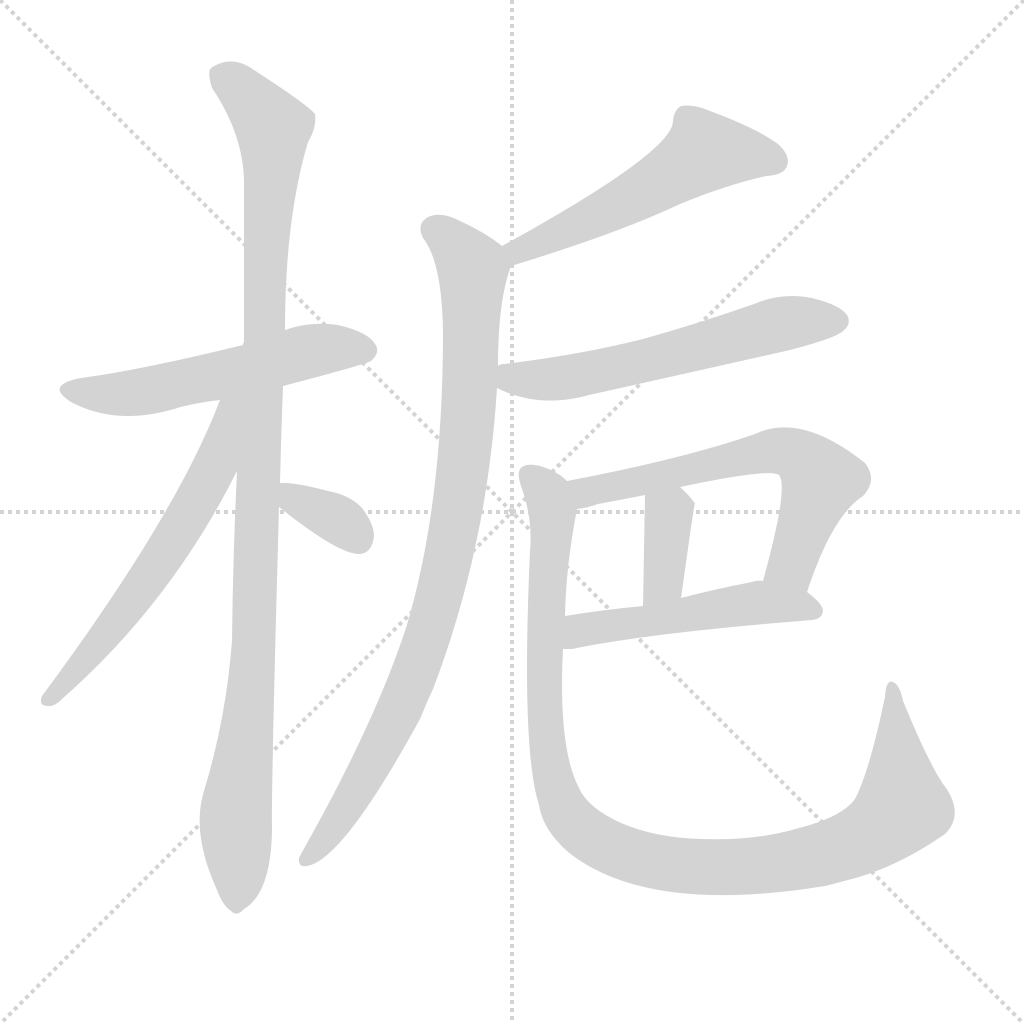
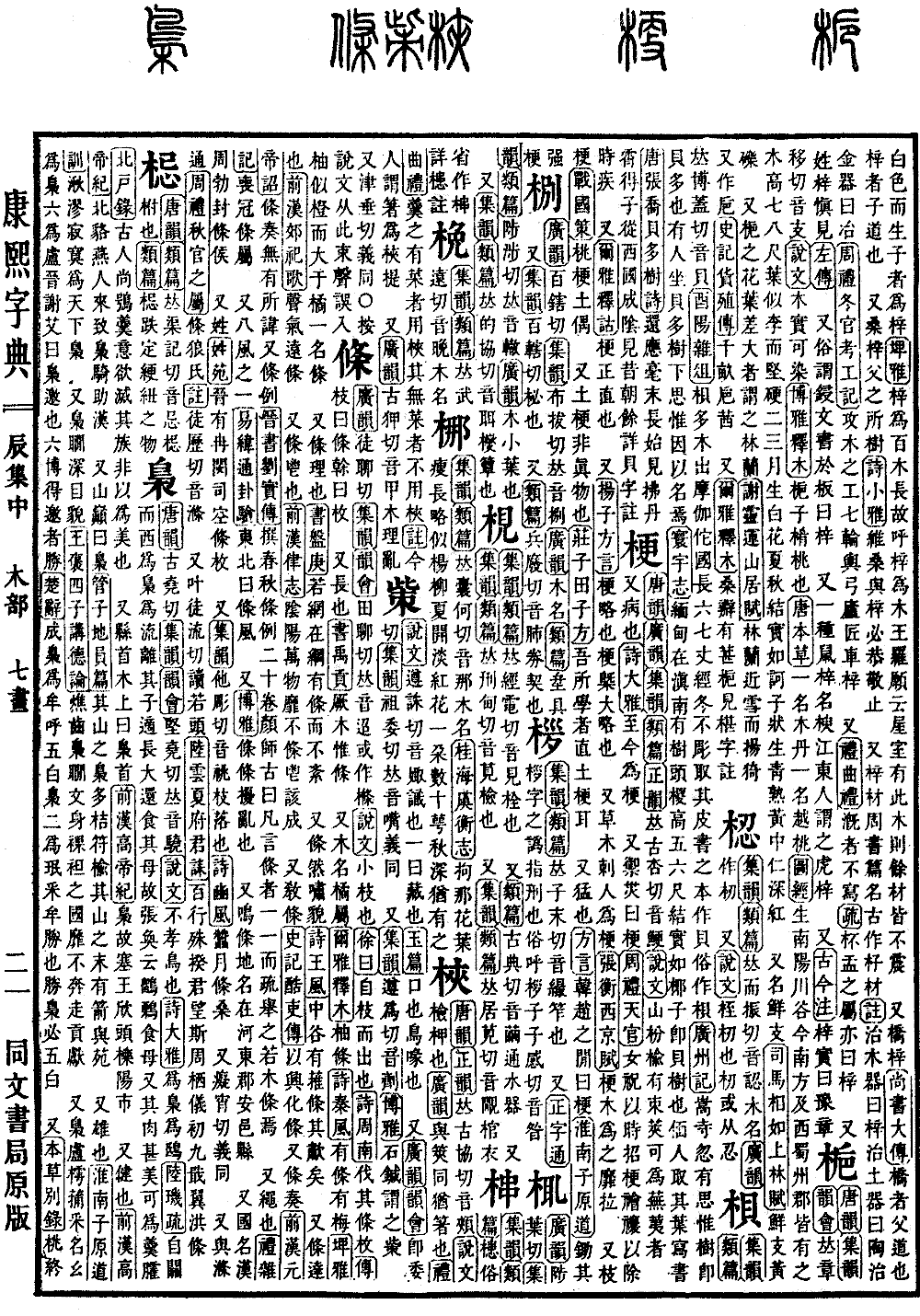
Chen Collection, Middle Volume. Radical: Wood (mù).
Kangxi Stroke Count: 11. Page 529, Entry 01.
Pronounced zhi.
Shuowen Jiezi (Shuowen) states: A yellow wood that can be used for dyeing.
Guangya (Boya), in the section on trees, states: The gardenia is also known as tao.
Tang Materia Medica (Tang bencao) states: It is also known as mudan, and also known as yuetao.
Tujing states: It grows in the river valleys of Nanyang; today it is found in all the southern regions and the prefectures of western Shu. The tree grows to seven or eight feet high, with leaves like those of the plum but firm and hard. In the second or third month, it produces white flowers. In summer and autumn, it bears fruit shaped like the chebula fruit, which is green when it grows and yellow when ripe, with deep red seeds inside. It is also known as xianzhi.
Sima Xiangru, in the Shanglin Fu, writes: Xianzhi and huangli.
Furthermore, the variety of gardenia with larger flowers and leaves is called linlan.
Xie Lingyun, in the Shanju Fu, writes: The linlan is near the snow and sways in the wind.
Also written in the variant form zhi.
Records of the Grand Historian (Shiji), in the Biography of Money-makers (Huozhi Zhuan), mentions: One thousand mu of zhi and qian.
Furthermore, the Erya, in the section on trees, states: The mulberry has fruit called zhi. See the note under the character zhen.
Textual research: In the Shuowen Jiezi entry, the original text states wood fruit can be used for dyeing. According to the original text, this has been corrected to yellow wood.