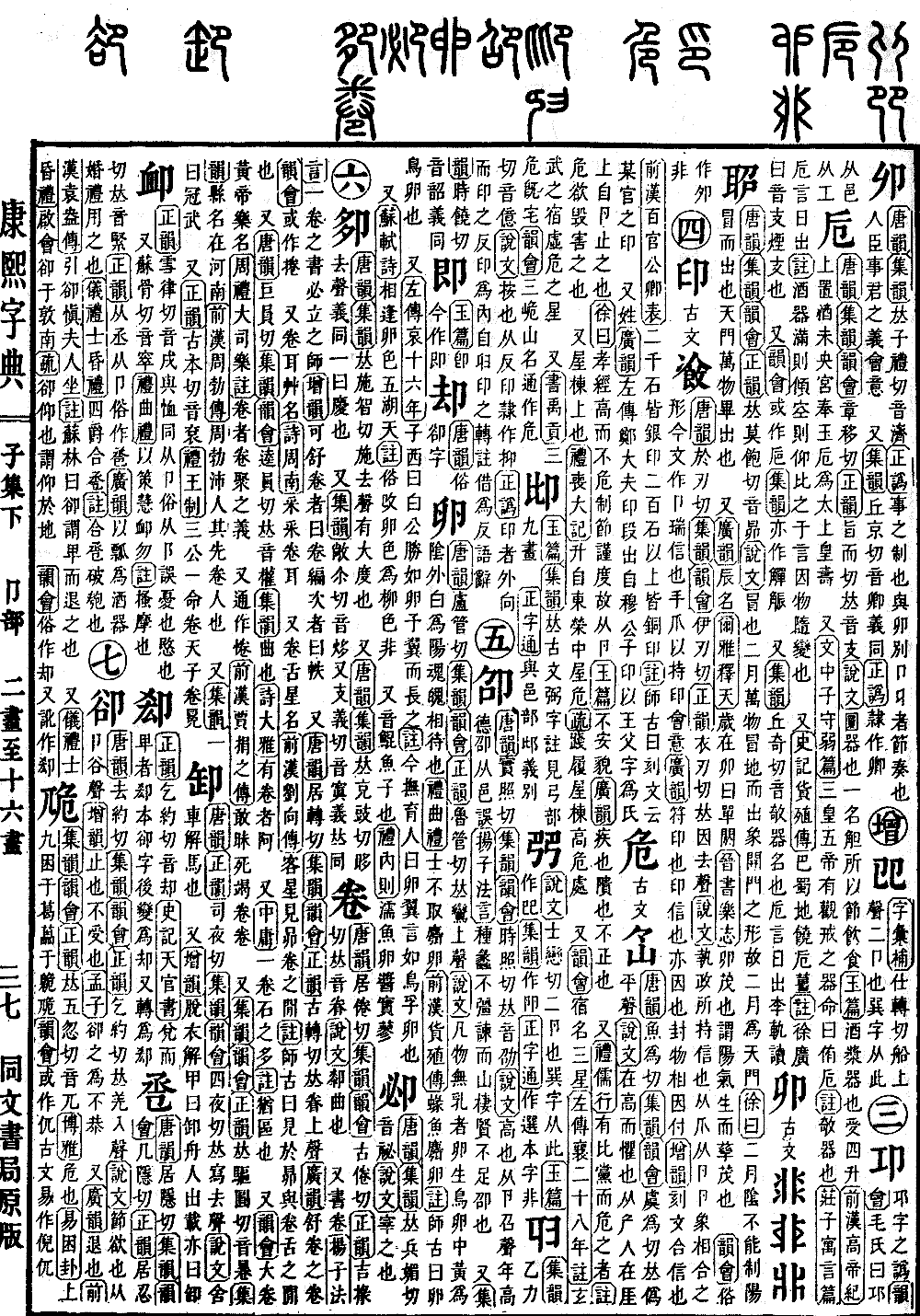
Zi Collection, Page Position: Lower
Radical: Seal (jié)
Entry: zhi
Kangxi Stroke Count: 5
Page 159, Entry 04
Tang Rhymes (Tangyun), Collected Rhymes (Jiyun), and Rhyme Compendium (Yunhui) state it is pronounced zhi (level tone). Correct Rhymes (Zhengyun) states it is pronounced zhi (rising tone).
According to the Explaining Graphs and Analyzing Characters (Shuowen), it is a round vessel. It is also called dan, and it is used for regulating diet. The Jade Chapter (Yupian) defines it as a vessel for holding wine or liquids, with a capacity of four liters.
In the History of the Former Han (Qian Han Shu), Biography of Emperor Gao, it is recorded: The Emperor held a banquet at Weiyang Palace, holding a jade zhi to toast the Grand Emperor.
According to the Book of the Master of Letters (Wenzhongzi), Chapter on Preserving Weakness (Shouruo pian), the Three Sovereigns and Five Emperors possessed a vessel used for admonishment, called a youzhi. The commentary notes it is a type of vessel.
In the Zhuangzi, Chapter on Allegories (Yuyan pian), it mentions zhi words emerging daily. The commentary notes: A wine vessel tips over when full and rights itself when empty; this is used as a metaphor for language that should adapt according to the situation.
According to the Records of the Grand Historian (Shiji), Biography of Merchants (Huozhi zhuan), the Ba and Shu regions are rich in zhi ginger. The commentary by Xu Guang states: It is pronounced zhi, meaning rouge.
The Rhyme Compendium (Yunhui) notes it is sometimes written in a variant form (zhi). The Collected Rhymes (Jiyun) notes it is also written as (zhi).
According to the Collected Rhymes (Jiyun), it is pronounced qi. It is the name of a vessel. The phrase zhi words emerging daily is read this way by Li Gui.