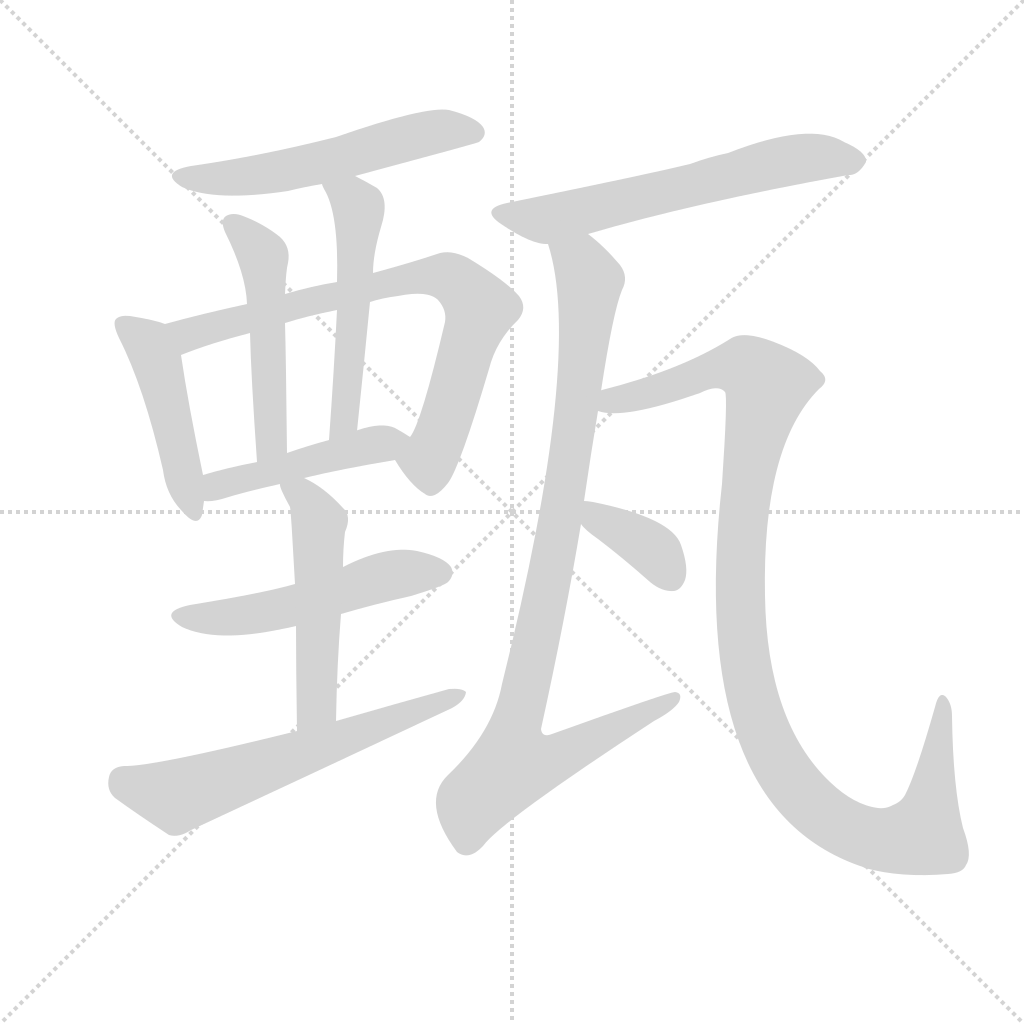
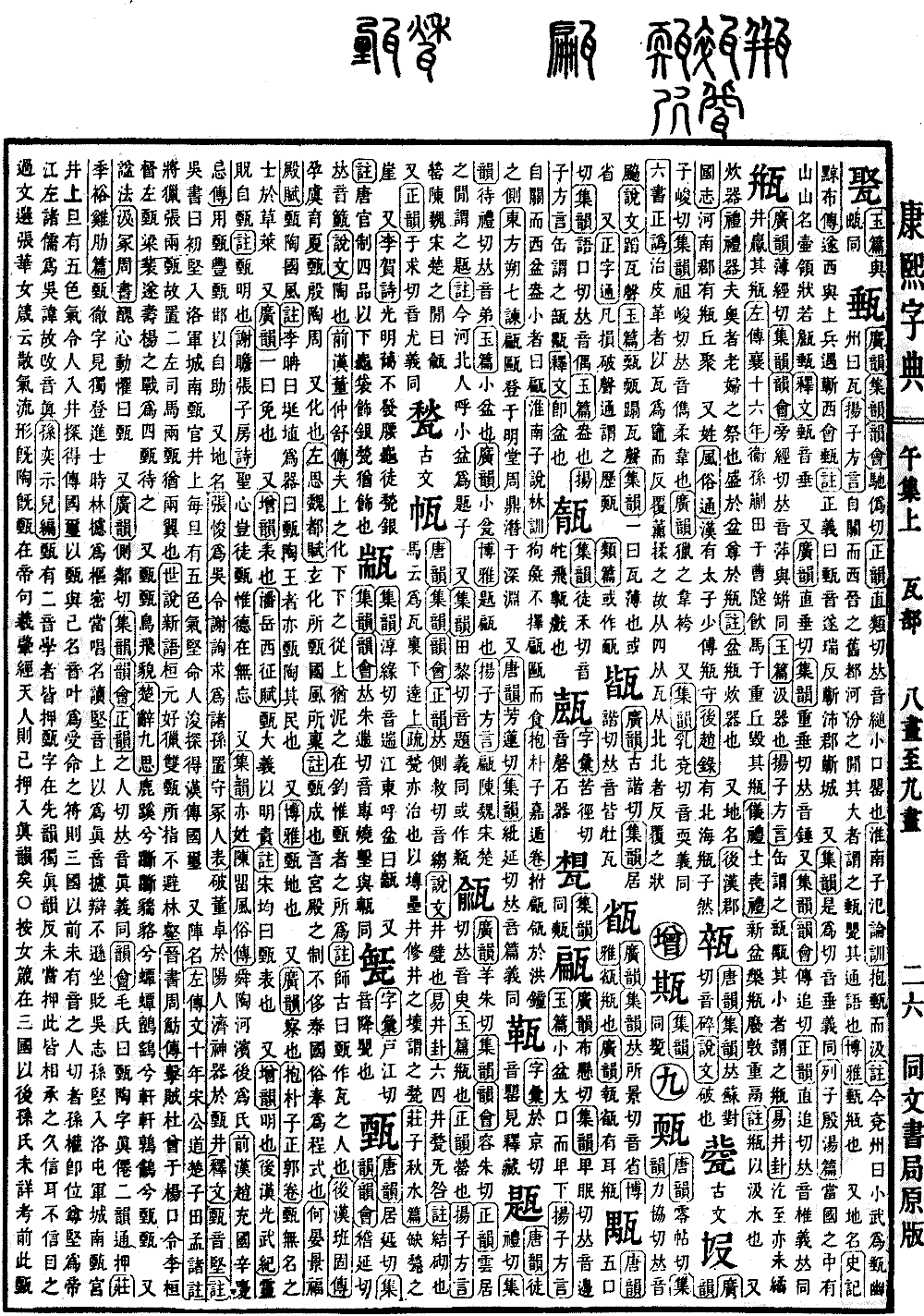
Wu Collection, Upper Volume. Radical: Tile (wǎ). Kangxi Stroke Count: 14. Page 750, Entry 23.
Pronounced jian.
According to the Tang Rhyme (Tangyun), the Collection of Rhymes (Jiyun), and the Rhyme Gathering (Yunhui), the pronunciation is jian.
In the Explaining Graphs and Analyzing Characters (Shuowen Jiezi), it refers to a potter.
In the Biography of Dong Zhongshu from the History of the Former Han (Qianhan Shu), it says: When the superior transforms the inferior, and the inferior follows the superior, it is like clay on a potter's wheel, directed entirely by the potter. The commentary by Shigu says: A zhen is one who makes tiles.
In the Biography of Ban Gu from the History of the Later Han (Houhan Shu), it says: Nurturing Yu and raising Xia, shaping Yin and pottery-making for Zhou.
It also means to transform.
In the Rhapsody on the Wei Capital (Wei Du Fu) by Zuo Si, it says: Transformed by what is shaped, and influenced by the customs of the state. The commentary says: Zhen means to complete. It means that the design of the palaces was not extravagant, and the national customs adopted this as a standard.
In the Rhapsody on the Jingfu Palace (Jingfu Dian Fu) by He Yan, it says: Shaping and molding the customs of the state. The commentary by Li says: To temper clay to make vessels is called zhen-tao; kings also mold their people in this way.
It also refers to the ground, according to the Bowaya.
It also means to examine, according to the Guangyun. In the Baopuzi, it says: To examine the worthy among the recluses.
It also means to exempt, according to the Guangyun.
It also means to manifest, according to the Zengyun. In the Western Expedition Rhapsody (Xi Zheng Fu) by Pan Yue, it says: To manifest the great righteousness and clarify responsibilities. The commentary by Song Jun says: Zhen means to display.
It also means to clarify, according to the Zengyun. In the Annals of Emperor Guangwu of the Later Han, it says: The spiritual blessing is self-evident. The commentary says: Zhen means to clarify. In a poem by Xie Zhan on Zhang Zifang, it says: How could the sage's heart merely clarify, his virtue lies in not forgetting.
It is also a surname, according to the Jiyun. The Fengsu Tong (Customs and Traditions) says: Shun made pottery on the banks of the Yellow River, and later descendants took this as a clan name. In the biographies of Zhao Chongguo and Xin Qingji in the History of the Former Han, it mentions: Using Zhen Feng and Zhen Han to assist oneself.
It is also a place name. In the memorial by Zhang Quan, it says: Defeating Dong Zhuo at Yangren, and saving the imperial regalia at the Zhen Officer's well. The commentary says: Pronounced jian. The Records of Wu (Wu Shu) states: When Sun Jian first entered Luoyang and camped south of the city, at the Zhen Officer's well, there was five-colored vapor every morning. Jian ordered people to dredge it, and found the Han imperial seal.
It also refers to military formations. In the Zuo Tradition (Zuo Zhuan), it mentions the deployment of two zhen, which refers to two wings of an army. In the New Account of Tales of the World (Shishuo Xinyu), it mentions the double zhen in hunting. In the History of the Jin Dynasty, it records the use of four zhen in the battle of Shouyang.
Zhen-zhen describes the flight of birds, according to the Nine Longings (Jiusi) of the Chu Songs (Chuci).
In the Book of Zhou (Zhoushu), it is a term for a posthumous title: One who is fearful in heart is called zhen.
Pronounced zhen.
The meaning is the same as above. The Rhyme Gathering (Yunhui) quotes Mr. Mao as saying: The characters for pottery-making are interchangeable in the zhen and xian rhymes. In the Jilei Pian by Zhuang Jiyu, it says: When Zhen Che passed the imperial examination, Lin Hu was a grand councilor; when the names were called, he read it as jian, but the Emperor corrected it to zhen. Lin Hu argued impertinently and was demoted. The Records of Wu says Sun Jian found the seal, and since the name matched the sound of the seal, it was seen as a mandate; prior to the Three Kingdoms period, there was no pronunciation of zhen. When Sun Quan ascended the throne, he honored Sun Jian as Emperor, so scholars in the south changed the pronunciation to zhen to avoid the taboo of the Emperor's father's name.
According to the Shier Bian by Sun Yi: Zhen has two pronunciations. Scholars always rhyme it with the xian group, but never the zhen group; this is due to long-standing habit. In the Admonitions of the Instructress to the Court Ladies (Nüshi Zhen) by Zhang Hua in the Selections of Refined Literature (Wenxuan), it rhymes with the zhen group. The Nüshi Zhen dates to after the Three Kingdoms, so the assumption that there was no zhen pronunciation before this is incorrect.
According to the Bowaya, the space under a floor is called a zhen. Pronounced bin.
According to the Bowaya, it refers to a brick. Pronounced zhen.
Pronounced jian.
To examine or to strive.
Pronounced juan.
To watch.
Pronounced juan.
Identical to the character for the place name Juan, located in Wei. Now in Qi/Yin, Juan City; sometimes written as Zhen. In the Records of the Grand Historian (Shiji), it mentions the feudal lords meeting Duke Huan at Zhen. Du Yu says: Zhen is a place in Wei, now in the north of Zhencheng County, Puyang. In the Biography of Tian Jingzhong, it says: Formerly Zhao attacked Zhen, and you could not save it. The commentary says: Pronounced juan.
Pronounced zhen.
Describes the sound of a bell. In the Rites of Zhou (Zhouli), it mentions thin sounds. The commentary says: Zhen is read as zhen-yao, meaning to vibrate.
Pronounced ji.
In the Book of the Life-Ordering Narrative (Mingli Xu) of the Spring and Autumn period, it mentions: Shennong zhenned the four seas, and Baifu traced the mountains and rivers. Baifu is a person's name. It is also used in the Buddhist term for "to clarify." Also pronounced ji.