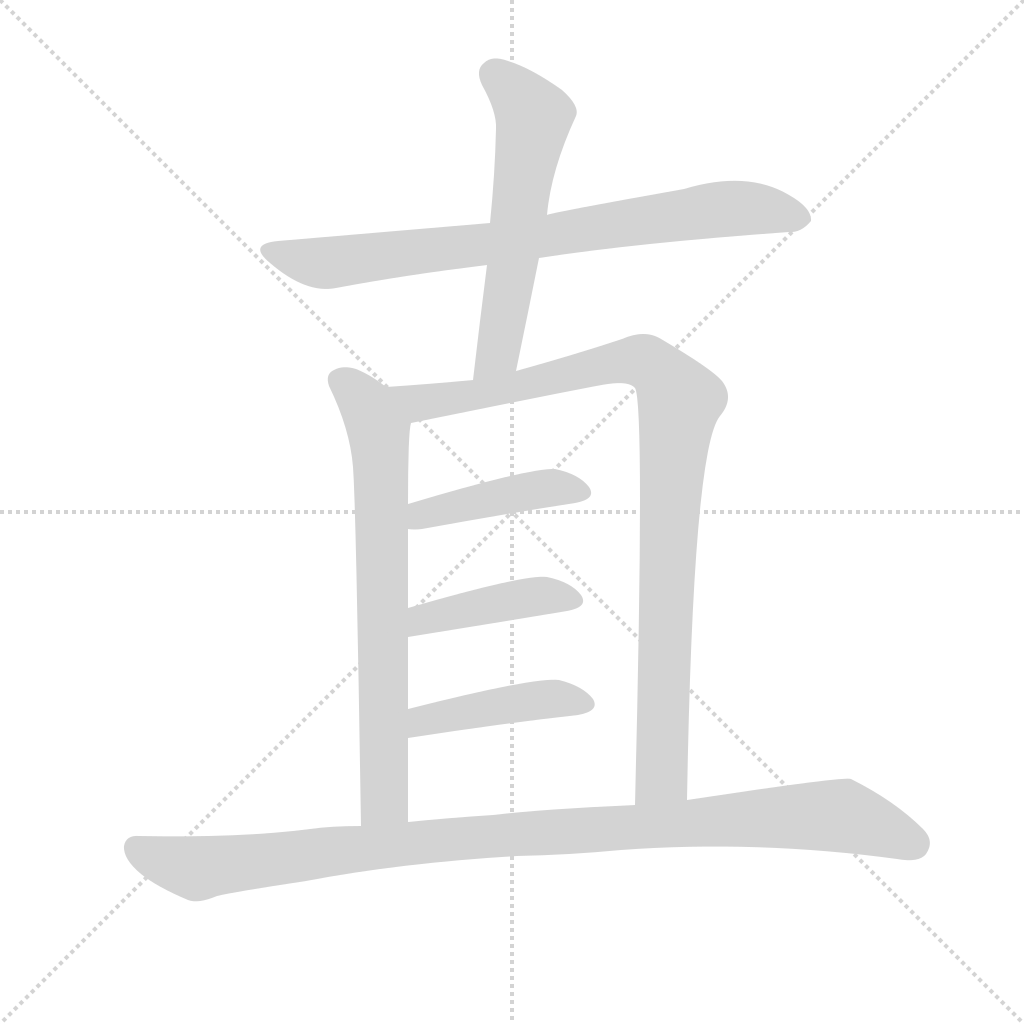
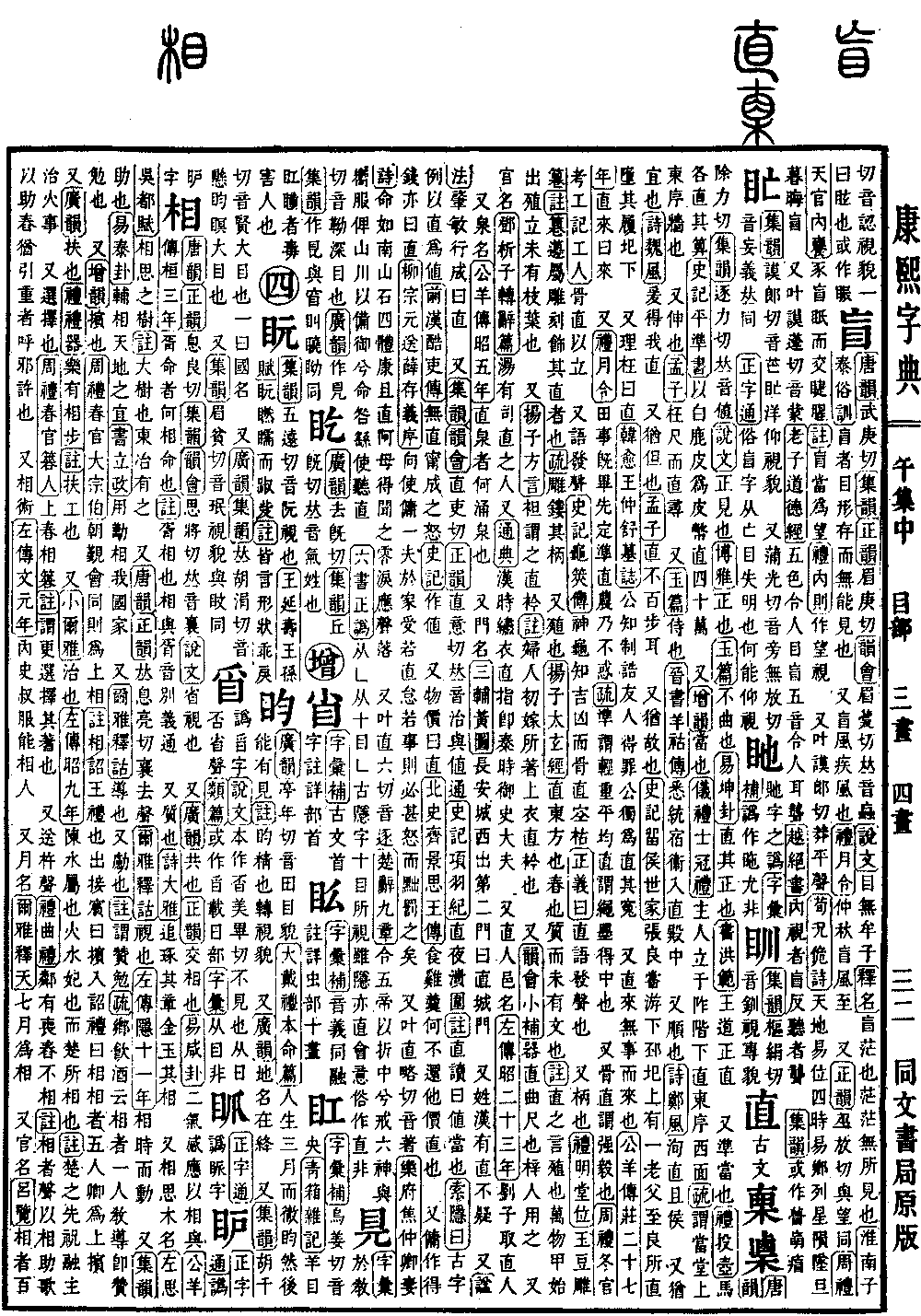
Wu Collection, Middle Volume. Radical: Eye (mù). Stroke count: 8. Page 800, Entry 05. Ancient character. Pronounced zhi.
Shuowen Jiezi (Explaining Single-Component Characters and Analyzing Compound Characters): To see uprightly.
Boya (Broad Refinement): Upright.
Yupian (Jade Chapters): Not crooked.
Book of Changes (Yijing), Kun Hexagram: To make upright is its correctness.
Book of Documents (Shujing), Great Plan (Hongfan): The royal way is upright and honest.
Also means to correspond or equal.
Book of Rites (Liji), Throwing at the Pot (Touhu): Each horse is worth its count.
Records of the Grand Historian (Shiji), Treatise on the Balanced Standard (Pingzhun Shu): Using white deer skin as currency, valued at 400,000.
Also in Zengyun (Added Rhymes): To correspond.
Ceremonial Rites (Yili), Capping Rites for Officers (Shi Guanli): The host stands below the eastern steps, facing west, aligned with the eastern wall.
Commentary: Meaning directly aligned with the eastern wall of the hall.
Also to extend.
Mencius: To bend a cubit to straighten a span.
Also Yupian (Jade Chapters): To serve.
Book of Jin (Jin Shu), Biography of Yang Hu: Fully in charge of the night guards, entering to serve in the palace.
Also to follow.
Book of Odes (Shijing), Odes of Zheng: Truly compliant and noble.
Also used as ought to.
Book of Odes (Shijing), Odes of Wei: There I found my due.
Also used as merely.
Mencius: Merely not a hundred paces.
Also used as therefore.
Records of the Grand Historian (Shiji), Hereditary House of the Marquis of Liu (Zhang Liang): Zhang Liang once traveled to Xiapi; there was an old man on the bridge who, upon seeing Liang, deliberately dropped his shoe under the bridge.
Also to bury a grievance is called zhi.
Han Yu, Epitaph for Wang Zhongshu: The public knew the drafting official was wronged by a friend, and he alone cleared his name.
Also to come directly, meaning to come without a specific task.
Gongyang Commentary (Gongyang Zhuan), 27th Year of Duke Zhuang: To come directly is called coming.
Also Book of Rites (Liji), Monthly Ordinances (Yueling): When agricultural work is finished, first establish the standard, so that farmers are not confused.
Commentary: The standard refers to weighing lightness and heaviness; zhi refers to the plumb line being centered.
Also bone-straight, meaning strong and determined.
Book of Rites (Zhouli), Artificers' Record (Kaogongji): The bones must be straight to stand.
Also a particle for starting a sentence.
Records of the Grand Historian (Shiji), Treatise on Tortoise and Milfoil Divination (Gui Ce Zhuan): The divine tortoise knows fortune and misfortune, but its bones are straight, empty, and withered.
Commentary: Zhi is a particle used at the beginning of a sentence.
Also a handle.
Book of Rites (Liji), Regulations of the Bright Hall (Mingtang Wei): Jade bean and carved stem.
Commentary: A bean is a type of vessel; the carving decorates its handle.
Commentary: Refers to carving the handle.
Also to propagate.
Yang Xiong, Grand Mystery (Taixuan Jing): Zhi represents the East and Spring. It is raw and not yet ornate.
Commentary: Zhi means to propagate. All things begin to sprout and stand, not yet having branches or leaves.
Also Yang Xiong, Dialects (Fangyan): Exposure and decoration are called zhi ling.
Commentary: The upper garment worn by a woman upon first marriage is called zhi ling.
Also Rhyme Treasury Supplement (Yunhui Xiaobu): An instrument called zhi is a carpenter's square.
Also an official title.
Deng Xizi, Chapter on Transforming Words: King Tang had the official of straight-pointing.
Also Comprehensive Institutes (Tongdian): During the Han dynasty, the embroidery-clothed straight-pointers were the Imperial Censors of the Qin dynasty.
Also Zhiren, a place name.
Zuo Commentary (Zuo Zhuan), 23rd Year of Duke Zhao: Lord Liu took Zhiren.
Also a spring name.
Gongyang Commentary (Gongyang Zhuan), 5th Year of Duke Zhao: What is the straight spring? It is a gushing spring.
Also a gate name.
Three Subsidiary Maps (Sanfu Huangtu): The second gate out of the west side of Chang'an city is called Zhicheng Gate.
Also a surname. The Han dynasty had Zhi Buyi.
Also in the Law of Posthumous Titles: One who initiates and is quick in action is called zhi.
Also Rhyme Treasury (Yunhui): Pronounced zhi. Interconnected with the word for value.
Records of the Grand Historian (Shiji), Annals of Xiang Yu: Standing in the night, he broke the siege.
Commentary: Zhi is read as value, meaning to correspond.
Commentary: Ancient texts often used zhi for value.
History of the Former Han (Qian Han Shu), Biography of Harsh Officials: No one dared to face the anger of Ning Cheng.
Records of the Grand Historian (Shiji) uses the character for value.
Also the price of goods is called zhi.
History of the Northern Dynasties (Bei Shi), Biography of Prince Jing Si of Qi: Eating chicken soup, why not return him the price?
Also wages for labor are called zhi.
Liu Zongyuan, Sending off Xue Cunyi: If you hired a laborer at home, paid him his wages, and he was lazy in his duties, you would surely be very angry and dismiss him.
Also rhymes with zhi-lüe, pronounced zhuo.
Music Bureau (Yuefu), Poem of Jiao Zhongqing's Wife: My life is like the stone of the Southern Mountain, my body is healthy and upright. When my mother heard this, tears fell with the sound.
Also rhymes with zhi-liu, pronounced zhu.
Songs of Chu (Chucí), Nine Declarations (Jiuzhang): I ordered the Five Emperors to seek the center; I warned the Six Gods and the spirits of the cardinal directions. I ordered the mountains and rivers to be fully prepared; I commanded Gao Yao to listen to the upright.
Six Writings' Corrections (Liushu Zheng'e): Composed of ten and eye. The original character for hidden. When ten eyes look, even if hidden, one is upright. This is an associative compound. The vulgar form is zhi, which is incorrect.