Si Collection, Lower Volume
Radical: Cow (niú)
Kangxi Strokes: 12
Page 702, Entry 09
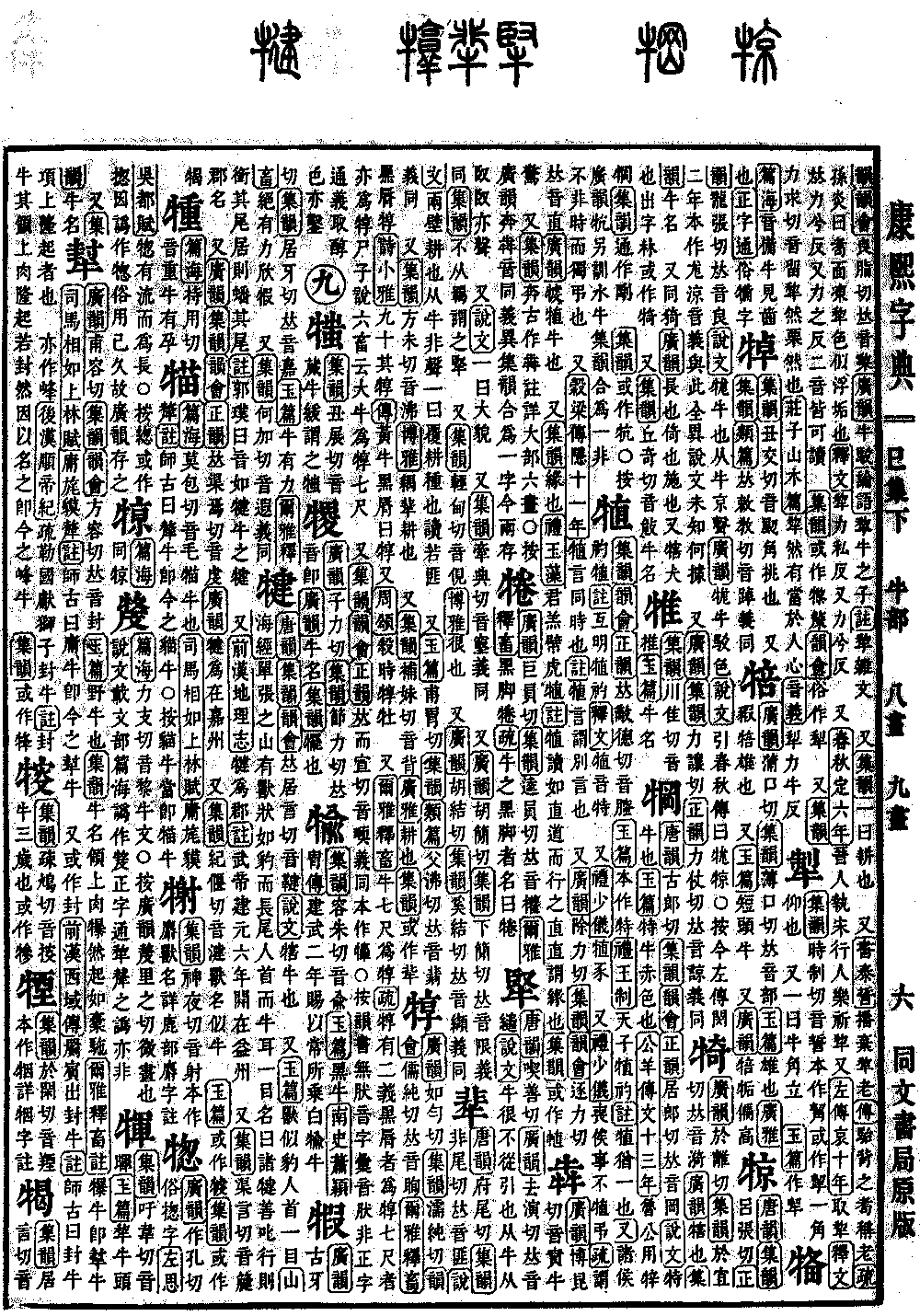
According to the Collection of Rhymes (Jiyun), the Collection of Rhymes (Yunhui), and the Correct Rhymes (Zhengyun), the pronunciation is te (rising tone).
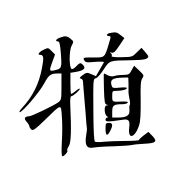
The Jade Chapter (Yupian) notes this is the original form of te.
Book of Rites (Liji), Royal Regulations (Wangzhi): The Son of Heaven performs the teyue sacrifice. Commentary: Te means one.
Also: The feudal lords perform the yue te sacrifice. Commentary: This mutually clarifies the meaning of teyue.
Explanation of Terms (Shiwen): Te is pronounced te.
Also, Book of Rites (Liji), Lesser Rules of Demeanor (Shaoyi): A te pig.
Also, Book of Rites (Liji), Lesser Rules of Demeanor (Shaoyi): In mourning, one does not pay a private visit (te) before the time for attending to business. Commentary: This means one does not pay a private visit at an irregular time.
Also, Guliang Commentary (Guliang zhuan), Eleventh Year of Duke Yin: If the words are te, they are simultaneous. Commentary: Te words refer to words spoken separately.
Also, Broad Rhymes (Guangyun): Pronounced zhi (entering tone). The Collection of Rhymes (Jiyun) and the Collection of Rhymes (Yunhui): Pronounced zhi (entering tone).
Broad Rhymes (Guangyun): Te refers to a cow.
Also, Collection of Rhymes (Jiyun): To edge or border.
Book of Rites (Liji), Jade Pattern (Yuzao): The ruler uses a lambskin cover with a tiger-skin border (te). Commentary: Te is read like the zhi in the phrase walking the straight (zhi) path. Zhi means a border or edge.
Collection of Rhymes (Jiyun): Sometimes also written in a variant form.