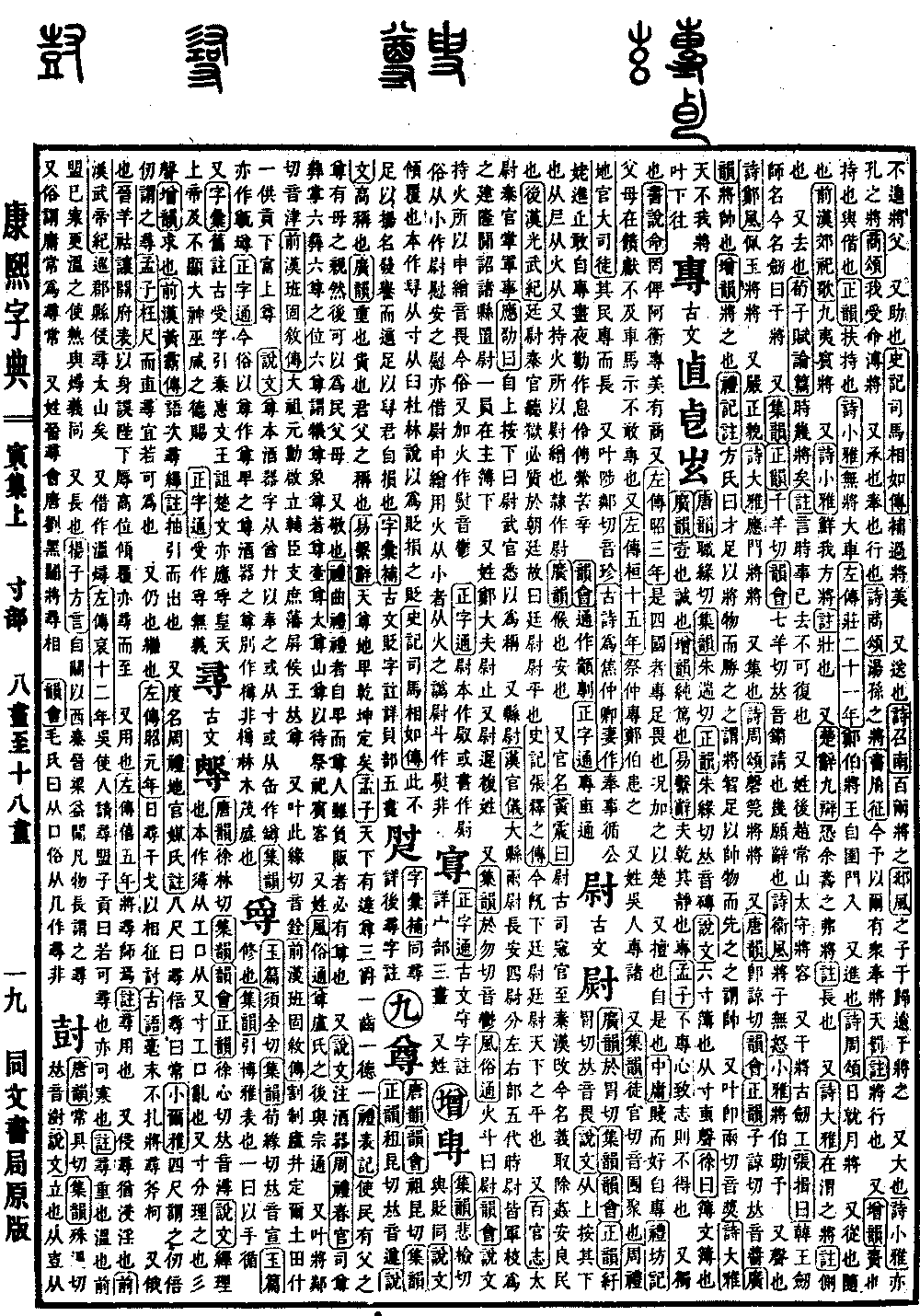
Yin Collection, Upper Volume
Radical: Inch (cùn)
Kangxi Strokes: 11
Page 295, Entry 01
Ancient character form.
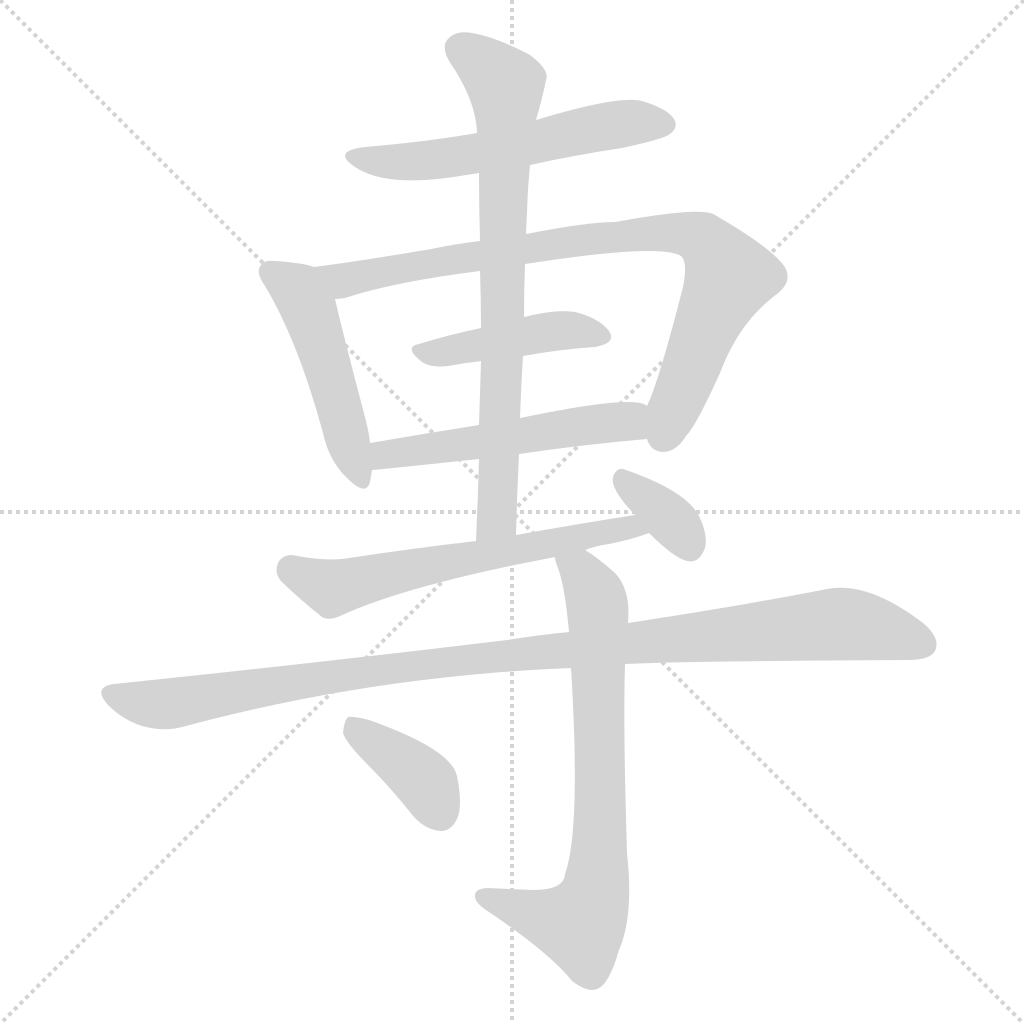
Pronounced zhuan.
As defined in the Analytical Dictionary of Characters (Shuowen Jiezi), it refers to a six-inch record book. Formed from the radical for inch, with the phonetic component zhuan. Xu Kai states: The term record refers to a register of documents.
In the Broad Rhymes (Guangyun), it means one or sincere. In the Supplementary Rhymes (Zengyun), it means pure and honest.
From the Book of Changes (Yijing), section Appended Remarks: When Qian is in a state of rest, it is concentrated.
From the Mencius (Mengzi): If one does not concentrate their mind and focus their intent, they will not achieve anything.
It also means alone or singular. From the Book of Documents (Shujing), Record of Yue: Do not allow A-Heng to take sole credit for the beauty of the Shang dynasty.
From the Zuo Tradition (Zuozhuan), 12th year of Duke Zhao: Zighe replied, saying these four states are uniquely formidable.
It also means to usurp or to act on one's own authority. From the Doctrine of the Mean (Zhongyong): To be of low status and yet fond of acting on one's own authority.
From the Record of Rites (Liji), Record on Customary Restrictions: When parents are alive, one does not present gifts of carriages or horses, as a sign that one dare not act on one's own authority.
From the Zuo Tradition (Zuozhuan), 15th year of Duke Huan: Zhai Zhong acted with total authority, and the Earl of Zheng was troubled by this.
It is also a surname. Zhuan Zhu was a native of the state of Wu.
Pronounced tuan. It means to gather. From the Rites of Zhou (Zhouli), Ministry of Earth, Grand Minister of Instruction: The people are gathered and long-lived.
Rhyming as zhen. From the ancient poem "For the Wife of Jiao Zhongqing": I served my mother-in-law diligently, never daring to act on my own authority in movement or rest. Day and night I labored in work and sleep, lonely and entwined with bitter hardships.
In the Collection of Rhymes (Yunhui), it is commonly written as zhuan or zhuan.
In the Correct Meaning of Characters (Zhengzitong), it is noted that the characters zhuan and zhuan are interchangeable.
Textual research: The original text cited the 3rd year of Duke Zhao of the Zuo Tradition, saying these four states are uniquely formidable, and included an additional clause regarding the state of Chu. This clause is incomplete in terms of meaning and the year cited is incorrect. It has been corrected to the 12th year of Duke Zhao, where Zighe replied, saying these four states are uniquely formidable.