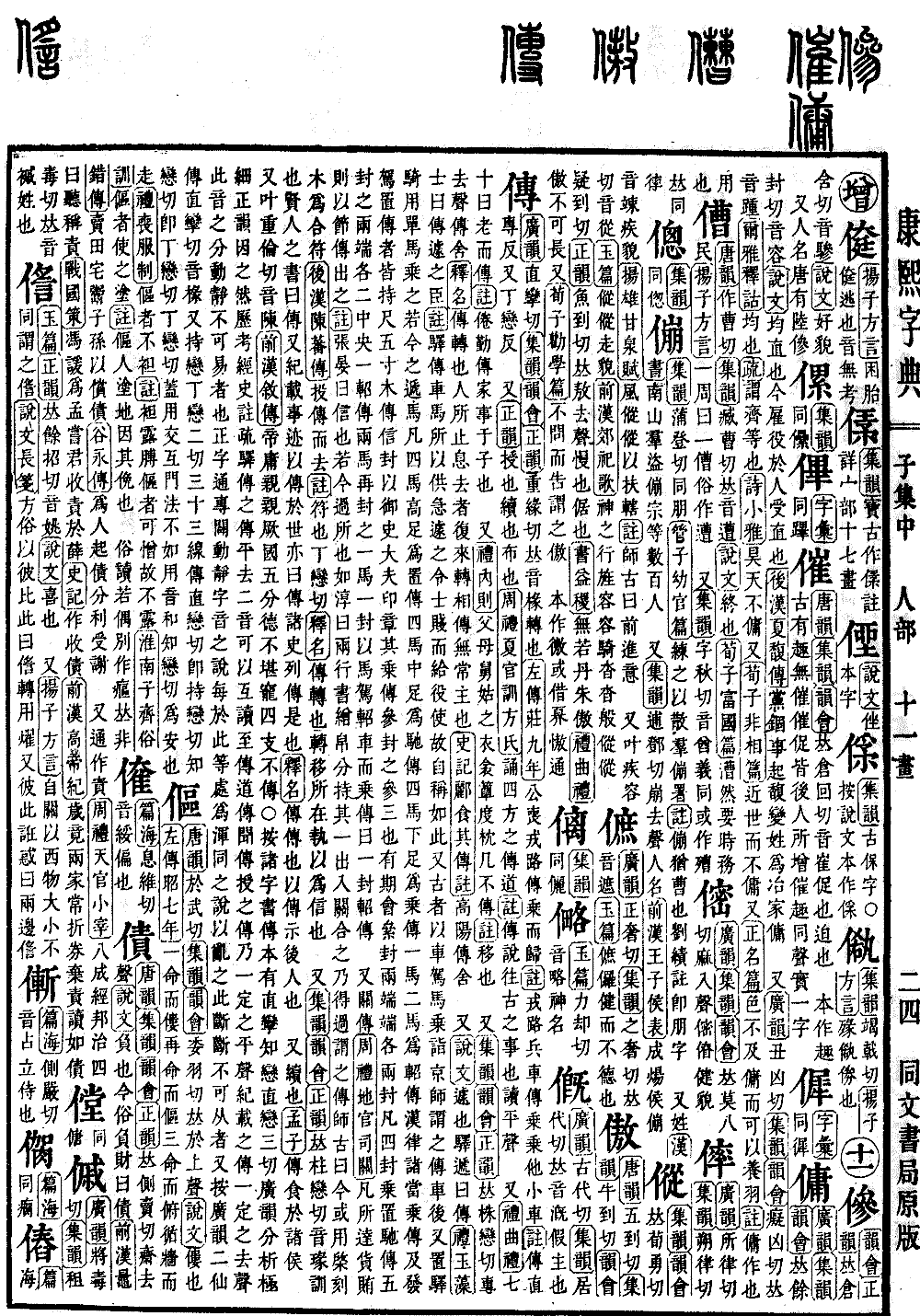
Zi Collection, Middle Volume Radical: Person (rén)
Page 114, Entry 23
Pronounced chuan (rising tone).
Meaning: To transfer or pass on.
Book of Zuo (Zuozhuan), Year 9 of Duke Zhuang: The Duke lost his war carriage and returned by taking a carriage that was being passed along.
Commentary: War carriage refers to a military vehicle. Taking a carriage refers to riding a different vehicle.
Exegesis: Pronounced chuan (rising tone); also pronounced ding (rising tone).
Meaning: To teach, continue, or disseminate.
Book of Rites of Zhou (Zhouli), Ministry of Summer, Instructors of the Regions: Reciting the teachings (chuan dao) of the four regions.
Commentary: To narrate the affairs of the past. Pronounced with a level tone.
Book of Rites (Liji), Qu Li: At seventy, one is called old and transfers (chuan) responsibilities.
Commentary: Due to weariness from toil, one transfers household duties to one's son.
Book of Rites (Liji), Nei Ze: The clothing, bedclothes, mats, pillows, and tables of parents and parents-in-law should not be moved (chuan).
Commentary: To move.
Pronounced zhuan (falling tone).
Meaning: Post station or relay house.
Explanation of Names (Shiming): Chuan means to revolve or rotate (zhuan). People stop and rest here, and those who depart are replaced by others. It means passing on without a fixed owner.
Records of the Grand Historian (Shiji), Biography of Li Yiji, Commentary: The relay house of Gaoyang.
Shuowen Jiezi: Speed; relay transmission is called chuan.
Book of Rites (Liji), Yuzao: A scholar is called a minister of urgent post (chuan ju).
Commentary: Relay carriages and horses are used to supply urgent orders; scholars of low status perform these tasks, hence this self-designation.
In ancient times, using a carriage to reach the capital was called a post-carriage (chuan che). Later, relay riders were established, using single horses like modern postal horses. Those with four superior horses are called zhi chuan; four medium horses are called chi chuan; four inferior horses are called cheng chuan; one or two horses are called yao chuan. Han law stipulated that those traveling by post-carriage or setting up post-carriages carried a wooden tally one foot five inches long, stamped with the seal of the Censor-in-Chief. Those traveling by post-carriage required three seals. Can means three. If there was a scheduled meeting, the seals were placed at both ends; two seals at each end made four in total. Traveling by zhi chuan or chi chuan required five seals; two at each end and one in the center. Yao chuan with two horses required two seals, and one horse required one seal; using horses to drive a light carriage and traveling by post is called a one-seal yao chuan.
Also, gate pass (guan chuan).
Book of Rites of Zhou (Zhouli), Ministry of Earth, Minister of Gates: Whenever transporting goods, one uses a tally and a pass (chuan) to exit the gate.
History of the Former Han (Qianhan), Annals of Emperor Wen, Commentary: Zhang Yan says: It is a credential, like a modern travel permit. Ru Chun says: It is written on silk in two lines, divided into two halves; one holds each, and they must be matched to pass through the gate. This is called a chuan. Shigu says: Some now use carved wood (qi) as a matching tally.
History of the Later Han (Houhan), Biography of Fan: Abandoned the pass (chuan fu) and left.
Commentary: A tally credential.
Pronounced zhuan (falling tone).
Meaning: To explain or elucidate. Books by sages are called chuan.
Also, the recording of deeds to be handed down to the world is called chuan, such as the biographies in history books.
Explanation of Names (Shiming): Chuan means to transmit (chuan). Used to pass information to later generations.
Also, to continue.
Mencius: Moving from one place to another to receive support from the feudal lords.
Also pronounced chong (level tone).
History of the Former Han (Qianhan), Narrative Biography: The Emperor employed his relatives, dividing the country into five parts; their virtue was insufficient to bear the grace, and their limbs could not continue.
According to various dictionaries, the character has three pronunciations (fanqie). Guangyun analyzes them in great detail, and Zheng Yun follows this. However, after investigating the commentaries on the classics and histories, the chuan of postal relay can be pronounced in both level and falling tones. Regarding chuan in chuan dao (teaching the way), chuan wen (hearing by report), or chuan shou (handing down), it must be a level tone. Regarding chuan as a record (biography), it must be a falling tone. This is the distinction between dynamic and static word usages, which cannot be altered. Zhengzitong specifically refutes the distinction of dynamic and static tones, often using ambiguous arguments to cause confusion; this is absolutely not to be followed. According to Guangyun, rhyme group er-xian, chuan is pronounced chuan (level tone); it also has two other pronunciations. In rhyme group thirty-three, chuan is pronounced zhuan (falling tone). The pronunciation ding (rising tone) likely uses the cross-gate method and is not as appropriate as the pronunciation zhi (rising tone).