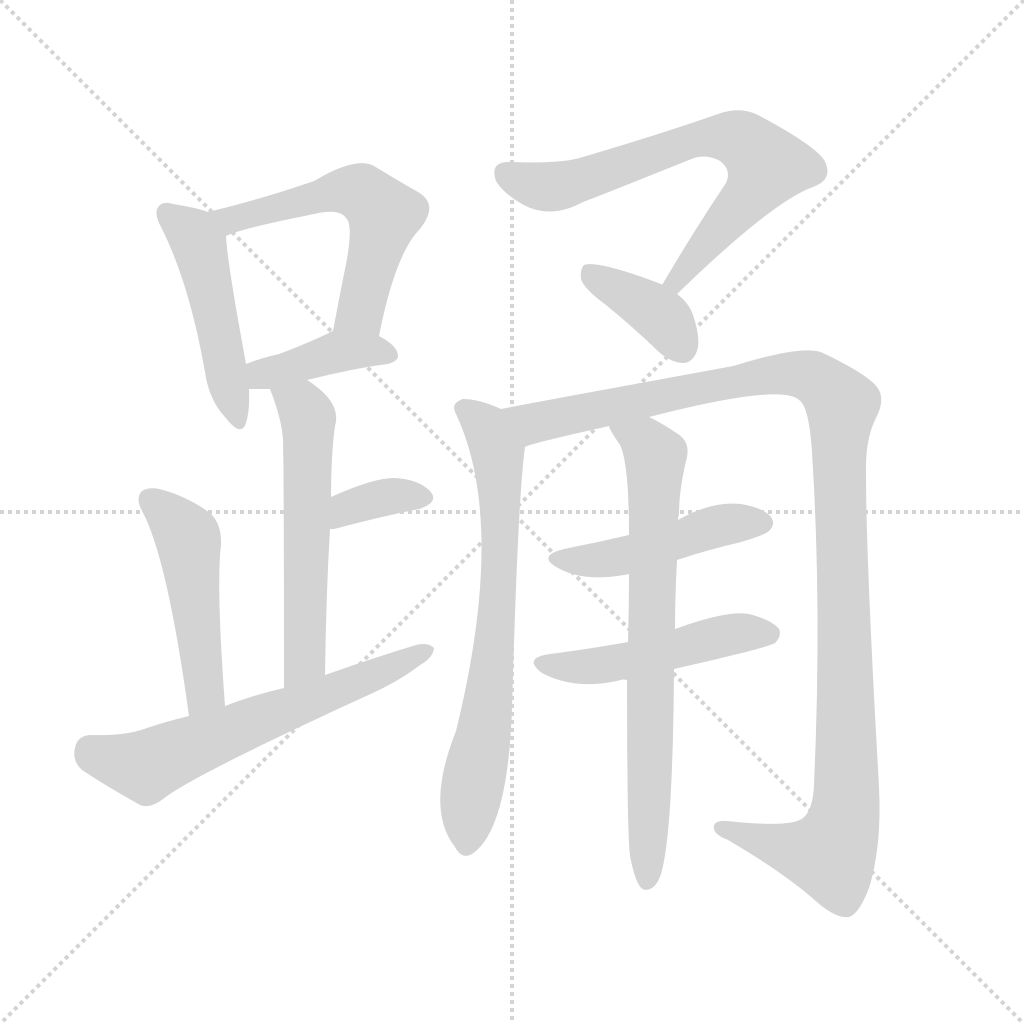
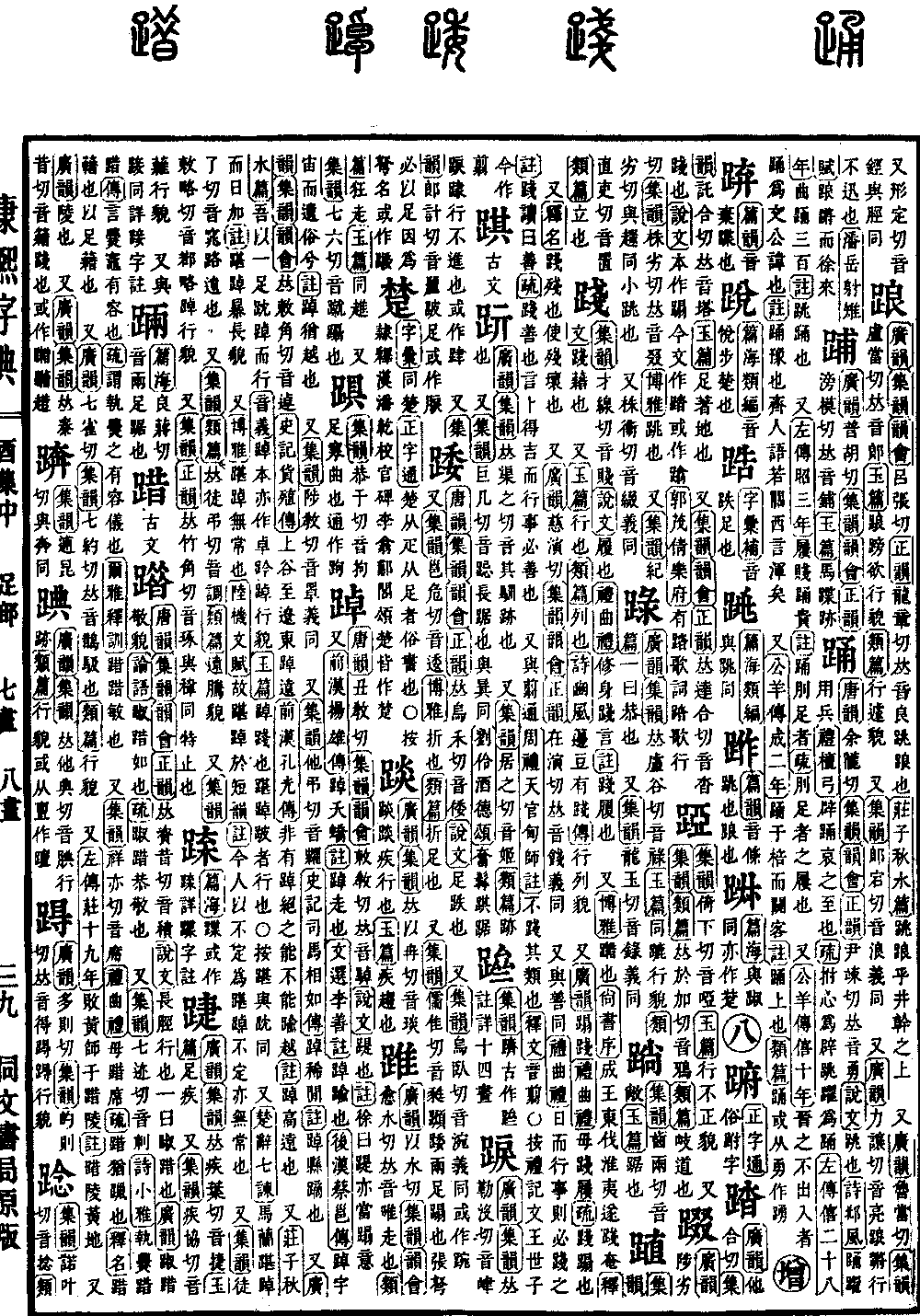
You Collection, Lower Volume
Radical: Foot (zú)
Yǒng; Kangxi strokes: 16; Page 1227, Entry 03
Textual Evidence:
According to Tang Rhyme (Tangyun), pronounced yǒng (rising tone). According to Collected Rhymes (Jiyun), Rhyme Anthology (Yunhui), and Standard Rhymes (Zhengyun), pronounced yǒng (rising tone).
Shuowen Jiezi says it means to jump.
Book of Odes (Shijing), Beifeng: To jump and move to use weapons.
Book of Rites (Liji), Tan Gong: Striking the chest and jumping (bi yǒng) is the extreme of mourning. The commentary states: Striking the chest is bi, and jumping is yǒng.
Zuo Tradition (Zuozhuan), 28th Year of Duke Xi: Three hundred men with bent jumps. The commentary states: This means to jump.
Zuo Tradition (Zuozhuan), 3rd Year of Duke Zhao: Shoes were cheap and artificial feet were expensive. The commentary states: Yǒng refers to those whose feet have been cut off. The sub-commentary states: These are shoes for those whose feet have been cut off.
Gongyang Commentary (Gongyang Zhuan), 10th Year of Duke Xi: The reason the state of Jin does not mention exit or entry is due to yǒng, which acts as a taboo for Duke Wen. The commentary states: Yǒng means to wait. In the dialect of Qi, it is similar to the Guanzhong expression for confused.
Gongyang Commentary (Gongyang Zhuan), 2nd Year of Duke Cheng: He jumped upon the staff to spy on the guest. The commentary states: Yǒng means to ascend.
Classified Chapters (Leipian): Yǒng is sometimes written with the yǒng character component as 踴.
Critical Revisions:
Gongyang Commentary (Gongyang Zhuan), 10th Year of Duke Xi: The reason the state of Jin does not mention exit or entry is due to yǒng, which acts as a taboo for Duke Wen. Revised according to the original text by removing the character for speak.
Note:
According to Collected Rhymes (Jiyun), yǒng may be written with the yǒng character component. According to Five Classics Orthography (Wujing Wenzi), writing it as 踴 is incorrect.