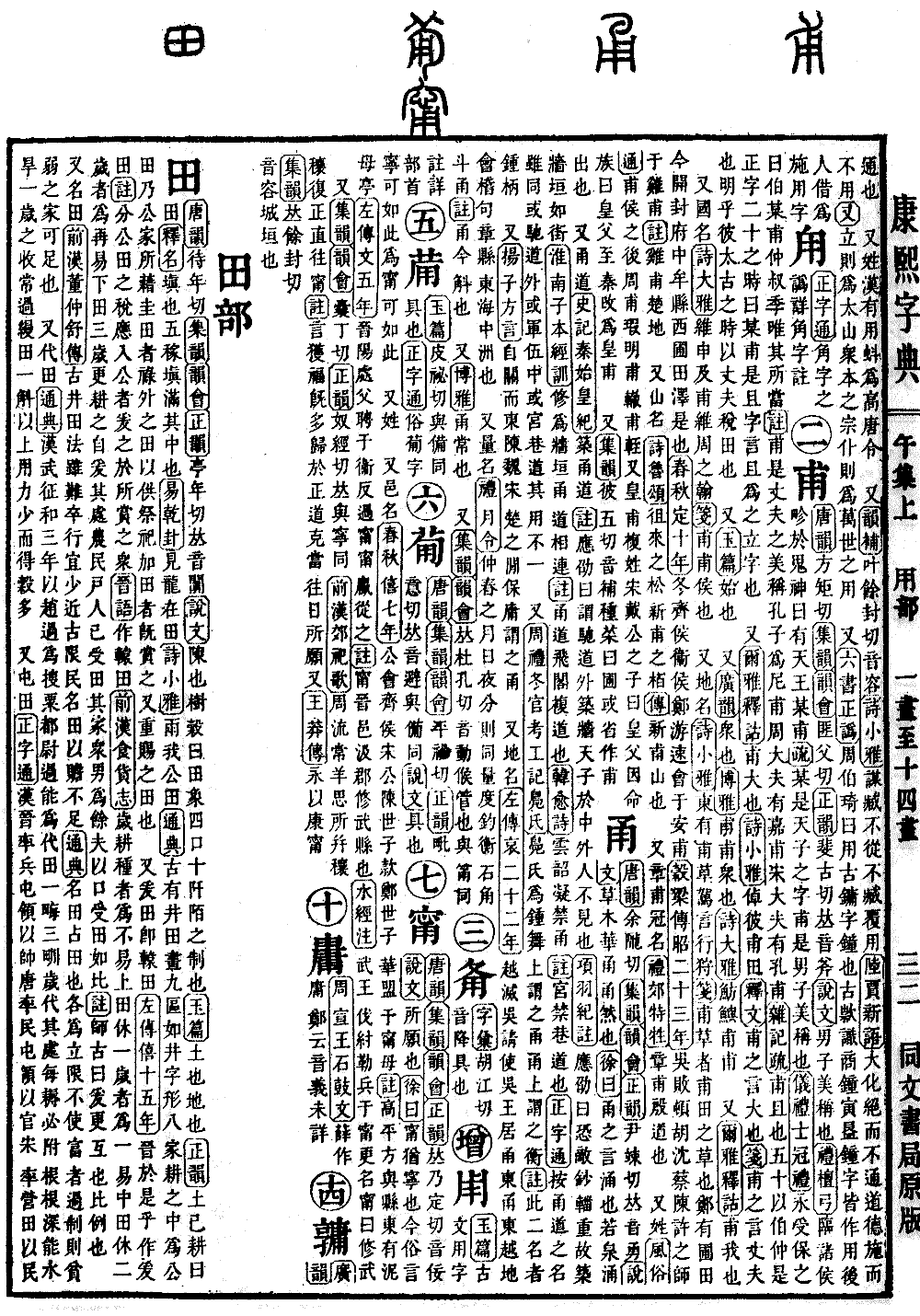
Wu Collection, Upper Volume
Radical: Use (yòng)
Page 756, Entry 03
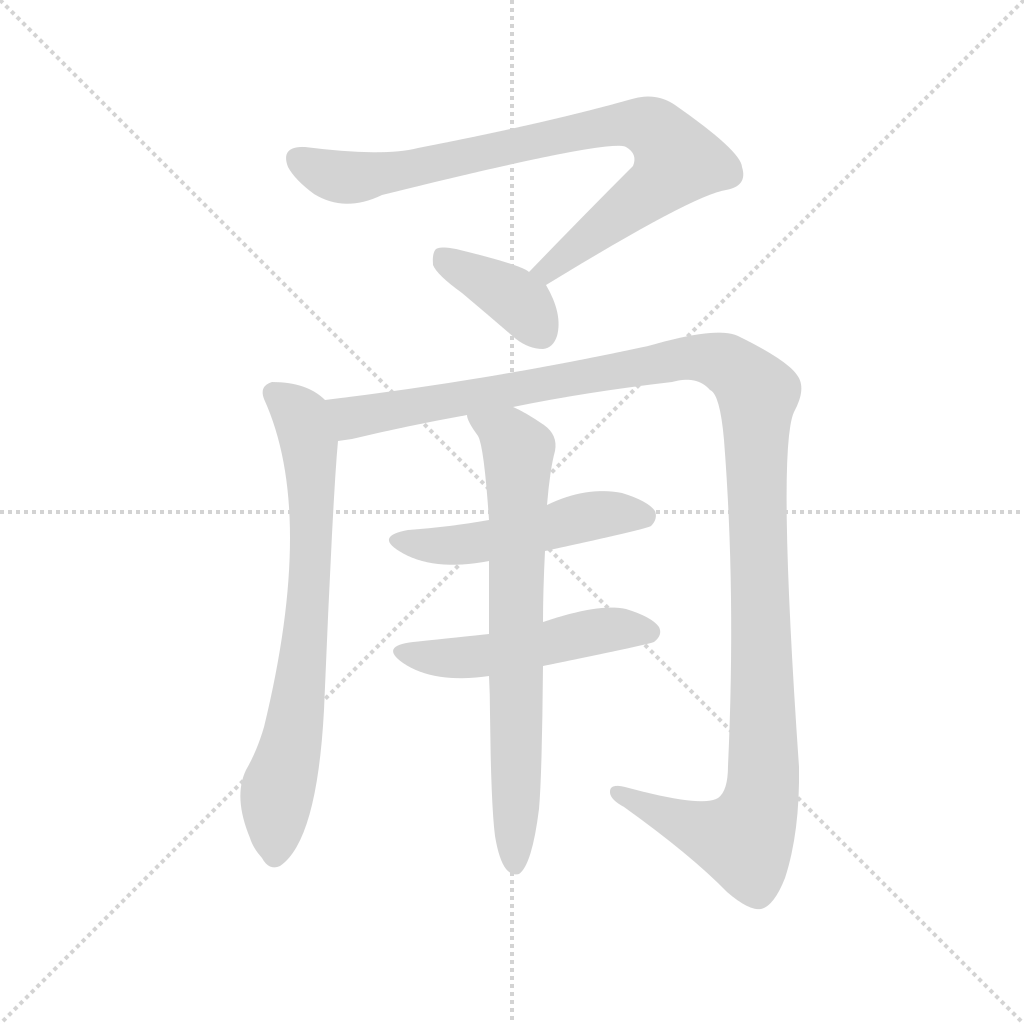
Pronounced yǒng.
According to the Explaining and Analyzing Characters (Shuowen), it describes the appearance of plants and flowers budding forth. According to Master Xu, the meaning of yong is to gush forth, like water emerging from a spring.
It also refers to an enclosed path. In the Records of the Grand Historian (Shiji), Annals of Qin Shi Huang, it is written: Constructed an enclosed path. The commentary by Ying Shao states: It refers to building walls on the sides of a main road so the emperor may walk within, hidden from the view of those outside. In the commentary to the Annals of Xiang Yu, Ying Shao states: It was built to protect provisions and heavy baggage from enemy raiding, resembling a walled street. In the Huainanzi (Huainanzi), Book of Essential Standards, it states: Built walls and enclosed paths to connect them. The commentary states: These paths are elevated, covered walkways. In the poetry of Han Yu, it states: Clouds and music gather in the forbidden paths. The commentary states: This refers to the lanes within the imperial palace.
According to the Correction of Character Dictionary (Zhengzitong), although the name of the path is the same, its function differs whether it is situated along a main highway, within a military camp, or inside palace lanes.
Furthermore, in the Rites of Zhou (Zhouli), Winter Officials, Artificers' Record, The Bell Makers section, it is stated: The bell makers cast bells; the top part of the bell body is called the yong, and the part above the yong is called the heng. The commentary states: These two names refer to the handle of the bell.
Furthermore, according to the Dialect (Fangyan), in the regions east of the passes, and between the states of Wei, Song, and Chu, hired laborers are called yong.
Furthermore, a place name. In the Zuo Tradition (Zuo Zhuan), 22nd Year of Duke Ai, it is written: The state of Yue destroyed the state of Wu and requested that the King of Wu be allowed to reside in Yongdong. Yongdong is a location within the state of Yue, in Gouzhang County of Kuaiji, referring to an island in the East Sea.
Furthermore, the name of a measurement tool. In the Book of Rites (Liji), Monthly Ordinances, it is written: In the month of the second month of spring, when day and night are equal in length, unify the measurements, calibrate the balance weights and stones, and calibrate the bushels and yong. The commentary states: The yong is the current hu.
Furthermore, according to the Broad Reference (Boya), yong means constant.
Furthermore, pronounced dòng. Refers to a tubular object. It is the same as tong.
Textual research: In the Book of Rites (Liji), Monthly Ordinances, it is written: In the month of the second month of spring, when day and night are equal in length, unify the measurements. Revised according to the original text to read: unify the weights and measures.