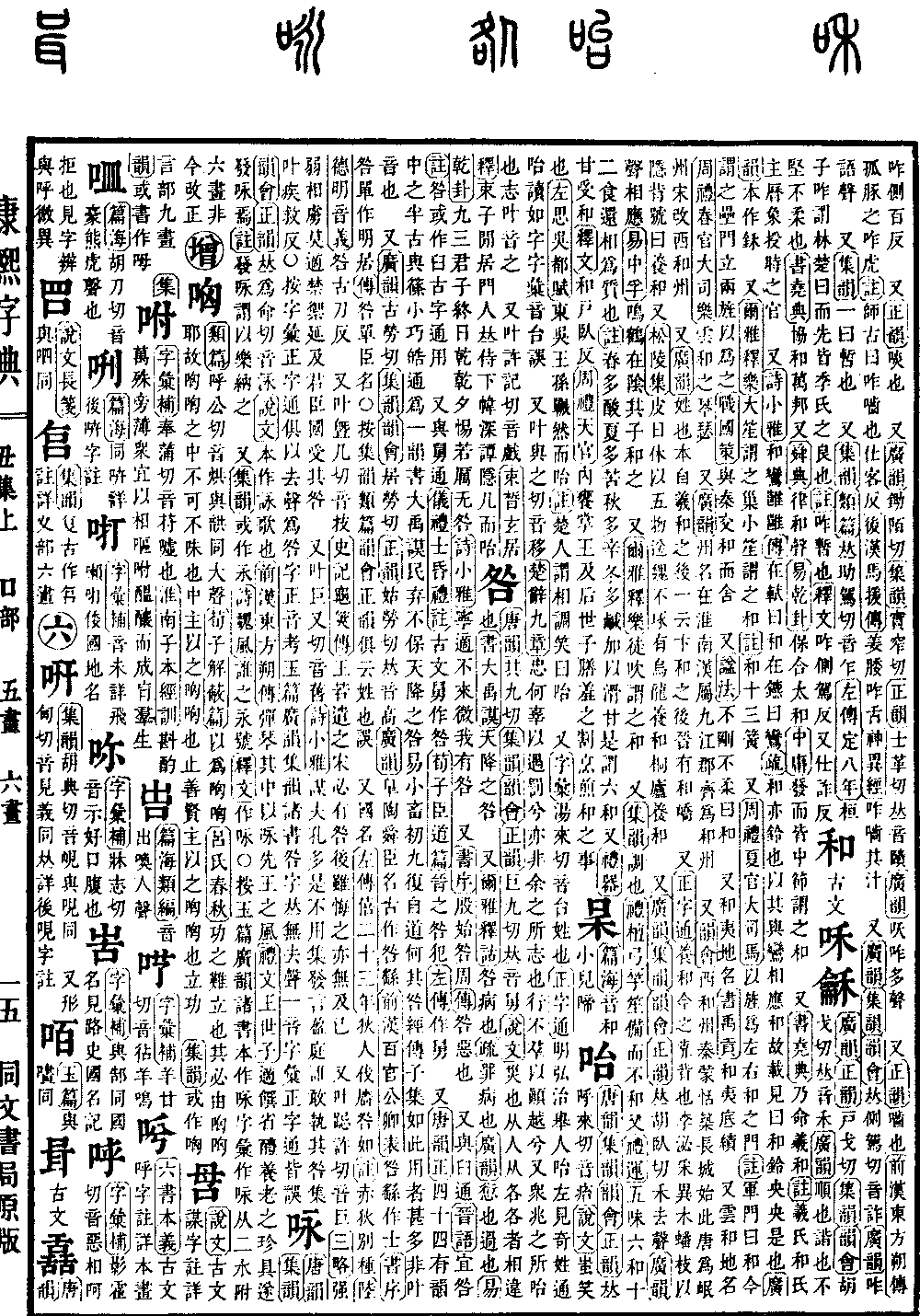
Chou Collection, Upper Volume
Radical: Mouth (kǒu)
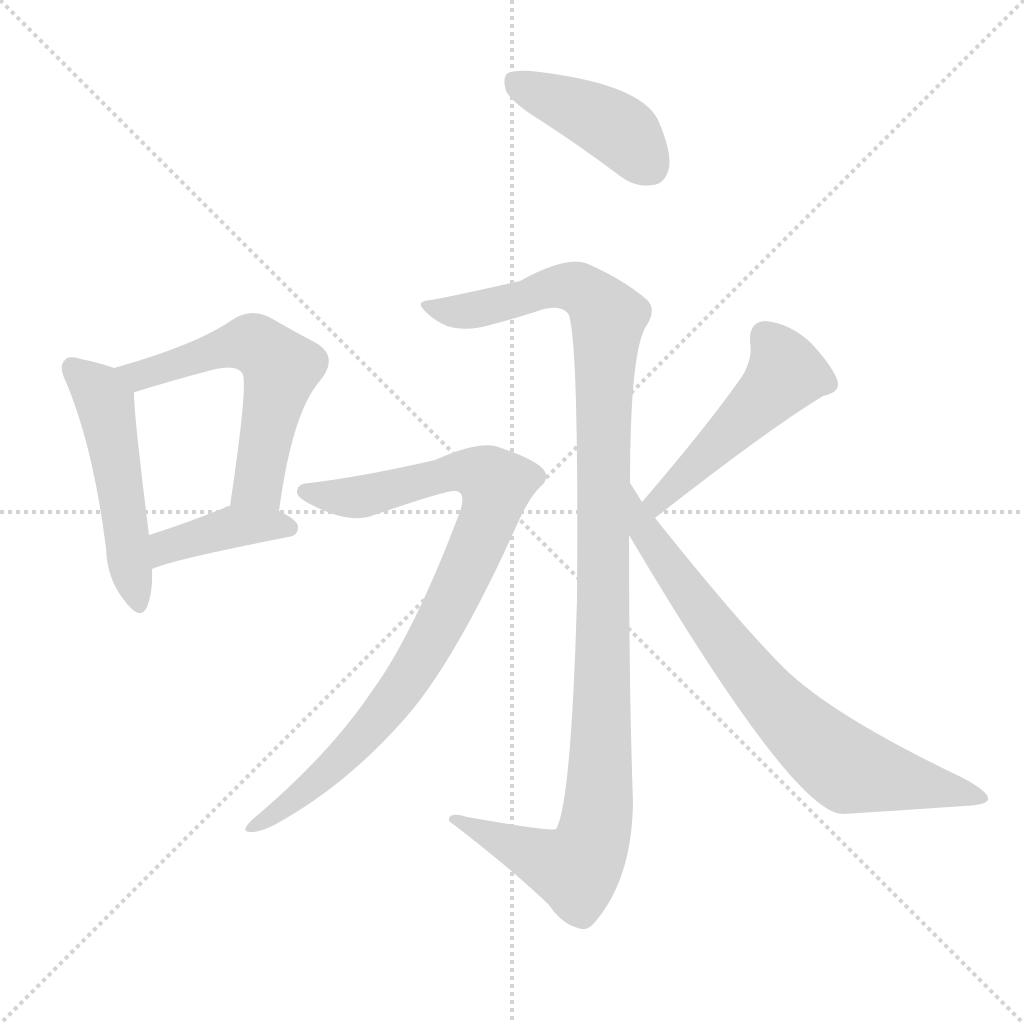
Character: Yong
Kangxi Stroke Count: 8
Page 185, Entry 07
Tang Rhyme (Tangyun), Collected Rhymes (Jiyun), Rhyme Meetings (Yunhui), Correct Rhymes (Zhengyun): pronounced yǒng.
Explaining Graphs (Shuowen): Originally written as yǒng, meaning to sing.
History of the Former Han (Qianhan): Dongfang Shuo Biography: Playing the zither within it to chant and sing the virtues of the ancient kings.
Book of Rites (Liji): Wenwang Shizi: Arriving at the place where the wine and food were arranged to inspect the sweet wine, and seeing that the precious food for the elderly was all prepared, he then began to sing.
Commentary: To begin singing refers to using music to accompany it.
Also, Collected Rhymes (Jiyun): Sometimes written as yǒng.
Book of Odes (Shijing): Wei Odes: Who is calling out with a long voice.
Explanation of Texts (Shiwen): Written as yǒng.
Note: In books such as Jade Chapters (Yupian) and Extensive Rhymes (Guangyun), it was originally written as yǒng. Dictionary of Characters (Zihui) wrote it as yǒng, using two water radicals, attached under six strokes, which is incorrect; it has now been corrected. The right side of the character yǒng should not be written with two water radicals.
Yong
Tang Rhyme (Tangyun), Collected Rhymes (Jiyun), Rhyme Meetings (Yunhui), Correct Rhymes (Zhengyun): pronounced yǒng.
Explaining Graphs (Shuowen): To sing.
Jade Chapters (Yupian): To draw out the voice while speaking.
Augmented Rhymes (Zengyun): Yong means to sing, to chant, or to recite.
Book of Documents (Shujing): Yiji: Strike the jade chimes and pluck the zither and flute to accompany the singing.
Commentary: To coordinate with the sound of the singing.
Preface to the Er Ya (Erya Xu): Narrating the inspiration of the poets to sing.
Commentary: Yong means to draw out the voice while speaking.
History of the Former Han (Qianhan): Treatise on Arts and Literature (Yiwenzhi): Singing and chanting its sound is called a song.
Also, the chirping of birds is also called yong.
Lu Ji: Beizai Xing: The ears feel sad hearing the birds chirping in accordance with the season.
Commentary: The calls of birds change according to the shifting seasons.
Also used interchangeably with yong.
Records of the Grand Historian (Shiji): Book of Music (Yueshu): Singing and chanting its sound.
Book of Rites (Liji): Book of Music (Yueji): Written as ge yǒng.
Also, Long Notes on Explaining Graphs (Shuowen Changjian): Simplified as yǒng.
Book of Documents (Shujing): Shun Dian: Poetry is the expression of intent, and song is the lengthening of words through singing.