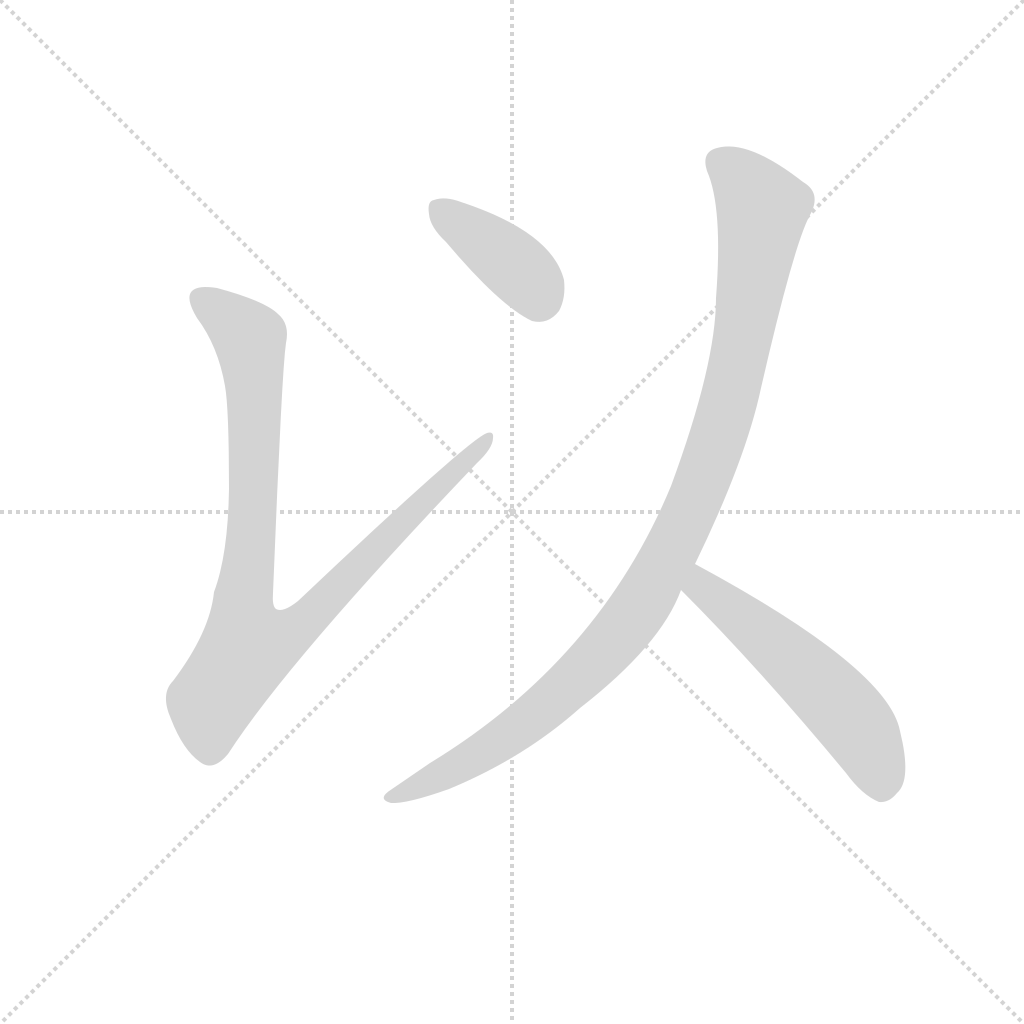
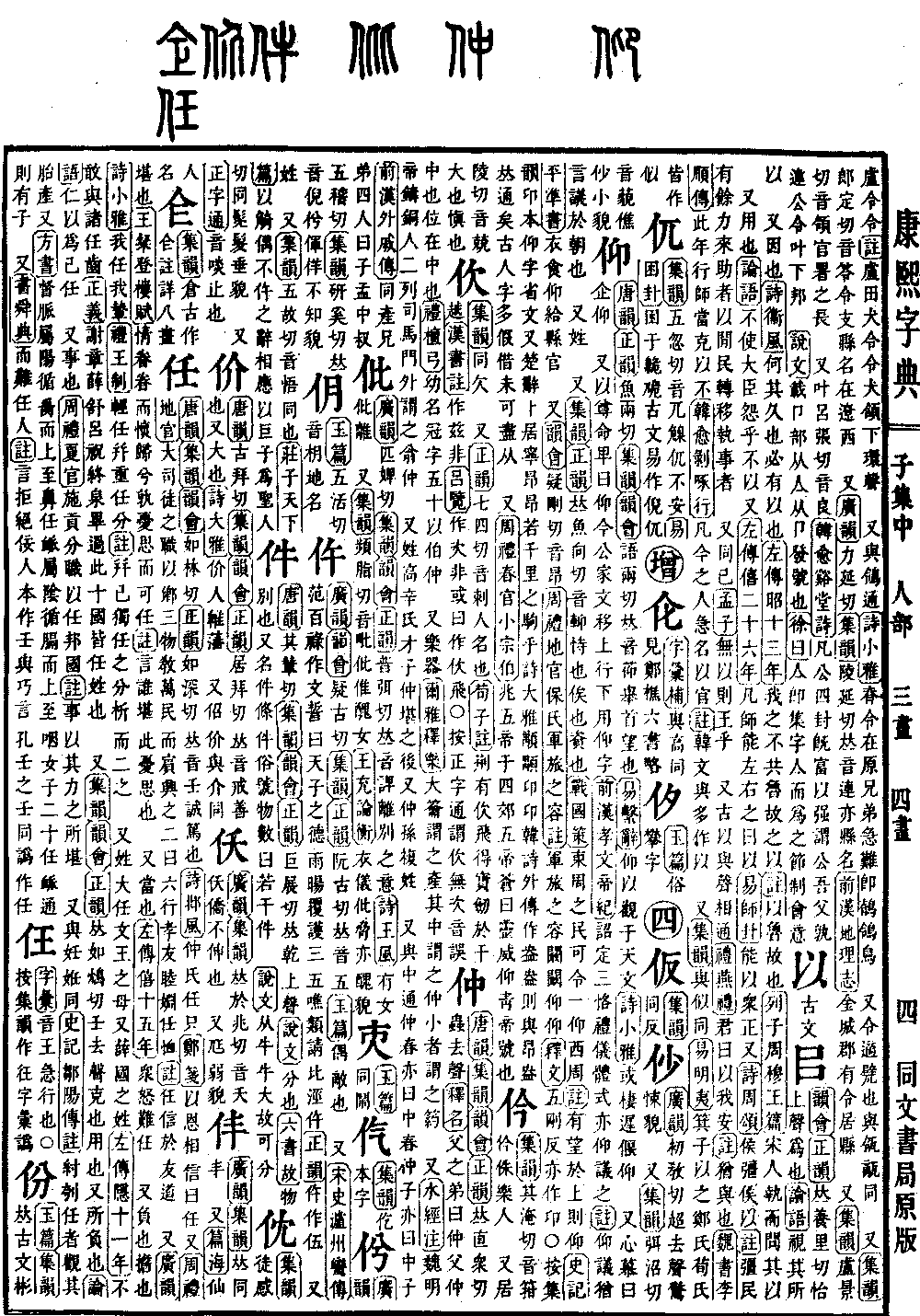
Zi Collection, Middle Volume. Radical: Person (rén). Kangxi stroke count: 5. Page number: 94, position 01. Ancient script. According to the Rhyme Compendium (Yunhui) and the Correct Rhymes (Zhengyun), it is pronounced yi (rising tone). It means to do. The Analects (Lunyu) states, Look at what he does. It also means because of. The Book of Odes (Shijing), Odes of Bei (Beifeng), states, Why is it so long, there must be a reason. The Zuo Commentary (Zuozhuan), Thirteenth Year of Duke Zhao, states, If our state does not provide tribute, it is because of the state of Lu. The Book of Liezi (Liezi), Zhou Mu Wang Chapter, states, A man from the state of Song captured him and asked him the reason. It also means to use. The Analects states, Do not let high officials complain that they are not employed. The Zuo Commentary, Twenty-sixth Year of Duke Xi, states, Any military force that can be flexibly directed is called yi. The Book of Changes (Yijing), Shi Hexagram, states, Able to lead the masses onto the right path. Further, the Book of Odes, Odes of Zhou (Zhousong), states, Some are strong, some are helpful. The annotation states: The strong commoners have surplus strength to provide help, and they lead the idle commoners to perform tasks. It is also synonymous with yi (already). The Book of Mencius (Mengzi) states, If it does not work, can one practice the kingly way. In ancient times, the pronunciations of yi and yu were interchangeable. The Book of Rites (Liji), Banquet Rites (Yanli), states, The ruler says: Be at peace with me. The annotation states: This means the same as yu. The Book of Wei (Weishu), Biography of Li Shun, states, Sending troops out this year, whether or not one can achieve victory. Han Yu's Po Zhuo Xing states, Modern people are in a hurry to use official titles to seek fame. The annotation states: In Han Yu's writings, yu is often written as yi. Furthermore, the Collected Rhymes (Jiyun) states it is the same as si. The Book of Changes, Mingyi Hexagram, states, Jizi is like this. Zheng Xuan and Xun Shuang both write it as si. Textual research: The Book of Odes, Odes of Wei (Weifeng), states, Why is it so long, there must be a reason. According to the original text, Weifeng has been corrected to Beifeng.